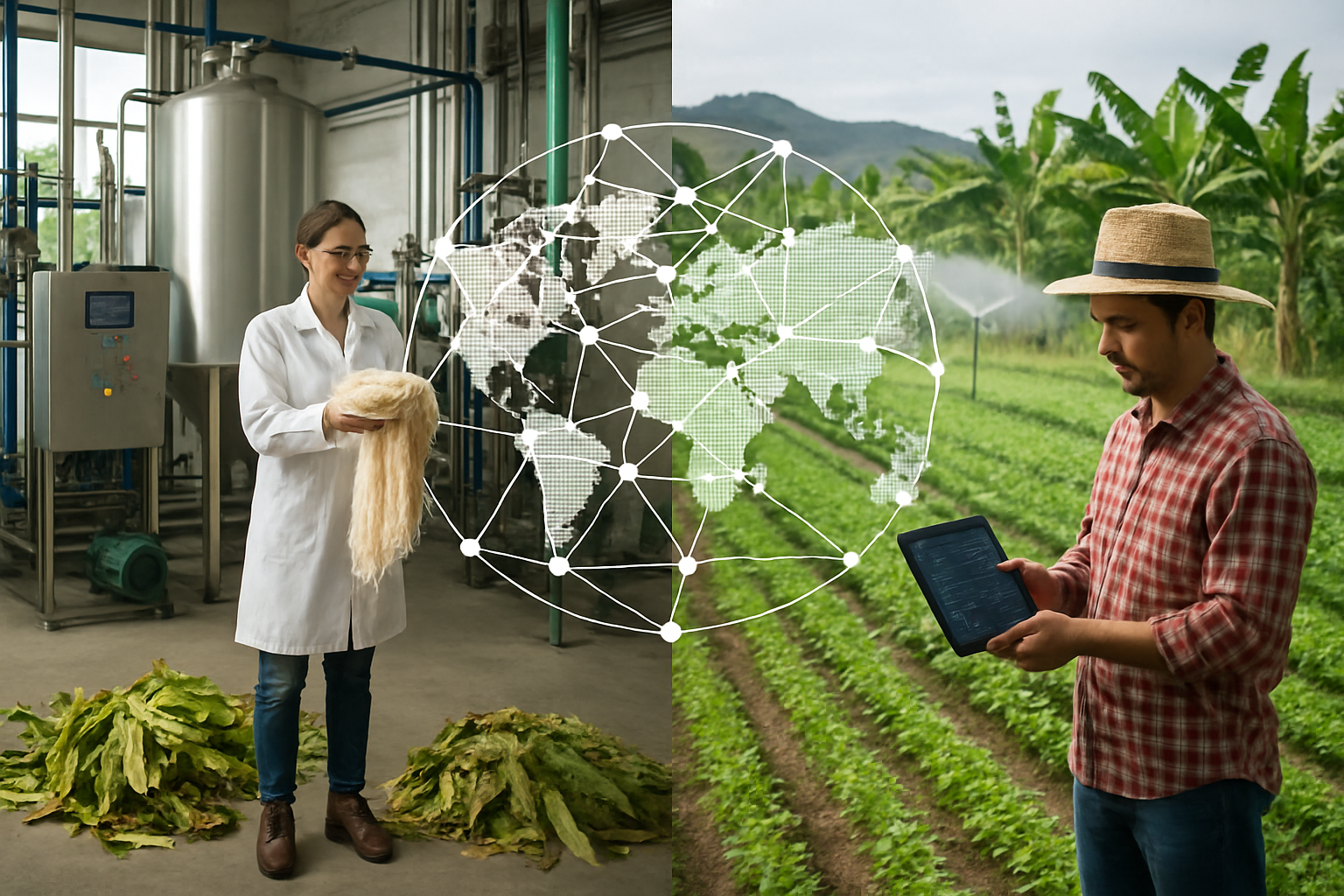
A revolutionary wave of agricultural innovation is transforming global food security, with countries from Pakistan to Guyana pioneering waste-to-resource technologies and diaspora-driven agricultural partnerships that promise to reshape food systems during Earth's most challenging environmental period on record.
In what experts are calling the "2026 Agricultural Renaissance," two major developments—Pakistan's launch of a groundbreaking banana waste-to-textile project and Guyana's strategic engagement with its regional diaspora—exemplify how nations are adapting to the 19th consecutive month of global temperatures exceeding 1.5°C above pre-industrial levels, fundamentally altering agricultural strategies worldwide.
Pakistan Pioneers Bio-Economy Transformation
Pakistan's Small and Medium Enterprises Development Authority (SMEDA), in collaboration with the Food and Agriculture Organisation (FAO) and international partners, has launched an innovative initiative to transform banana waste into eco-friendly textile fiber. The project, unveiled during the "Made in Pakistan – SME Cluster Showcase Expo 2026," represents a paradigm shift toward circular economy approaches in agricultural waste management.
The initiative forms part of the "Elimination of Hazardous Chemicals from Supply Chains Integrated Programme," funded by the Global Environment Facility (GEF) and executed by UN agencies across eight countries. This systematic approach addresses both environmental sustainability and economic development by converting agricultural waste—traditionally discarded or burned—into valuable textile materials.
"This represents a fundamental shift from waste disposal to value creation," explains Dr. Éric H. Abiassi, coordinator of similar programs in West Africa. "We're seeing nations transform traditional agricultural byproducts into economic opportunities while addressing climate challenges."
— Dr. Éric H. Abiassi, Agricultural Development Coordinator
Pakistan's banana fiber technology addresses multiple challenges simultaneously: reducing agricultural waste, creating sustainable textile alternatives, and supporting rural employment through bio-economy innovations. The project builds on Pakistan's established agricultural research capabilities, demonstrated through the Pakistan Food System Transformation Secretariat's collaboration with the Global Alliance for Improved Nutrition on climate-resilient food systems.
Guyana Emerges as Caribbean Food Security Leader
Simultaneously, Guyana is positioning itself as the Caribbean's principal food supplier through strategic diaspora engagement and technological partnerships. The nation's approach involves leveraging its regional diaspora's expertise while strengthening partnerships with neighboring countries, particularly St. Kitts and Nevis, to accelerate food security initiatives across the Caribbean basin.
This strategy reflects Guyana's sophisticated understanding that food security requires not just production capacity, but also knowledge networks, skills exchange, and regional cooperation frameworks. By engaging diaspora communities, Guyana taps into global expertise while maintaining strong cultural and economic ties to traditional agricultural practices.
The initiative builds on Guyana's successful agricultural transformation since 2020, when the country began repositioning itself as a regional food security leader. Despite climate disruption affecting traditional Caribbean growing seasons, Guyana has maintained agricultural productivity through strategic technology integration and international partnerships.
Global Context: The Climate-Agriculture Nexus
These developments occur within an unprecedented global climate context. January 2026 marked the hottest month in recorded history, extending a streak of 19 consecutive months exceeding the critical 1.5°C threshold. This sustained warming has fundamentally altered agricultural systems worldwide, forcing rapid adaptation in crop selection, irrigation methods, and harvest timing.
The climate crisis is creating cascading effects throughout global food systems. Traditional growing seasons have become unpredictable, water availability patterns have shifted dramatically, and new pest and disease pressures are emerging. In response, nations are developing increasingly sophisticated approaches that combine cutting-edge technology with traditional agricultural knowledge.
South-South Cooperation Renaissance
Both Pakistan's bio-economy initiative and Guyana's diaspora strategy exemplify the emergence of South-South cooperation as a preferred model for agricultural development. This approach emphasizes peer-to-peer knowledge sharing and culturally appropriate technology transfer, moving beyond traditional North-South aid dependency.
Evidence from similar programs across Africa and Latin America demonstrates that South-South cooperation often proves more sustainable and culturally appropriate than conventional development assistance. Malaysia's "outcome-driven delivery" approach, Kenya's Nguruman irrigation rehabilitation benefiting 10,000+ farmers, and Algeria's date waste livestock feed innovation all showcase how developing nations are leading global agricultural innovation.
The African Continental Free Trade Agreement (AfCFTA) is facilitating these partnerships by enabling cross-border agricultural ventures and shared value chains. Similarly, Caribbean cooperation frameworks are allowing countries like Guyana to share expertise while building regional food security resilience.
Technology-Tradition Integration
A critical success factor in both initiatives is the sophisticated integration of modern technology with traditional ecological knowledge. Pakistan's banana fiber project respects community structures while introducing contemporary biotechnology. Guyana's approach preserves indigenous farming wisdom while incorporating precision agriculture, advanced irrigation, and digital monitoring systems.
This synthesis represents a maturation of agricultural development strategies beyond simple technology transfer toward comprehensive systems that honor local knowledge while embracing beneficial innovations. Research consistently shows that programs combining traditional wisdom with modern science achieve better long-term sustainability and community acceptance.
Innovation in Practice
Pakistan's bio-economy approach demonstrates how agricultural waste can become a valuable resource through systematic processing. The banana fiber extraction process transforms materials that would otherwise contribute to environmental pollution into textile alternatives that reduce dependence on conventional cotton and synthetic fibers.
Meanwhile, Guyana's diaspora engagement model shows how human capital networks can accelerate technology adoption and knowledge transfer. By connecting international expertise with local implementation capacity, Guyana creates sustainable pathways for agricultural modernization.
Economic Development Engine
Both initiatives function as economic development strategies rather than regulatory burdens. Pakistan's bio-economy project creates employment in waste processing, biotechnology, and environmental services while reducing disposal costs and improving public health outcomes. The textile applications open new export markets while building domestic manufacturing capabilities.
Guyana's food security leadership attracts international investment while building agricultural export capacity. The country's approach of maintaining affordable domestic prices while increasing exports demonstrates sophisticated policy coordination that benefits both producers and consumers.
Countries implementing comprehensive agricultural innovation consistently demonstrate greater economic resilience and attract sustainable investment. The multiplier effects extend beyond agriculture to include transportation, processing, research and development, and export services.
Implementation Challenges and Solutions
Despite promising developments, both initiatives face significant implementation challenges. Funding sustainability remains critical for developing nations where immediate economic pressures often override long-term environmental considerations. Technical capacity building requires sustained investment in education, training, and institutional development.
Climate change continues to disrupt project timelines, requiring adaptive management capabilities that can respond to rapidly changing conditions. However, the diversity of approaches provides resilience against single-solution dependencies, offering multiple adaptation pathways for different national circumstances.
"Success depends on sustained political commitment, community engagement, and international cooperation," notes Zulfikar Mustapha, Guyana's Minister of Agriculture. "We must balance immediate needs with long-term sustainability while maintaining community ownership of development processes."
— Zulfikar Mustapha, Guyana's Minister of Agriculture
Key success factors identified across similar programs include community ownership, transparent governance, sustained political commitment, and adaptive management responding to environmental change. International cooperation proves essential, but must respect local autonomy and cultural contexts.
Global Food Security Templates
The Pakistan and Guyana models provide templates for global food security interventions through complementary approaches. Pakistan's focus on bio-economy innovation demonstrates how waste-to-resource technologies can address environmental and economic challenges simultaneously. Guyana's diaspora engagement shows how human capital networks can accelerate agricultural development while maintaining cultural connections.
These approaches are part of a broader global agricultural renaissance documented across continents. Similar innovations include Algeria's date waste conversion, Finland's controlled environment cultivation, Ethiopia's irrigation potential development, and Papua New Guinea's mechanized farming demonstrations generating millions in revenue.
The diversity of successful approaches provides resilience against single-solution dependencies while offering multiple pathways for different national circumstances. What unites these initiatives is their emphasis on community participation, technological innovation, and international cooperation during humanity's most challenging environmental period.
Strategic Significance for Global Food Systems
The convergence of bio-economy innovation and diaspora-driven agricultural development represents a critical juncture for global food security. The window for building resilient, equitable food systems is narrowing rapidly as climate acceleration and population growth create additional pressures on agricultural systems worldwide.
However, the tools and knowledge exist for effective responses, as demonstrated by these pioneering initiatives. Success depends on sustained political commitment that transcends electoral cycles, adequate and predictable funding for both emergency response and long-term development, and coordination between immediate crisis response and long-term resilience building.
The recognition of food security as a global public good requiring unprecedented international cooperation is gaining traction among policymakers and development practitioners. The human dimension remains central—millions of farmers, food workers, and vulnerable communities depend on stable, fair global food systems that provide nutrition while supporting rural livelihoods.
Future Implications
The agricultural innovations emerging in 2026 may determine whether food production can keep pace with environmental change while serving growing populations during the critical climate action decade. The combination of bio-economy technologies and diaspora-driven development offers hope for sustainable food systems that protect ecological foundations while serving community needs.
As countries like Pakistan and Guyana demonstrate leadership in agricultural innovation, their approaches provide blueprints for scaling successful interventions globally. The emphasis on community empowerment, technological innovation, and international cooperation creates frameworks that can adapt to diverse contexts while maintaining effectiveness principles.
The success of these initiatives could mark 2026 as a turning point toward more resilient and sustainable global food systems. Conversely, failure to scale these innovations could deepen food insecurity among the world's most vulnerable populations at a time when environmental pressures are intensifying.
The choice between traditional agricultural approaches and innovative bio-economy solutions represents more than technical decisions—it reflects humanity's fundamental approach to balancing economic development with environmental sustainability during Earth's most environmentally challenging period. The pioneering work in Pakistan and Guyana suggests that this balance is achievable through careful integration of innovation with community wisdom and international cooperation.