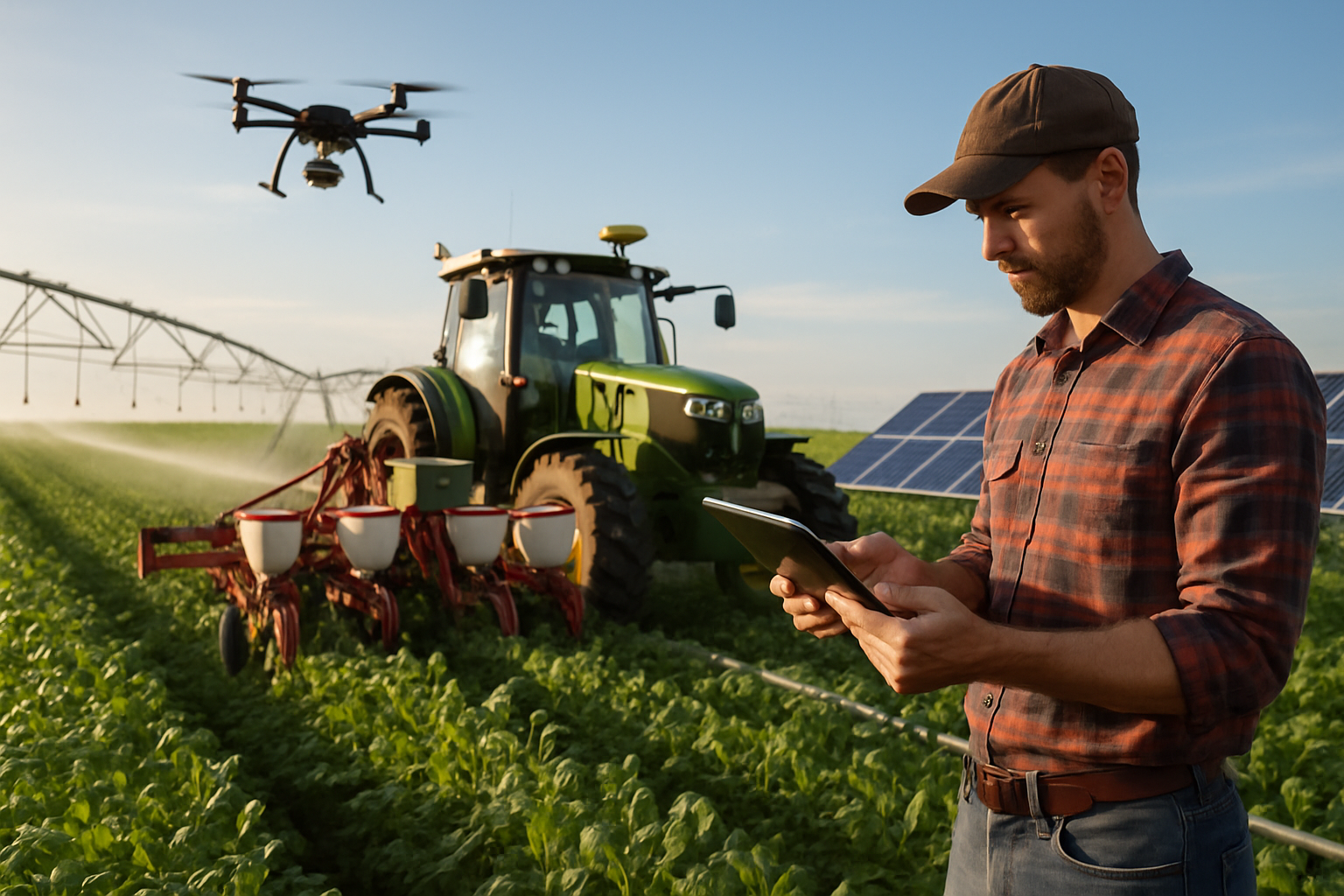
As global temperatures continue rising for the 18th consecutive month above 1.5°C pre-industrial levels, agricultural technology is emerging as humanity's crucial tool for maintaining food security while protecting the planet's environmental future.
The agricultural technology revolution of 2026 represents a fundamental shift in how we produce food, combining cutting-edge innovations with traditional farming wisdom to address unprecedented challenges. From precision farming systems that optimize resource use to climate-adaptive technologies that help crops survive extreme weather, these innovations are reshaping agriculture across every continent.
Precision Agriculture: The Digital Transformation of Farming
At the forefront of this revolution is precision agriculture, where farmers leverage GPS-guided equipment, drone monitoring, and artificial intelligence to optimize every aspect of crop production. Modern farming operations now use sophisticated sensors to monitor soil moisture, nutrient levels, and plant health in real-time, allowing for precise application of water, fertilizers, and pesticides only where needed.
In Papua New Guinea, mechanized operations at Rumion Farm are generating millions in revenue through precise harvesting demonstrations, while Finland has achieved breakthrough success in controlled environment cultivation with winter raspberry production. These examples showcase how technological precision can dramatically increase yields while reducing environmental impact.
"Technology-tradition integration is becoming essential for climate resilience. We're seeing sophisticated synthesis of cutting-edge technology with traditional ecological knowledge creating more robust farming systems."
— Agricultural Development Expert
Climate-Adaptive Technologies: Farming for a Changing World
As climate patterns shift dramatically, agricultural technology is adapting to help farmers navigate new environmental realities. Drought-resistant crop varieties developed through advanced breeding techniques are becoming standard, while smart irrigation systems use weather data and soil sensors to optimize water usage with up to 90% efficiency improvements.
Eritrea's hydroponic and aquaponic systems exemplify this adaptation, providing year-round production capabilities that protect crops from climate disruption while using minimal water resources. These controlled environment technologies are particularly crucial for water-scarce regions and areas experiencing unprecedented weather volatility.
Indonesia's Gerakan Pangan Murah (cheap food movement) demonstrates how technology can be deployed to stabilize food prices during climate-induced supply disruptions, coordinating distribution systems to ensure community food access regardless of environmental challenges.
Sustainable Innovation: Technology Meeting Environmental Goals
The 2026 agricultural technology wave prioritizes sustainability alongside productivity. Solar-powered farming equipment, renewable energy systems for processing facilities, and circular economy approaches are becoming standard practice. Algeria's "Tamr Al-Aghanm" innovation, which converts date waste into livestock feed, represents the kind of waste-to-nutrition technology that's gaining global adoption.
Biomimetic technologies, such as the falcon-like drones developed by Canadian company AERIUM Analytics for crop protection in Australia, demonstrate how agriculture is learning from nature to create sustainable solutions. These "scarecrows of the sky" replicate natural predator behavior to protect crops without harmful chemicals.
Global Cooperation and Knowledge Sharing
The agricultural technology revolution is characterized by unprecedented international cooperation. South-South partnerships are replacing traditional aid models, with countries like Malaysia leading agricultural transformation through "outcome-driven delivery" approaches that other nations are adapting to their contexts.
Kenya's Nguruman irrigation scheme rehabilitation benefiting 10,000+ farmers, Sierra Leone's transition to collective farming systems, and Indonesia's UMKM empowerment schemes promoting integrated livestock operations all demonstrate how technological innovations are being scaled through peer-to-peer knowledge sharing.
Economic Impact and Rural Development
Agricultural technology is proving to be an economic development engine, creating sustainable rural employment while improving food security. These innovations generate multiplier effects through increased productivity, reduced losses, and new market opportunities. Countries implementing comprehensive agricultural technology programs report improved community resilience and reduced dependence on imports.
The technology-tradition integration approach ensures that innovations serve local communities rather than displacing traditional farming knowledge. Successful programs combine modern sensors and analytics with indigenous farming practices, creating solutions that are both technologically advanced and culturally appropriate.
Challenges and Future Outlook
Despite remarkable progress, significant challenges remain. Funding sustainability for developing nations, technical capacity building requirements, and the need for adaptive management as climate conditions continue changing all present ongoing obstacles. The global semiconductor crisis, with memory chip prices surging sixfold, has created infrastructure bottlenecks affecting technology-dependent agricultural systems.
However, the diversity of technological approaches provides resilience against single-solution dependencies. From Ghana's cocoa processing innovations to Rwanda's 417,000 hectare irrigation potential identification, multiple pathways are emerging for agricultural technology adoption across different contexts and resource levels.
The Path Forward
As 2026 continues to break temperature records, agricultural technology represents both humanity's adaptive capacity and our commitment to feeding a growing population while protecting planetary resources. The success of these innovations depends on continued international cooperation, sustained political commitment, and the integration of technological advancement with traditional farming wisdom.
The agricultural technology revolution is not just about producing more food—it's about creating farming systems that can thrive in an uncertain climate while supporting the communities and ecosystems they depend upon. From precision farming to climate adaptation, these technologies are writing the next chapter of global food security.