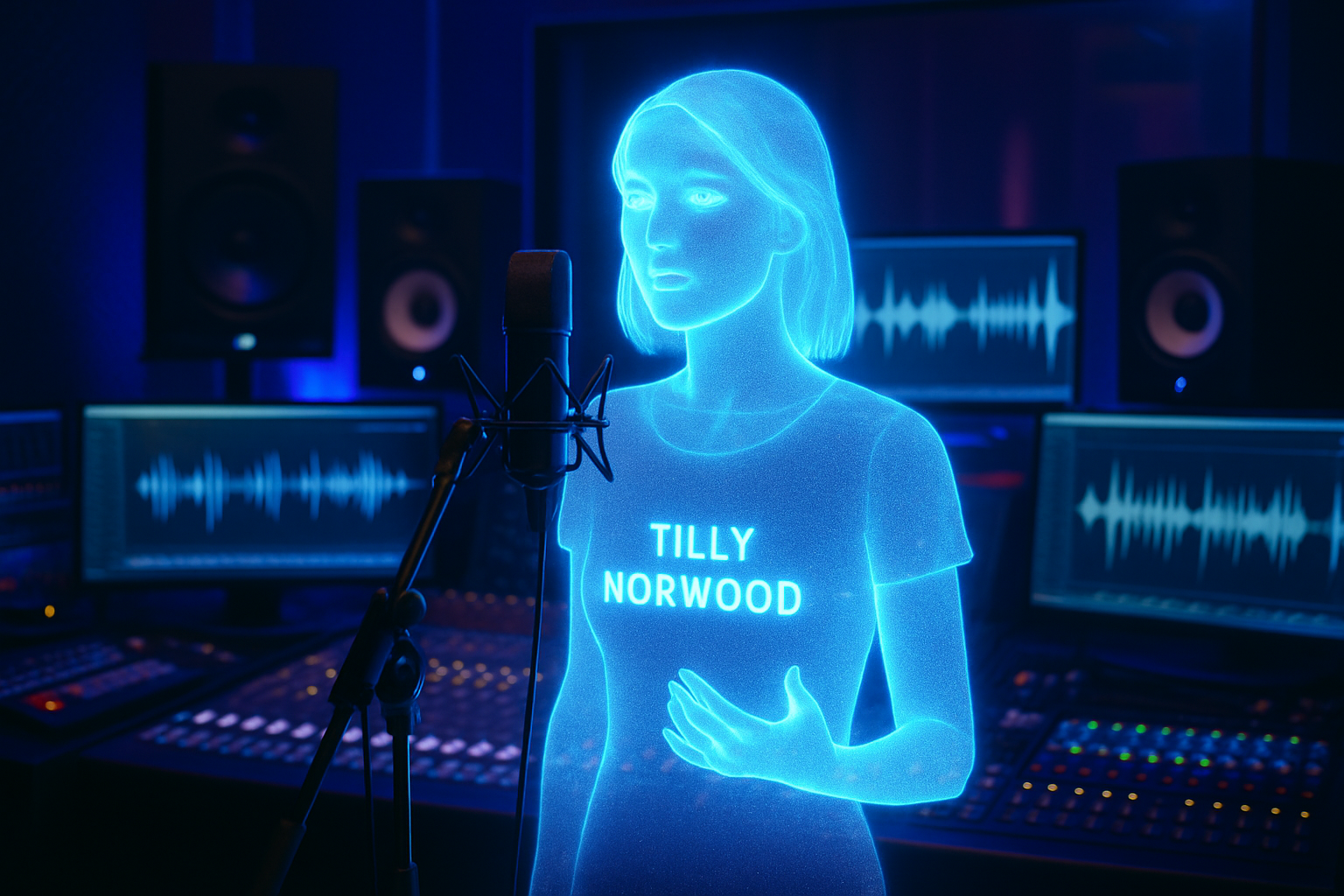
The first AI actress, known as "Tilly Norwood," has released her debut song "Take the Lead," marking a groundbreaking moment in artificial intelligence entertainment that simultaneously showcases both the potential and current limitations of synthetic creativity in the entertainment industry.
The Austrian media outlet Der Standard reported on March 12, 2026, that the AI-generated performer's musical venture reveals significant gaps between the ambitious vision of artificial artists and current technological capabilities. The publication described the project as demonstrating "how unfinished the dream of the artificial artist still is," suggesting that while AI entertainment represents a new frontier, the technology remains far from achieving truly convincing synthetic performance.
The Evolution of AI Entertainment
Tilly Norwood's emergence as the entertainment industry's first AI actress occurred during what researchers have documented as the "2026 AI Revolution in Cinema." This unprecedented transformation period has witnessed artificial intelligence fundamentally reshaping creative industries, from Hollywood's adoption of AI filmmaking tools to sophisticated AI-generated content that increasingly blurs the line between human and machine creativity.
The development follows a pattern of AI advancement in entertainment that began gaining momentum in early 2026. ByteDance's Seedance 2.0 technology has demonstrated the ability to create cinema-quality video content from simple text prompts, while major entertainment companies have issued copyright warnings about unauthorized use of intellectual property in AI-generated content.
Technical Limitations and Creative Challenges
Despite the historic nature of an AI actress releasing original music, industry observers note significant shortcomings in the current execution. The Austrian analysis suggests that "Take the Lead" exposes fundamental challenges in creating convincing synthetic entertainment that can genuinely connect with human audiences on an emotional level.
"The makers behind the AI figure show how unfinished the dream of the artificial artist still is"
— Der Standard, Austrian Media Analysis
This assessment aligns with broader industry findings about AI-generated content. Recent studies from Oxford University published in Nature Medicine revealed that AI systems, including advanced chatbots like ChatGPT-4, perform no better than basic internet searches in many complex tasks. The limitation appears to stem not from technological capabilities but from what researchers describe as "human interpretation errors" – suggesting that the problem lies in how humans interact with and direct AI systems rather than in the AI technology itself.
Global Context of AI Entertainment Integration
Tilly Norwood's musical debut occurs during a critical period of AI integration across multiple entertainment sectors. The global entertainment industry is experiencing what analysts call a "renaissance" of AI-enhanced creativity, with successful integration models emerging from unexpected quarters.
Educational institutions have pioneered human-AI collaboration approaches that preserve essential human elements while leveraging computational advantages. Malaysia operates the world's first AI-integrated Islamic school, combining artificial intelligence with traditional learning methods. Similarly, Singapore's WonderBot 2.0 has achieved remarkable success in heritage education, while Canadian universities have implemented AI teaching assistants that maintain critical thinking standards.

Industry Infrastructure Challenges
The AI entertainment revolution faces significant infrastructure constraints that may be limiting the quality of current AI-generated content. A global memory semiconductor crisis has driven chip prices to increase sixfold, affecting major manufacturers including Samsung, SK Hynix, and Micron. These shortages are expected to persist until 2027, when new manufacturing facilities come online.
Despite these constraints, massive investments continue in AI entertainment infrastructure. Alphabet has committed $185 billion to AI development in 2026, while Amazon has announced development plans exceeding $1 trillion. The World Bank projects that AI systems will require 4.2-6.6 billion cubic meters of water by 2027 for data center cooling alone – equivalent to four to six times Denmark's entire annual water consumption.
Successful Human-AI Collaboration Models
While Tilly Norwood's debut exposes current limitations, other entertainment projects demonstrate more successful approaches to AI integration. The most promising examples treat artificial intelligence as sophisticated amplification tools for human creativity rather than direct replacements for human artists.
Hollywood's Curious Refuge AI film academy has become essential training for entertainment professionals, with visual effects veteran Michael Eng representing thousands of workers acquiring machine learning skills for career adaptation. Similarly, Belgium's Atomium has successfully integrated AI-enhanced digital art programming while preserving cultural heritage and authenticity.
Regulatory and Ethical Considerations
The emergence of AI entertainers like Tilly Norwood occurs amid intensifying global regulatory scrutiny of artificial intelligence applications. Spain has implemented the world's first criminal executive liability framework for technology platforms, while France has conducted cybercrime raids on AI companies. The United Nations has established an Independent Scientific Panel with 40 experts to provide the first fully independent global AI assessment.
These regulatory developments reflect growing recognition that AI entertainment raises fundamental questions about authenticity, intellectual property, and the preservation of human creativity. The entertainment industry serves as a crucial testing ground for broader questions about the role of AI in society and the importance of maintaining human elements in creative expression.
Economic Implications for Entertainment
The AI entertainment revolution has triggered what industry analysts call the "SaaSpocalypse" – the elimination of hundreds of billions of dollars in traditional software market capitalization as AI systems demonstrate direct replacement capabilities for conventional entertainment production tools. Microsoft's Mustafa Suleyman predicts that AI will replace the majority of office workers within two years, with lawyers and auditors facing replacement within 18 months.
However, regional variations in adaptation strategies suggest alternative approaches. Indian IT giants including Infosys, Wipro, and HCL have successfully implemented worker transition programs rather than mass layoffs, demonstrating that thoughtful AI integration can enhance rather than eliminate human employment in creative industries.
The Future of AI Entertainment
Tilly Norwood's musical debut represents both a milestone and a reality check for AI entertainment. While the project demonstrates the technical feasibility of AI-generated performers, the reported limitations suggest that the industry still faces significant challenges in creating compelling, emotionally resonant synthetic entertainment.
The most successful path forward appears to lie in sophisticated human-AI collaboration that preserves uniquely human elements – imagination, cultural understanding, emotional depth, and authentic expression – while leveraging AI's computational advantages for enhanced production efficiency and creative exploration.
Critical Inflection Point
March 2026 represents a critical inflection point for the entertainment industry's relationship with artificial intelligence. The decisions made by studios, performers, regulators, and audiences in the coming months will determine whether AI enhances human creativity or diminishes the authentic expression that defines compelling entertainment.
Success in this transformation requires unprecedented coordination between technology companies, entertainment institutions, regulatory bodies, and civil society. The challenge involves balancing innovation acceleration with safety governance, commercial interests with human welfare, and global competitiveness with cultural preservation.
"The future lies in sophisticated human-AI collaboration rather than wholesale replacement of creative professionals"
— Industry Analysis, Entertainment Technology Renaissance
As Tilly Norwood's debut song continues to generate discussion about the possibilities and limitations of AI entertainment, the project serves as a valuable case study for the industry's ongoing evolution. While the current technology may fall short of creating truly convincing artificial artists, it provides crucial insights into the collaborative future of human and artificial creativity that will likely define entertainment for decades to come.