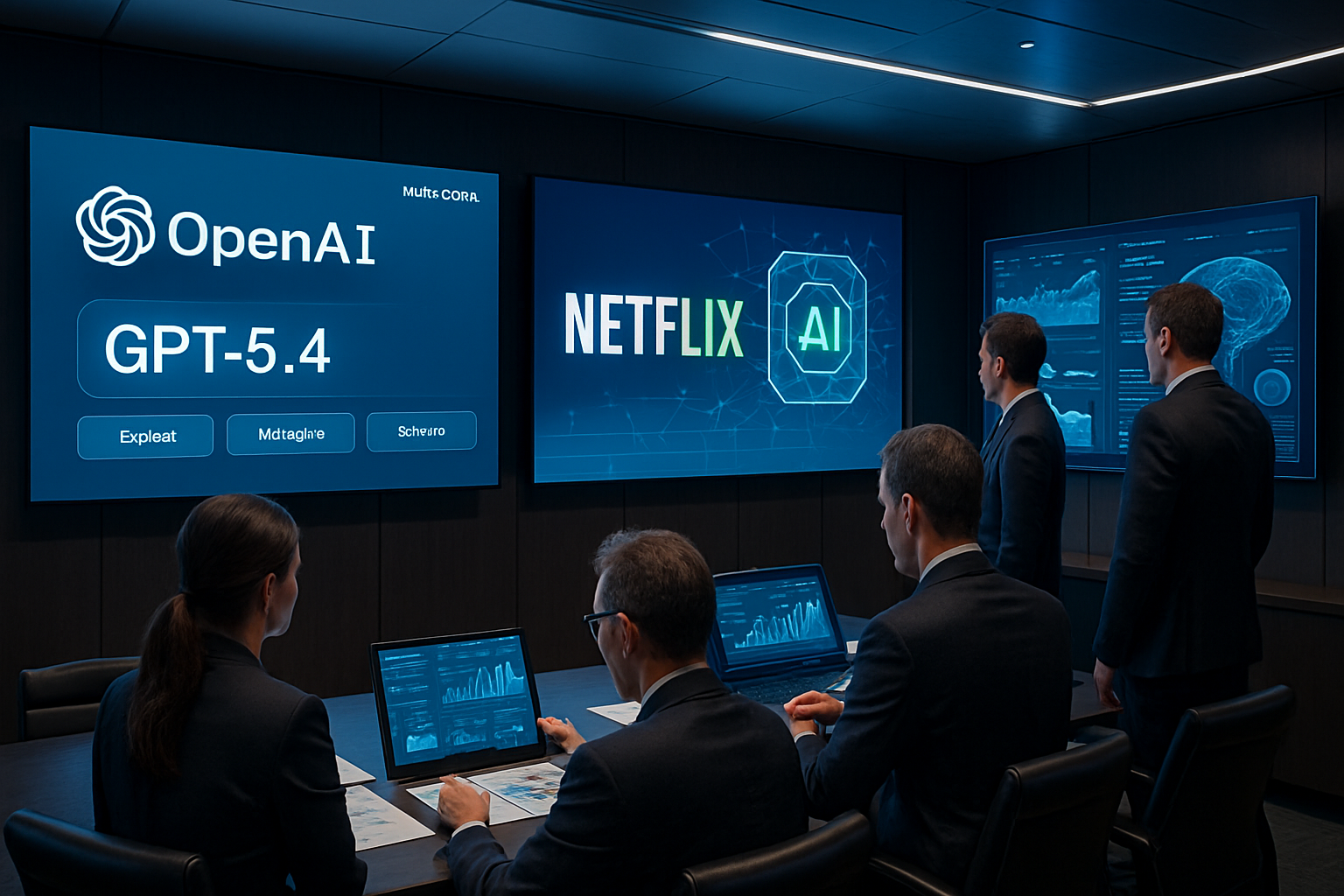
The artificial intelligence industry reached a critical inflection point this week as OpenAI announced the release of GPT-5.4, a sophisticated AI model designed specifically for professional and complex tasks, while Netflix made headlines by acquiring Hollywood actor Ben Affleck's AI company InterPositive, signaling a major shift in how entertainment giants are embracing artificial intelligence technology.
These developments come at a time when the AI industry faces unprecedented challenges, from global semiconductor shortages to increasing regulatory scrutiny, while simultaneously witnessing remarkable breakthroughs that are fundamentally reshaping how we interact with technology in professional environments.
OpenAI's GPT-5.4: A New Era for Professional AI Applications
OpenAI's latest release, GPT-5.4, represents a significant advancement in artificial intelligence capabilities, specifically engineered to handle complex professional tasks that were previously beyond the reach of AI systems. According to reports from AzerNews citing foreign media sources, the new model builds upon the company's existing foundation while introducing enhanced capabilities for specialized professional environments.
The timing of GPT-5.4's release is particularly significant given the current landscape of AI development. With over 800 million weekly users already engaging with ChatGPT systems globally, OpenAI's expansion into specialized professional applications demonstrates the company's strategic shift toward more targeted, high-value applications rather than simply expanding general consumer usage.
Netflix's Strategic AI Acquisition: Ben Affleck's InterPositive
In a move that highlights the entertainment industry's accelerating embrace of artificial intelligence, Netflix has acquired InterPositive, the AI company founded by Academy Award-winning actor and director Ben Affleck. The acquisition signals Netflix's commitment to leveraging AI technology to enhance its content creation and production processes.
"Hollywood A-lister Ben Affleck says his company InterPositive's AI tools 'take out all the logistical, difficult, technical stuff that often gets in the way' of the filmmaking process."
— NPR Report on Netflix Acquisition
Affleck's company specializes in helping filmmakers build their own AI models that handle time-intensive production details, potentially revolutionizing how content is created in Hollywood. The acquisition represents more than just a technology purchase—it's a strategic positioning move that places Netflix at the forefront of AI-enhanced content production.
Global Regulatory Tensions and Military Applications
While technological breakthroughs capture headlines, the AI industry continues to grapple with complex regulatory challenges and ethical considerations. Recent developments have highlighted growing tensions between AI companies and government agencies, particularly regarding military applications and safety restrictions.
Anthropic, OpenAI's primary competitor, has faced significant pressure from the Pentagon to remove safety restrictions on its Claude AI system, leading to what sources describe as a "supply chain risk" designation. The company's refusal to allow unrestricted military use of its technology, despite potentially losing over $200 million in federal contracts, underscores the ongoing debate about AI safety and ethical deployment.
Infrastructure Challenges and the Global Semiconductor Crisis
The AI revolution is occurring against a backdrop of severe infrastructure constraints. The global semiconductor shortage has driven memory chip prices up sixfold, affecting major manufacturers including Samsung, SK Hynix, and Micron. These shortages are expected to persist until 2027, when new fabrication facilities come online.
This crisis has forced AI companies to develop more memory-efficient algorithms and explore alternative computational approaches. Paradoxically, the constraints have spurred innovation in AI efficiency, leading to breakthrough developments like the recent achievement by Chinese scientists who created AI vision models that are 1/1000th the size of traditional systems by studying macaque monkey neural networks.
The Entertainment Industry's AI Transformation
Netflix's acquisition of InterPositive is part of a broader transformation within the entertainment industry. Recent developments have shown both the promise and perils of AI in creative fields. In Prague, AI-generated apocalyptic videos have become so sophisticated that viewers mistake them for real footage, while 4,000 French actors and filmmakers have condemned what they call the "systematic plundering" of their work by AI systems.
The industry is navigating complex questions about intellectual property, creativity, and the role of human artistry in an AI-enhanced world. Netflix's strategic approach—acquiring companies that enhance rather than replace human creativity—may provide a template for successful AI integration in creative industries.
Economic Implications and Market Disruption
The AI developments are occurring within what industry analysts have termed the "SaaSpocalypse"—a market disruption that has eliminated hundreds of billions in market capitalization from traditional software companies as AI systems demonstrate the ability to replace conventional business applications.
Despite infrastructure constraints, major technology companies continue to make massive investments in AI capabilities. Alphabet has committed $185 billion to AI infrastructure in 2026, while Amazon has announced development plans exceeding $1 trillion. These investments underscore the industry's confidence that current challenges are temporary obstacles rather than fundamental limitations.
Human-Centered AI Integration Models
Amid the technological upheaval, several successful models have emerged for integrating AI in ways that enhance rather than replace human capabilities. Canadian universities have implemented AI teaching assistants while maintaining critical thinking standards, while Malaysia has opened the world's first AI-integrated Islamic school, combining artificial intelligence with traditional religious and academic learning.
Singapore's WonderBot 2.0 has achieved success in heritage education, demonstrating how AI can be used to preserve and transmit cultural knowledge. These examples provide blueprints for thoughtful AI integration that serves human goals rather than replacing human relationships and creativity.
International Governance and Regulatory Frameworks
The global response to AI development has intensified, with unprecedented international coordination on governance frameworks. The United Nations has established an Independent International Scientific Panel on Artificial Intelligence with 40 experts, representing the first fully independent global AI impact assessment body.
European nations are leading regulatory efforts, with Spain implementing the world's first criminal executive liability framework for technology platforms, while France has conducted cybercrime raids on AI companies. These developments represent the most sophisticated global technology governance effort since the commercialization of the internet.
Looking Ahead: Critical Decisions for 2026
As we move through 2026, the decisions made by companies, governments, and international organizations will likely determine whether AI fulfills its transformative promise or creates systemic disruptions requiring dramatic corrections. The success of initiatives like OpenAI's GPT-5.4 and Netflix's AI integration strategy will provide crucial data points for understanding how AI can be successfully deployed at scale.
The convergence of technological breakthroughs, regulatory pressures, infrastructure challenges, and successful civilian integration models illustrates the complex landscape that stakeholders must navigate. Success will require unprecedented coordination between governments, technology companies, educational institutions, and civil society to ensure AI serves human welfare while maintaining democratic governance and international stability.
Conclusion: Balancing Innovation with Responsibility
The developments this week—from OpenAI's professional-focused GPT-5.4 to Netflix's strategic AI acquisition—represent more than technological milestones. They embody the critical choices facing the AI industry as it transitions from experimental applications to essential infrastructure across multiple sectors.
The path forward requires balancing innovation acceleration with safety governance, commercial interests with human welfare, and national competitiveness with international cooperation. As demonstrated by the successful human-centered integration models emerging globally, the future lies not in wholesale replacement of human capabilities, but in sophisticated collaboration that amplifies human creativity, cultural understanding, and emotional intelligence while leveraging AI's computational advantages.
The decisions made in the coming months will echo through decades, determining whether artificial intelligence becomes a tool for human flourishing or creates systemic challenges requiring fundamental course corrections. The stakes could not be higher, and the window for thoughtful, coordinated action continues to narrow as technological capabilities advance at an unprecedented pace.