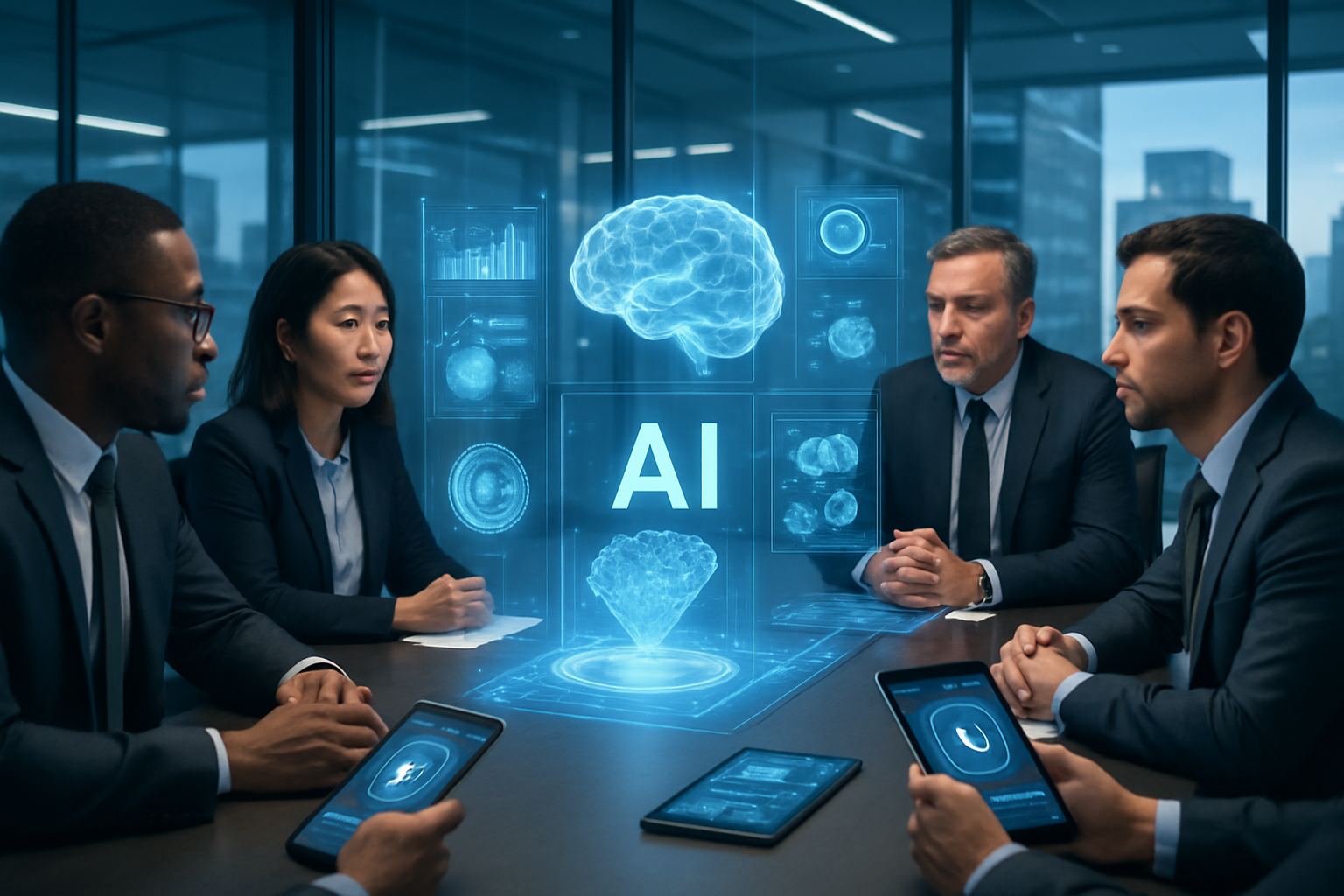
April 2026 has emerged as a watershed moment for artificial intelligence in business applications, with groundbreaking developments spanning from German tax consultancy automation to high-level AI security discussions in Cyprus, signaling the technology's transition from experimental tool to essential business infrastructure.
The past month has witnessed unprecedented AI implementation across multiple sectors, with industry experts characterizing this period as a critical "civilizational choice point" where artificial intelligence fundamentally reshapes how businesses operate globally.
German Business Automation Revolution
Germany's business landscape is experiencing a seismic shift as 15 AI-powered startups target the country's multi-billion-euro tax advisory and auditing sector. These platforms offer automated solutions for complex calculations, regulatory compliance, and financial advisory services that traditionally required extensive human expertise.
The timing aligns with Microsoft's Mustafa Suleyman's predictions that AI will replace the majority of office workers within two years and lawyers and auditors within 18 months. International platforms and entrepreneurs are introducing efficiency solutions to address Germany's workforce shortages while navigating the country's complex regulatory environment.
"We're witnessing the end of conventional business processes as AI demonstrates direct replacement capabilities for tasks requiring years of human training."
— Industry Analysis Report, March 2026
China's Strategic AI Government Initiative
In a significant development highlighting government-level AI adoption, Chinese Premier Li Qiang met with Yang Zhilin, founder of rapidly growing Moonshot AI, as part of Beijing's accelerated push for digital transformation in manufacturing. The 32-year-old entrepreneur was among select business leaders invited to a high-level symposium focusing on China's economic resilience and future growth drivers.
This meeting underscores China's systematic approach to AI integration, particularly in addressing the country's demographic challenges through the "4-2-1 problem" where single children must support four aging parents and grandparents. The government's emphasis on industrial AI adoption represents a coordinated national strategy to maintain productivity despite population pressures.
Global AI Security and Governance Concerns
Meanwhile, a significant development in AI governance emerged from Cyprus, where a specialized event on artificial intelligence and national security drew diplomatic representatives and public audiences. Dr. Marina Theodotou, Executive Director of the Center for Frontier AI Security and former Pentagon Defense Innovation Board executive, delivered keynote warnings that AI is fundamentally reshaping global power dynamics.
The discussion, organized by the Politeia Centre for Socio-Political Thinking, focused on AI applications in security, governance, and strategic decision-making rather than broad philosophical questions. This represents the sophisticated international dialogue now occurring around AI's implications for national security and democratic governance.
Financial Sector AI Risk Management
Concurrent with these developments, reports indicate that US Treasury Secretary Scott Bessent and Federal Reserve Chair Jerome Powell held urgent talks over Anthropic's latest AI model, with experts warning of potential economic damage running into hundreds of billions of dollars without proper cybersecurity assessments.
In contrast, Chinese banks are reportedly taking a more cautious approach, prioritizing financial stability while intensifying monitoring of AI-related risks. This divergence highlights different national approaches to AI risk management in critical financial infrastructure.
Sports and Specialized Applications
The reach of AI applications extends beyond traditional business sectors. Azerbaijan's AMADA officials published research on artificial intelligence applications in anti-doping efforts in the prestigious international Scopus-indexed journal "Law. Human. Environment." This demonstrates how AI is penetrating specialized regulatory and compliance areas across diverse industries.
Infrastructure Challenges Drive Innovation
These developments occur amid a global semiconductor crisis, with memory chip prices experiencing a sixfold surge affecting major manufacturers Samsung, SK Hynix, and Micron. Despite these constraints, the crisis is paradoxically driving innovation toward memory-efficient algorithms and sustainable deployment strategies that could democratize AI access.
Major technology companies continue massive investments despite infrastructure challenges, with Alphabet committing $185 billion to AI infrastructure in 2026—the largest single-year corporate technology investment in history—while Amazon has announced plans exceeding $1 trillion in AI development.
The Human-Centered AI Success Model
Amid this technological transformation, the most successful AI implementations consistently demonstrate human-centered approaches that enhance rather than replace human capabilities. Examples include Malaysia's world-first AI-integrated Islamic school, Canadian university AI teaching assistants that maintain critical thinking standards, and Singapore's WonderBot 2.0 heritage education program.
These success stories share common characteristics: treating AI as amplification tools serving human goals, maintaining sustained commitment to human development, ensuring comprehensive stakeholder engagement, and demonstrating cultural sensitivity in implementation.
Regulatory Frameworks Emerge
The AI revolution is prompting unprecedented regulatory responses worldwide. Spain has implemented the world's first criminal executive liability framework for technology platforms, while France has conducted AI company cybercrime raids. The United Nations has established an Independent Scientific Panel of 40 experts under Secretary-General António Guterres, representing the first fully independent international AI assessment body.
This coordinated international approach represents the most sophisticated global technology governance framework since the commercialization of the internet, aimed at preventing regulatory arbitrage while fostering responsible innovation.
April 2026: A Defining Moment
Industry experts characterize April 2026 as a critical juncture determining whether AI serves human flourishing and democratic values or becomes an exploitation tool beyond democratic accountability. The convergence of supply chain constraints, regulatory intensification, massive corporate investments, and international cooperation requirements creates unprecedented coordination challenges.
Success in navigating this transition requires balancing innovation acceleration with responsible governance, commercial interests with human welfare, and national competitiveness with international cooperation. The decisions made in 2026 are establishing human-AI relationship patterns that will persist for decades.
Looking Forward
The most promising path forward involves sophisticated human-AI collaboration that amplifies human capabilities while preserving creativity, cultural understanding, and ethical reasoning that define human potential. As the window for coordinated action narrows rapidly, the challenge lies in ensuring AI serves humanity's highest aspirations through democratic governance and human-centered values during this experimental-to-essential infrastructure transition.
The developments of April 2026 suggest that artificial intelligence is no longer a future possibility but a present reality requiring immediate, thoughtful integration across all sectors of the global economy. The question is no longer whether AI will transform business, but how quickly and responsibly that transformation can be managed to serve human welfare while maintaining the technological innovation that drives economic progress.