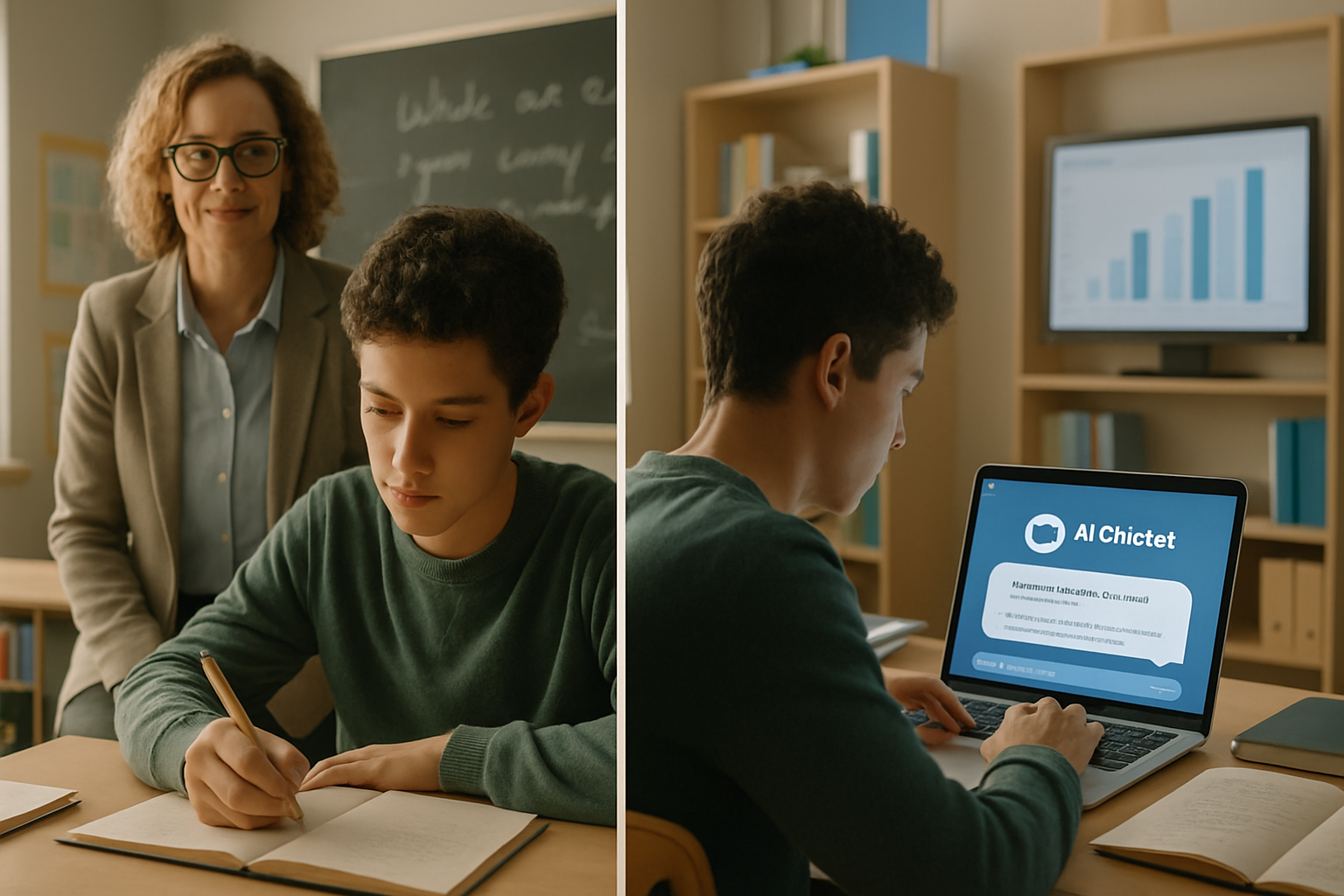
Artificial intelligence chatbots are fundamentally transforming writing education in American classrooms, providing students with personalized, round-the-clock coaching that adapts to their individual learning styles and needs—marking a pivotal moment in the evolution of educational technology.
The integration of AI-powered writing assistants represents more than just technological advancement; it embodies a paradigm shift toward personalized learning that could redefine how students develop one of humanity's most essential skills. As educators grapple with this transformation, early evidence suggests these digital tutors are not replacing teachers but rather augmenting their capabilities in unprecedented ways.
The AI Writing Revolution Takes Hold
The emergence of AI chatbots in writing instruction comes at a critical juncture in American education. Unlike traditional software tools that offer static feedback, these sophisticated systems engage in dynamic conversations with students, providing real-time guidance on everything from sentence structure to argumentative reasoning.
"These AI systems can work with students at any hour, providing immediate feedback that would be impossible for human teachers to match in terms of availability and consistency," explains Dr. Sarah Mitchell, an educational technology researcher at Stanford University. "What we're seeing is not replacement of human instruction, but augmentation that allows teachers to focus on higher-level mentoring while AI handles routine coaching."
The technology builds on successful integration models already demonstrated globally. Canadian universities have pioneered responsible AI teaching assistants that maintain critical thinking standards, while Malaysia operates the world's first AI-integrated Islamic school, successfully combining artificial intelligence with traditional learning approaches. Singapore's WonderBot 2.0 has shown remarkable success in heritage education, proving that thoughtful AI integration can enhance rather than diminish human-centered learning.
Personalization at Scale: The Promise of Adaptive Learning
The most compelling aspect of AI-powered writing instruction lies in its ability to provide truly personalized learning experiences. Unlike classroom settings where teachers must address diverse skill levels simultaneously, AI chatbots can tailor their coaching to each student's specific needs, learning pace, and preferred communication style.
"The AI doesn't get frustrated when I ask the same question multiple times, and it explains things in different ways until I understand. It's like having a patient tutor available whenever I need help with my writing."
— Madison Chen, 9th grade student, Roosevelt High School
This personalized approach addresses long-standing challenges in writing education. Research consistently shows that students learn to write most effectively when they receive frequent, specific feedback—something that traditional classroom structures often struggle to provide due to time constraints and large class sizes.
The AI systems analyze writing patterns, identify recurring errors, and adjust their teaching strategies accordingly. They can detect when students consistently struggle with particular concepts—such as thesis development or paragraph transitions—and provide targeted exercises and examples to address these specific weaknesses.
24/7 Accessibility: Breaking Down Time Barriers
Perhaps the most transformative aspect of AI writing coaches is their constant availability. Students no longer need to wait for office hours or the next class session to receive help with their writing assignments. This accessibility is particularly valuable for students who may feel intimidated by traditional classroom dynamics or those whose optimal learning times don't align with standard school schedules.
The round-the-clock availability also supports the iterative nature of writing improvement. Students can engage in multiple drafting cycles, receiving feedback and implementing changes in real-time rather than waiting days or weeks for teacher responses. This compressed feedback loop accelerates learning and keeps students engaged in the revision process.

Implementation Challenges and Concerns
Despite the promising early results, educators and parents raise legitimate concerns about AI integration in writing instruction. Critics worry about potential over-dependence on technology, arguing that students might lose the ability to write independently or develop their own authentic voice.
"There's a fine line between assistance and dependence," notes Dr. Robert Hayes, a composition specialist at the University of Michigan. "We need to ensure that AI tools are helping students develop their writing skills rather than doing the thinking for them."
Privacy concerns also loom large. AI systems require access to student writing samples to provide personalized feedback, raising questions about data security and the long-term storage of potentially sensitive student information. Schools implementing these systems must navigate complex privacy regulations while ensuring student data remains protected.
Additionally, the global memory crisis affecting semiconductor production—with prices surging sixfold and shortages expected until 2027—creates infrastructure challenges for widespread AI deployment in schools. This constraint forces educators to implement AI tools more thoughtfully, potentially leading to better integration strategies that focus on educational goals rather than technological novelty.
The Teacher's Evolving Role
Contrary to fears about AI replacing educators, evidence suggests that AI writing coaches are reshaping rather than eliminating the teacher's role. Educators report that AI tools handle routine feedback tasks, freeing them to focus on more complex aspects of writing instruction such as creativity development, critical thinking, and helping students find their unique voices.
"AI can tell students about grammar errors and structural issues, but it takes a human teacher to help them understand the deeper purposes of writing—how to move readers, how to construct compelling arguments, how to develop their own style," explains Maria Rodriguez, a high school English teacher who has integrated AI tools into her curriculum.
This division of labor allows teachers to operate more as writing mentors and coaches rather than primary feedback providers. They can focus on one-on-one conferences with students, discuss higher-order concerns like audience awareness and rhetorical strategy, and guide students through the more nuanced aspects of the writing process.
Global Context: Part of a Broader Educational Renaissance
The integration of AI writing coaches in American classrooms occurs within a broader global educational transformation. The period from late 2025 through 2026 has been characterized as an "Educational Technology Renaissance"—a coordinated international shift toward accessible, practical, technologically integrated learning systems that address local needs while maintaining global competitiveness.
This movement emphasizes thoughtful technology integration that enhances rather than replaces fundamental educational relationships. Success factors identified across international implementations include sustained political commitment, comprehensive stakeholder engagement, cultural sensitivity, and maintaining the balance between innovation and traditional educational values.
Student Outcomes: Early Results and Future Potential
Preliminary data from schools implementing AI writing coaches shows encouraging trends. Students using AI assistance demonstrate improved writing frequency, with many completing more drafts and revisions than their peers in traditional settings. Engagement metrics also show positive results, with students spending more time on writing tasks when AI support is available.
However, researchers emphasize the need for longitudinal studies to understand the full impact of AI integration on writing development. Questions remain about whether AI-assisted improvements translate to independent writing capability and how these tools affect students' creative expression and personal voice development.
"We're seeing students become more willing to experiment with their writing when they have AI support. They're less afraid to try complex sentence structures or tackle challenging topics because they know they have immediate help available."
— Dr. Jennifer Park, Educational Researcher, UCLA
Looking Forward: The Future of AI-Enhanced Writing Education
As AI technology continues to evolve, writing instruction will likely become increasingly sophisticated. Future developments may include AI systems that better understand context and cultural nuances, provide more nuanced feedback on creative expression, and seamlessly integrate with broader educational ecosystems.
The key to successful implementation lies in maintaining focus on educational goals rather than technological capabilities. Schools that treat AI as a powerful tool serving specific pedagogical objectives—rather than as a solution in search of a problem—show the most promising results.
The most successful programs demonstrate several common characteristics: clear guidelines for AI use, ongoing teacher training, regular assessment of student outcomes, and continuous dialogue about the role of technology in education. These implementations view AI as amplifying human capabilities rather than replacing human judgment.
Preparing Students for an AI-Integrated Future
Beyond immediate writing improvement, AI writing coaches serve a broader educational purpose: preparing students for a future where human-AI collaboration will be commonplace across many professional fields. Students learning to work effectively with AI writing tools are developing meta-skills that will serve them throughout their careers.
This preparation includes learning when to rely on AI assistance and when to work independently, how to maintain their authentic voice while leveraging technological support, and how to critically evaluate AI-generated suggestions. These skills represent a new form of literacy essential for success in an AI-integrated world.
The transformation of writing education through AI represents more than technological adoption—it embodies a fundamental shift toward personalized learning that could serve as a model for other educational domains. As implementation expands and research continues, the ultimate measure of success will be whether students emerge as more confident, skilled, and thoughtful writers prepared for the complex communication challenges of the 21st century.
The question is no longer whether AI will transform writing education, but how thoughtfully and effectively schools can harness this technology while preserving the essentially human aspects of written expression that make communication meaningful, persuasive, and beautiful.