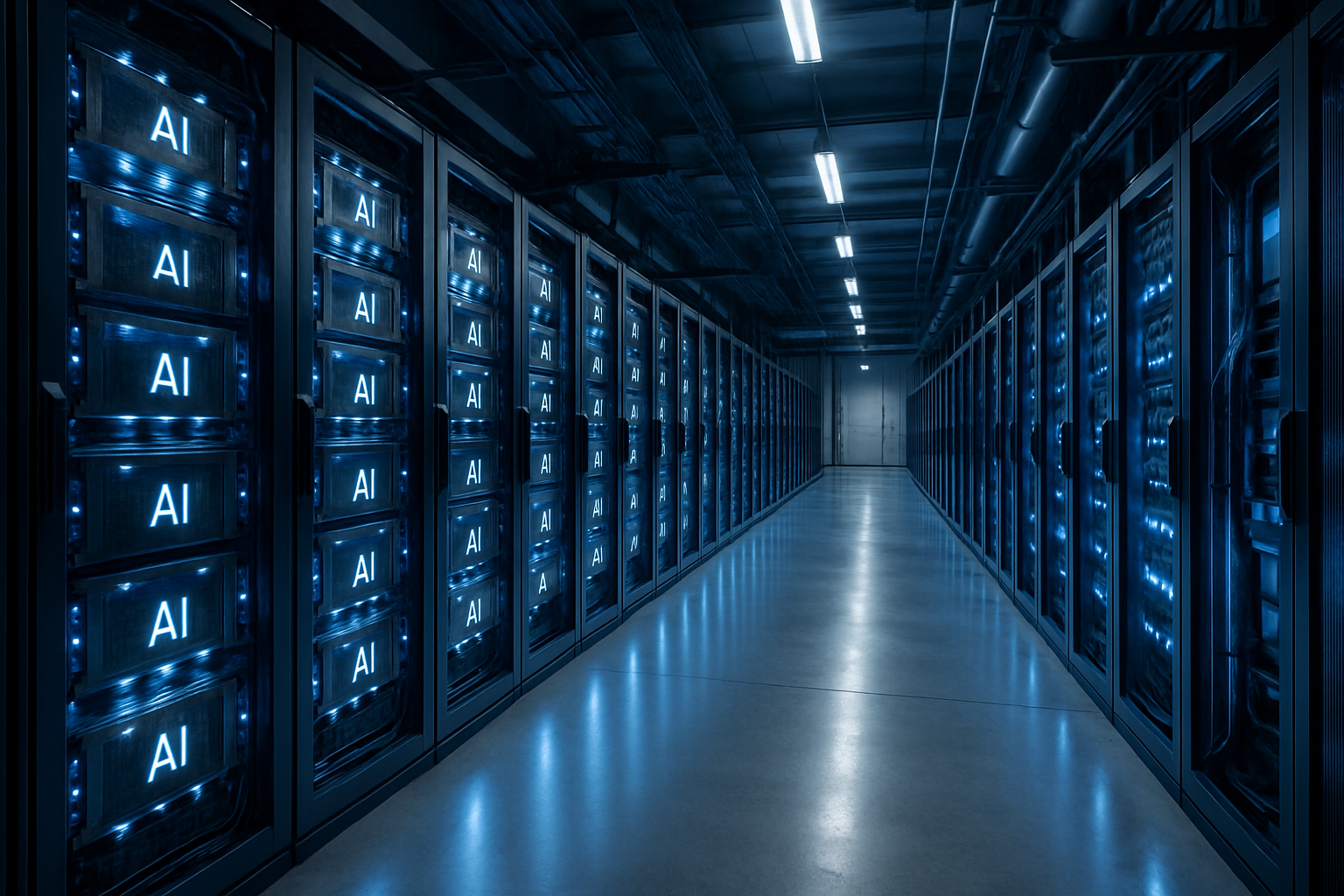
The artificial intelligence industry is experiencing the largest infrastructure investment surge in technology history, with companies from OpenAI to Nvidia channeling hundreds of billions of dollars into data centers, chips, and computing power as global demand for AI services reaches unprecedented levels.
This massive capital deployment comes at a critical juncture for the industry, as AI transitions from experimental technology to essential business infrastructure across all sectors. Despite facing severe semiconductor shortages and mounting regulatory scrutiny, technology giants are doubling down on their AI ambitions with record-breaking investments that will reshape the global digital landscape.
Record-Breaking Investment Commitments
The scale of AI infrastructure investment has reached staggering proportions. Alphabet has committed $185 billion to AI infrastructure in 2026 alone—the largest single-year corporate technology investment in history. Amazon's AI development plans exceed $1 trillion, while OpenAI recently secured an unprecedented $110 billion funding round from Amazon, SoftBank, and Nvidia, achieving a $730 billion pre-money valuation.
These investments represent a fundamental shift from viewing AI as a complementary technology to treating it as essential infrastructure comparable to electricity or telecommunications networks. The magnitude of these commitments demonstrates corporate America's belief that AI will fundamentally transform how business operates across every sector.
"We're witnessing the most significant technology infrastructure buildout since the internet's early days, but compressed into a much shorter timeframe with far greater capital requirements."
— Industry Analyst, Technology Investment Research
Global Semiconductor Crisis Creates Bottlenecks
The AI investment boom coincides with an unprecedented global semiconductor crisis that has driven memory chip prices up sixfold. Samsung, SK Hynix, and Micron are operating at full capacity but cannot meet the explosive demand from AI development companies like Nvidia, Microsoft, Google, and OpenAI.
Consumer electronics costs have increased 20-30% over the past year due to these supply shortages, and industry experts expect the crisis to persist until 2027 when new fabrication facilities come online. The 18-24 month construction timeline for new semiconductor plants means relief remains distant.
This supply constraint has created a strategic imperative for AI companies to secure chip access through long-term partnerships and massive upfront investments. OpenAI is actively seeking alternatives to Nvidia chips to reduce dependence on a single supplier, while other companies are exploring custom chip development to bypass the semiconductor bottleneck.
Water and Energy Demands Surge
The environmental implications of AI infrastructure expansion are staggering. The World Bank projects that AI systems will require 4.2-6.6 billion cubic meters of water annually by 2027 for data center cooling—equivalent to four to six times Denmark's entire annual water withdrawal.
This massive resource requirement has sparked the first major community protests against data center development, with Malaysia experiencing significant resistance from residents concerned about environmental and health impacts. Similar opposition is emerging globally as communities grapple with the local consequences of AI infrastructure expansion.
Energy demands are equally challenging, with data centers straining electricity grids worldwide. Companies are increasingly turning to renewable energy solutions and exploring innovative approaches like space-based data centers powered by solar energy to address these sustainability concerns.
Market Disruption and the "SaaSpocalypse"
The AI infrastructure boom is driving what analysts call the "SaaSpocalypse"—the elimination of hundreds of billions in market capitalization from traditional software companies as AI demonstrates direct replacement capabilities rather than merely complementary functions.
German analysts have described this as an "apocalypse for software houses," with many traditional software companies experiencing 20% stock declines. Indian IT giants like Infosys, Wipro, and HCL Tech have seen significant market value erosion, though some are adapting through worker transition programs rather than mass layoffs.
Microsoft's Mustafa Suleyman predicts that AI will replace the majority of office workers within two years, with lawyers and auditors facing displacement within 18 months. This employment disruption represents one of the most significant challenges accompanying the AI infrastructure buildout.
Regulatory Pressure Intensifies
As AI infrastructure investment accelerates, regulatory oversight is intensifying globally. Spain has implemented the world's first criminal executive liability framework for technology platforms, creating imprisonment risks for executives beyond traditional corporate penalties. France has conducted cybercrime raids on AI companies, while the EU is investigating potential Digital Services Act violations with billions in potential penalties.
The United Nations has established an Independent International Scientific Panel with 40 experts led by Secretary-General António Guterres—the first fully independent global AI assessment body. This represents the most sophisticated global technology governance attempt since internet commercialization.
The regulatory environment creates additional complexity for companies making massive infrastructure investments, as they must navigate evolving compliance requirements across multiple jurisdictions while maintaining growth momentum.
Multipolar Competition Emerges
The AI infrastructure race is creating a multipolar competitive landscape that challenges traditional Silicon Valley dominance. Chinese companies like DeepSeek have achieved breakthroughs that triggered market volatility and demonstrated that AI leadership may not remain concentrated in the United States.
European initiatives like Deutsche Telekom's Industrial AI Cloud in Munich represent regional technological sovereignty efforts. India has announced massive AI "data city" projects, rising to third place in global AI power rankings above South Korea and Japan. This geographic distribution of AI capabilities prevents single-entity control while enabling culturally sensitive development approaches.
Asian markets are particularly active, with Singapore and South Korea announcing a $300 million Global AI Fund for joint artificial intelligence development, while China continues scaling humanoid robot production and autonomous driving capabilities.
Successful Integration Models Emerge
Despite the massive scale of infrastructure investment and market disruption, successful models for responsible AI integration are emerging globally. Canadian universities have implemented AI teaching assistants while maintaining critical thinking standards. Malaysia operates the world's first AI-integrated Islamic school, combining artificial intelligence with traditional learning approaches.
Singapore's WonderBot 2.0 has demonstrated success in heritage education, showing how AI can enhance rather than replace human capabilities when implemented thoughtfully. These examples provide templates for other organizations seeking to harness AI's benefits while preserving essential human elements.
"The most successful AI implementations enhance human capabilities rather than replace them entirely. Technology should serve human flourishing, not supplant it."
— Educational Technology Researcher
Critical Inflection Point
March 2026 represents what industry observers call the most critical inflection point in artificial intelligence development. The massive infrastructure investments, regulatory pressures, market disruptions, and technological breakthroughs are converging to determine whether AI fulfills its transformative promise or creates systemic societal disruption.
Success in this transition requires unprecedented coordination between governments, technology companies, educational institutions, and civil society. The challenge involves balancing innovation acceleration with safety governance, commercial interests with human welfare, and national competitiveness with international cooperation.
The decisions made in 2026 regarding AI infrastructure investment, regulatory frameworks, and implementation approaches will echo through decades, determining the trajectory of human-AI relationships for the remainder of the century.
Looking Ahead
As AI companies continue channeling billions into infrastructure development, the stakes could not be higher. The current investment wave represents a civilization-level choice about whether artificial intelligence will serve democratic values and human flourishing or become a tool for exploitation and control.
The resolution of current infrastructure constraints, the development of international cooperation frameworks, and the creation of sustainable business models that prioritize human welfare alongside technological advancement will determine the ultimate legacy of this historic investment boom.
For now, the momentum continues building as companies bet their futures—and unprecedented sums of capital—on AI becoming as fundamental to modern society as electricity, telecommunications, or the internet itself. The next phase of this transformation promises to be even more dramatic than what we've witnessed so far.