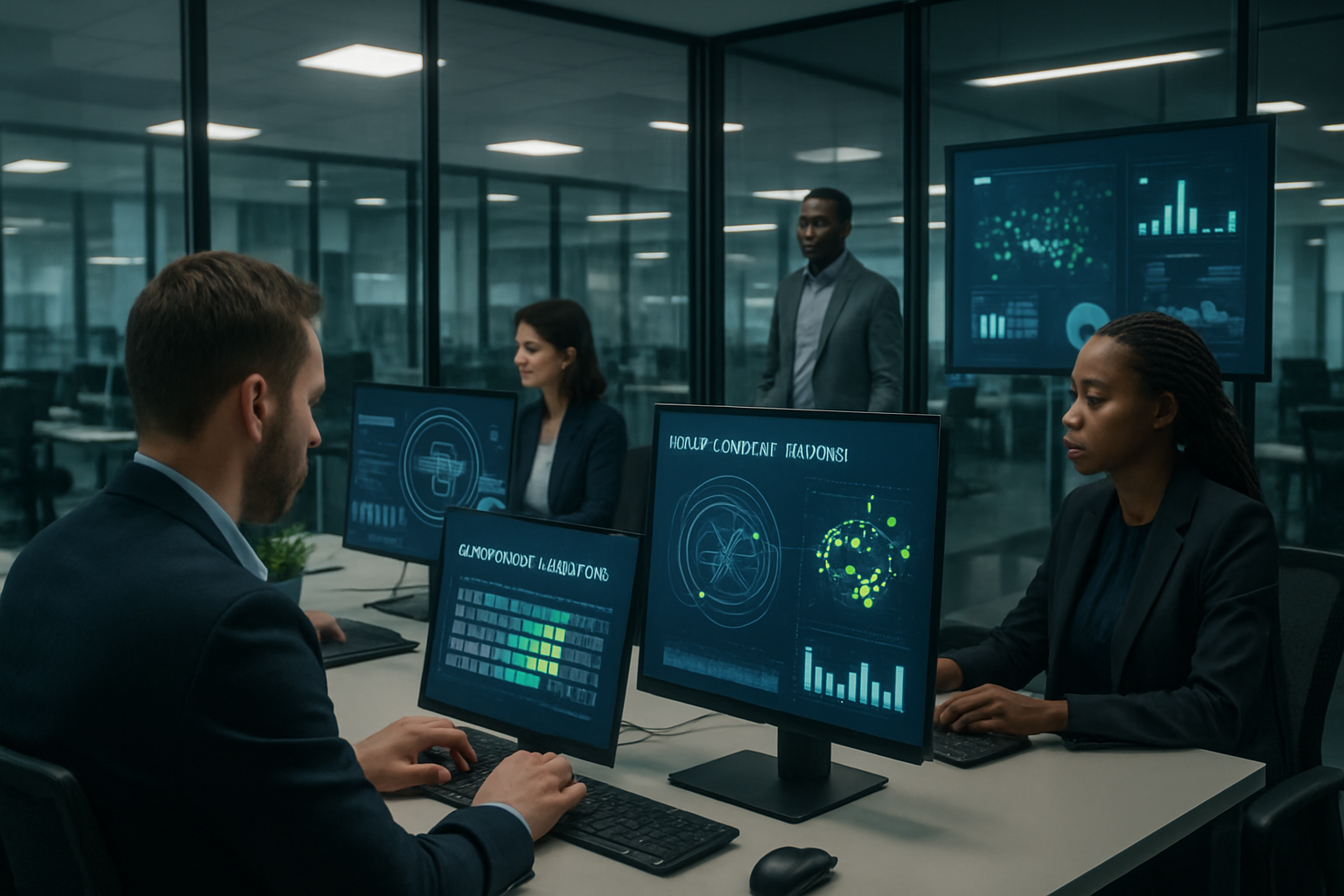
Major technology companies are dramatically expanding employee surveillance systems to gather training data for artificial intelligence models, while simultaneously grappling with significant security vulnerabilities that expose the very AI systems they're developing.
Meta Platforms has begun installing comprehensive tracking software on US-based employees' computers to capture detailed behavioral data including mouse movements, clicks, keystrokes, and screen content for AI training purposes. The initiative, called the Model Capability Initiative (MCI), represents a significant escalation in workplace surveillance technology as companies race to develop more sophisticated AI systems.
Meta's Unprecedented Employee Monitoring Program
According to internal memos obtained by Reuters, Meta's surveillance system will monitor work-related applications and websites while taking periodic screenshots of employee screens. The program specifically targets areas where AI models struggle to replicate human computer interactions, such as navigating dropdown menus and utilizing keyboard shortcuts.
The tracking software deployment coincides with Meta's broader AI infrastructure investments, including a $21 billion partnership with CoreWeave and the recent launch of their "Muse Spark" superintelligence model. However, these developments come as the company prepares for layoffs affecting potentially 20% of its workforce due to AI infrastructure costs.
"This is where all Meta employees can contribute to building the future of AI by helping improve our models' understanding of how humans interact with computers."
— Meta AI Research Team, Internal Memo
The surveillance program raises significant legal and ethical questions about employee privacy rights, GDPR compliance, and the boundaries of workplace monitoring. Employment law experts note that regulations governing AI-enhanced workplace surveillance remain largely untested in courts, creating uncertainty for both companies and workers.
Security Vulnerabilities Expose AI Development Risks
While Meta expands its data collection capabilities, other AI companies face serious security challenges. Anthropic's advanced "Mythos" AI model was reportedly accessed by unauthorized users through a third-party vendor environment on the same day the company announced plans to release the model to select organizations for testing.
A small group of users in a private online forum gained access to Mythos and have been using the system regularly, according to Bloomberg News reports. An Anthropic spokesperson confirmed they are "investigating a report claiming unauthorized access to Claude Mythos Preview through one of our third-party vendor environments."
The incident highlights critical vulnerabilities in AI development pipelines and raises questions about data security protocols as companies rush to deploy increasingly powerful AI systems. Mythos is being developed as part of Anthropic's "Project Glasswing," a controlled initiative for select organizational testing.
Global Infrastructure Crisis Driving AI Innovation
These developments occur against the backdrop of a global semiconductor crisis that has driven memory chip prices up sixfold, affecting major manufacturers including Samsung, SK Hynix, and Micron. The shortage, expected to continue until 2027 when new fabrication facilities come online, is paradoxically spurring innovation in memory-efficient algorithms and sustainable AI deployment strategies.
Despite infrastructure constraints, major technology companies continue massive AI investments. Alphabet has committed $185 billion to AI infrastructure in 2026—the largest single-year corporate technology investment in history—while Amazon has announced over $1 trillion in AI development plans through the decade.
The World Bank projects that AI systems will require 4.2-6.6 billion cubic meters of water annually by 2027 for data center cooling, equivalent to 4-6 times Denmark's total water consumption. This massive resource demand is driving interest in more efficient AI training methods and data collection strategies.
Corporate AI Adoption Accelerates Amid Regulatory Pressure
The appetite for AI capabilities among corporations has led to what industry analysts term the "SaaSpocalypse"—the elimination of hundreds of billions in traditional software market capitalization as AI systems demonstrate direct replacement capabilities for conventional solutions.
Microsoft's Mustafa Suleyman has predicted that AI will replace the majority of office workers within two years and lawyers and auditors within 18 months. These predictions are gaining credibility as companies like Block Inc. have eliminated 4,000 positions (40% of their workforce) explicitly citing AI advancement rather than financial pressures.
The rapid corporate adoption is occurring amid intensifying regulatory oversight globally. Spain has implemented the world's first criminal executive liability framework for technology platforms, creating potential imprisonment risks for executives. France has conducted cybercrime raids on AI companies, while the European Union is pursuing Digital Services Act violations with potential billion-dollar penalties.
"We're investigating a report claiming unauthorized access to Claude Mythos Preview through one of our third-party vendor environments."
— Anthropic Spokesperson
International Governance Frameworks Emerge
In response to rapid AI development, the United Nations has established an Independent Scientific Panel of 40 experts under Secretary-General António Guterres—the first fully independent international AI assessment body. This represents the most sophisticated global technology governance effort since the commercialization of the internet.
The panel's formation reflects growing recognition that AI governance requires unprecedented coordination between governments, companies, institutions, and civil society to balance innovation with safety governance, commercial interests with human welfare, and national competitiveness with international cooperation.
Alternative Models Show Promise for Human-Centered AI
Despite concerns about surveillance and security, several successful models demonstrate the potential for human-centered AI approaches. Canadian universities have implemented AI teaching assistants that maintain critical thinking standards, while Malaysia operates the world's first AI-integrated Islamic school, combining artificial intelligence with traditional learning methods.
Singapore's WonderBot 2.0 heritage education system has achieved notable success, demonstrating that AI can serve as an amplification tool enhancing human capabilities rather than replacing them. These implementations share common characteristics: sustained human development commitment, meaningful stakeholder engagement, cultural sensitivity, and treating AI as an enhancement rather than replacement mechanism.
The Productivity Paradox Challenge
Research by Dr. Frank Bäumer has documented a "productivity paradox" where AI implementation often creates a "double workload effect"—workers perform their original responsibilities while also supervising and correcting AI systems, sometimes resulting in declining efficiency compared to promised gains.
This finding suggests that successful AI integration requires comprehensive change management, worker training, and workflow redesign rather than simply adding AI tools to existing processes. Companies emphasizing employee upskilling and transition programs, particularly in Asian markets, show higher success rates than those pursuing wholesale replacement strategies.
April 2026: A Civilizational Choice Point
Industry experts characterize April 2026 as a "civilizational choice point"—a critical juncture determining whether AI serves human flourishing and democratic values or becomes a surveillance and control tool beyond democratic accountability.
The convergence of breakthrough AI capabilities, security vulnerabilities, massive infrastructure investments, and regulatory pressures creates a moment requiring coordinated global action. Decisions made in 2026 are establishing human-AI relationship patterns that will persist for decades.
The window for proactive adaptation is narrowing as AI capabilities advance faster than governance frameworks can develop. Success requires unprecedented coordination between governments, companies, institutions, and civil society to ensure that AI serves humanity's highest aspirations while preserving human creativity, empathy, and cultural understanding that artificial intelligence cannot replicate.
Looking Forward: The Challenge of Sustainable AI Development
The most promising path forward involves sophisticated human-AI collaboration that amplifies capabilities while preserving uniquely human qualities. Organizations treating AI as amplification tools for human goals, rather than wholesale replacement mechanisms, consistently achieve superior outcomes in productivity, employee satisfaction, and long-term sustainability.
As Meta's employee surveillance program and Anthropic's security challenges demonstrate, the stakes extend beyond individual privacy concerns to fundamental questions about corporate governance, democratic oversight, and the preservation of human agency in an increasingly automated world.
The challenge ahead requires resolving infrastructure constraints while maintaining innovation momentum, developing sustainable business models that prioritize human welfare alongside technological advancement, and fostering international cooperation that balances competitiveness with stability. The decisions made in the coming months will determine whether AI's transformative promise is realized or whether systemic risks require dramatic corrections to current development trajectories.