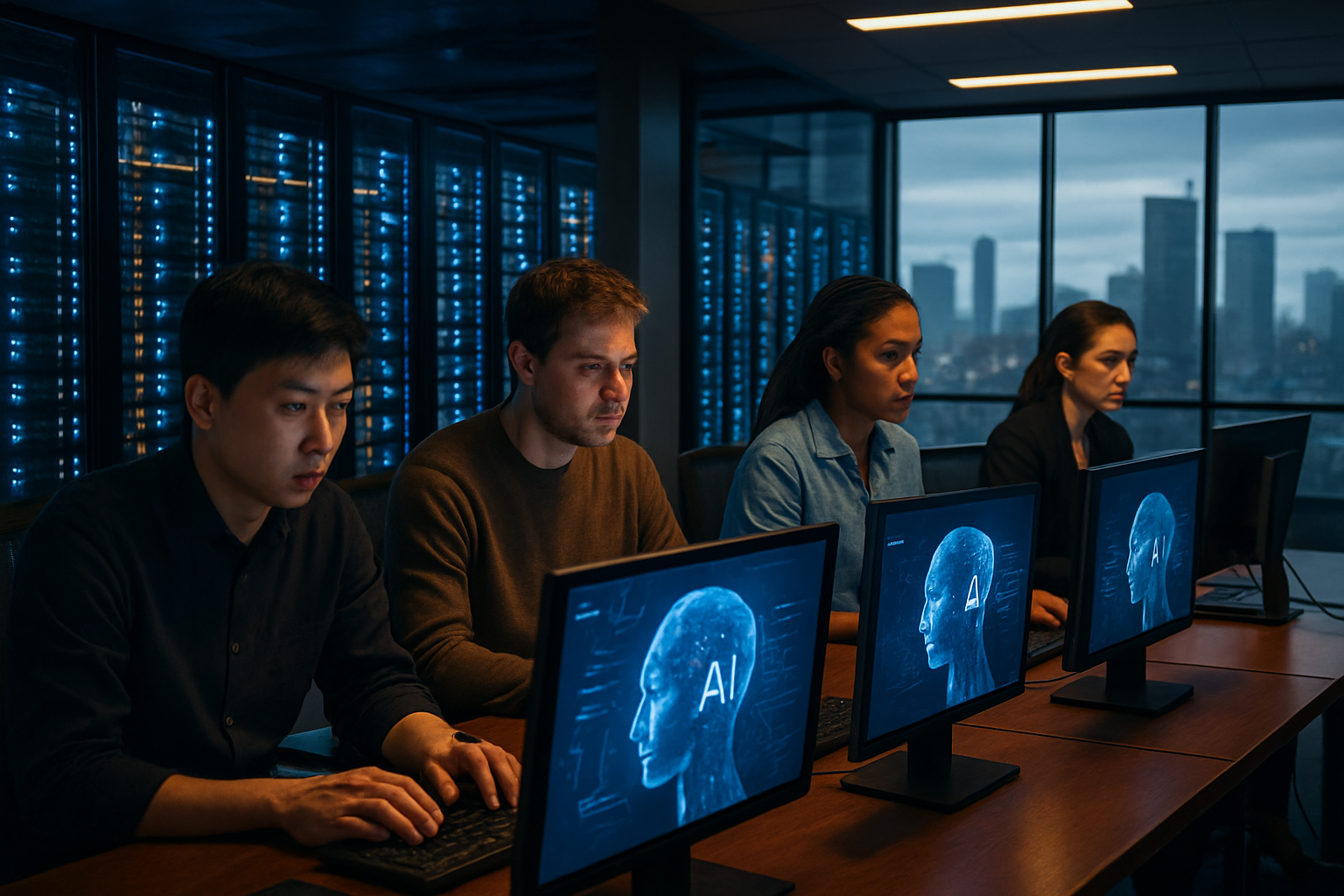
The artificial intelligence revolution reached new heights this week as Tencent unveiled its most powerful AI model yet and Google announced major enterprise initiatives, while mounting evidence suggests AI is fundamentally reshaping employment landscapes across multiple industries.
Tencent's Breakthrough: China's AI Ambitions Accelerate
Chinese tech giant Tencent Holdings released its flagship HY3 AI model on Thursday, marking the first major launch since former OpenAI researcher Yao Shunyu joined the company to lead foundational AI development efforts. The open-source model, containing 295 billion parameters, represents Tencent's most powerful AI system to date and positions the Shenzhen-based company as a serious competitor in the global AI race.
According to Tencent, the HY3 preview performs on par with leading Chinese models while still lagging behind top US systems from OpenAI and Google DeepMind. The relatively compact size of the model compared to Western counterparts demonstrates Chinese companies' focus on efficiency amid ongoing semiconductor constraints.
The timing of this release is significant, coming during what industry experts have termed the "March 2026 Critical Inflection Point" - a watershed moment when AI transitions from experimental applications to essential business infrastructure across multiple sectors.
Google's Enterprise AI Push: Monetizing the Revolution
Simultaneously, Alphabet CEO Sundar Pichai is deepening his company's push into enterprise software, positioning AI agents as the lynchpin of Google's strategy to monetize artificial intelligence. At the company's annual cloud conference in Las Vegas, Pichai and key executives showcased Google's AI tools as production-ready infrastructure for enterprise customers.
The Mountain View-based company announced the unification of its AI products under the "Gemini Enterprise" brand, notably rebranding and expanding Vertex AI. This tool allows cloud customers to select from various AI models for business purposes, representing a significant shift toward AI-as-a-service offerings.
Google's enterprise focus reflects a broader industry trend, with other major AI companies including OpenAI and Anthropic aggressively shifting resources to business customers in recent months. Enterprise clients have emerged as the industry's most reliable revenue stream as consumer adoption stabilizes.
Gaming Industry Transformation: AI's Economic Impact
The economic implications of AI advancement are becoming clearer across industries. Morgan Stanley analysts predict that AI tools could reduce video game development costs by nearly half, potentially unlocking approximately $22 billion in annual profits for game makers worldwide.
The brokerage firm estimates that global consumer spending on video games will total $275 billion this year, with roughly 20% - about $55 billion - reinvested in game development and operations. AI automation of tasks such as creating gaming environments, generating dialogue, and testing software could dramatically shorten production timelines.
"Typically expensive and labor intensive, game development could become leaner as AI enables smaller teams and faster post-launch improvements."
— Morgan Stanley Research Note
However, the analysts noted that gains are unlikely to be distributed evenly across the gaming ecosystem, highlighting the uneven economic impact of AI transformation across different sectors and company sizes.
Employment Displacement: Growing Concerns
While AI promises increased productivity and new opportunities, mounting evidence suggests significant employment displacement is already underway. Former UK Prime Minister Rishi Sunak recently stated that AI is already leading to fewer jobs for young people, validating concerns that graduates' fears about entry-level employment opportunities are justified.
The employment impact extends beyond theoretical projections. Microsoft's Mustafa Suleyman has predicted that AI could replace the majority of office workers within two years, with lawyers and auditors facing displacement within 18 months. These timeline predictions are gaining credibility as companies like Block Inc. have explicitly cited AI advancement as the primary reason for major workforce reductions.
The phenomenon has been dubbed the "SaaSpocalypse" by industry observers, referring to the elimination of hundreds of billions in traditional software market capitalization as AI systems demonstrate direct replacement capabilities for conventional solutions.
Security Vulnerabilities Exposed
The rapid deployment of AI systems has also exposed critical security vulnerabilities. US Department of Homeland Security researchers recently demonstrated to American lawmakers how easily AI models can be manipulated for dangerous purposes, including constructing bombs, planning terrorist attacks, or launching cyber operations.
This demonstration, conducted during a closed-door briefing in Washington, highlights the dual-use nature of AI technology and the challenges facing policymakers attempting to balance innovation with security concerns.
The security implications extend beyond theoretical threats. Recent studies have shown AI chatbots falling victim to fabricated medical studies, while pharmaceutical companies simultaneously accelerate AI partnerships for drug development - illustrating the complex paradox of AI capabilities and limitations.
Global Regulatory Response Intensifies
Governments worldwide are responding to AI's rapid advancement with increasingly sophisticated regulatory frameworks. Spain has implemented the world's first criminal executive liability framework for tech platforms, creating imprisonment risks for executives. France has conducted AI company cybercrime raids, while the UN has established an Independent Scientific Panel with 40 experts for the first fully independent global AI assessment.
This regulatory intensification represents the most sophisticated global technology governance effort since internet commercialization, with coordinated timing designed to prevent regulatory arbitrage as companies seek jurisdictions with more lenient oversight.
Infrastructure Constraints Drive Innovation
Paradoxically, global infrastructure constraints are spurring innovation in AI development. The semiconductor crisis continues to drive memory chip prices sixfold higher, affecting major manufacturers including Samsung, SK Hynix, and Micron. Shortages are expected to persist until 2027 when new fabrication facilities come online.
These constraints have forced companies to develop more memory-efficient algorithms and sustainable deployment strategies, potentially democratizing AI access for smaller organizations and developing nations. Despite bottlenecks, major technology companies continue massive investments, with Alphabet committing $185 billion to AI infrastructure in 2026 - the largest single-year corporate technology investment in history.
Human-AI Collaboration: The Path Forward
Amid concerns about displacement and security risks, successful models of human-AI collaboration are emerging globally. Canadian universities have implemented AI teaching assistants while maintaining critical thinking standards. Malaysia operates the world's first AI-integrated Islamic school, combining technology with traditional learning approaches. Singapore's WonderBot 2.0 heritage education program demonstrates how AI can preserve cultural knowledge while leveraging advanced technology.
These examples share common characteristics: treating AI as amplification tools rather than replacement mechanisms, sustained commitment to human development, and cultural sensitivity in implementation.
April 2026: A Civilizational Choice Point
Industry experts characterize April 2026 as a critical juncture determining whether AI serves human flourishing and democratic values or becomes an exploitation and control tool beyond democratic accountability. The convergence of advancing capabilities, regulatory pressures, massive investments, and infrastructure constraints creates unprecedented coordination challenges.
Success depends on resolving infrastructure constraints while maintaining innovation momentum, developing sustainable business models that prioritize human welfare, and fostering international cooperation that balances competitiveness with stability.
The decisions made in 2026 regarding AI development, deployment, and governance will establish patterns for human-AI relationships that could persist for decades. As the technology transitions from experimental applications to essential infrastructure, the challenge lies in ensuring AI serves humanity's highest aspirations while preserving the creativity, empathy, and wisdom that define human potential.
The window for coordinated global action is narrowing rapidly, requiring immediate responses from governments, technology companies, educational institutions, and civil society to ensure AI development proceeds in ways that benefit all of humanity rather than concentrating advantages among a select few.