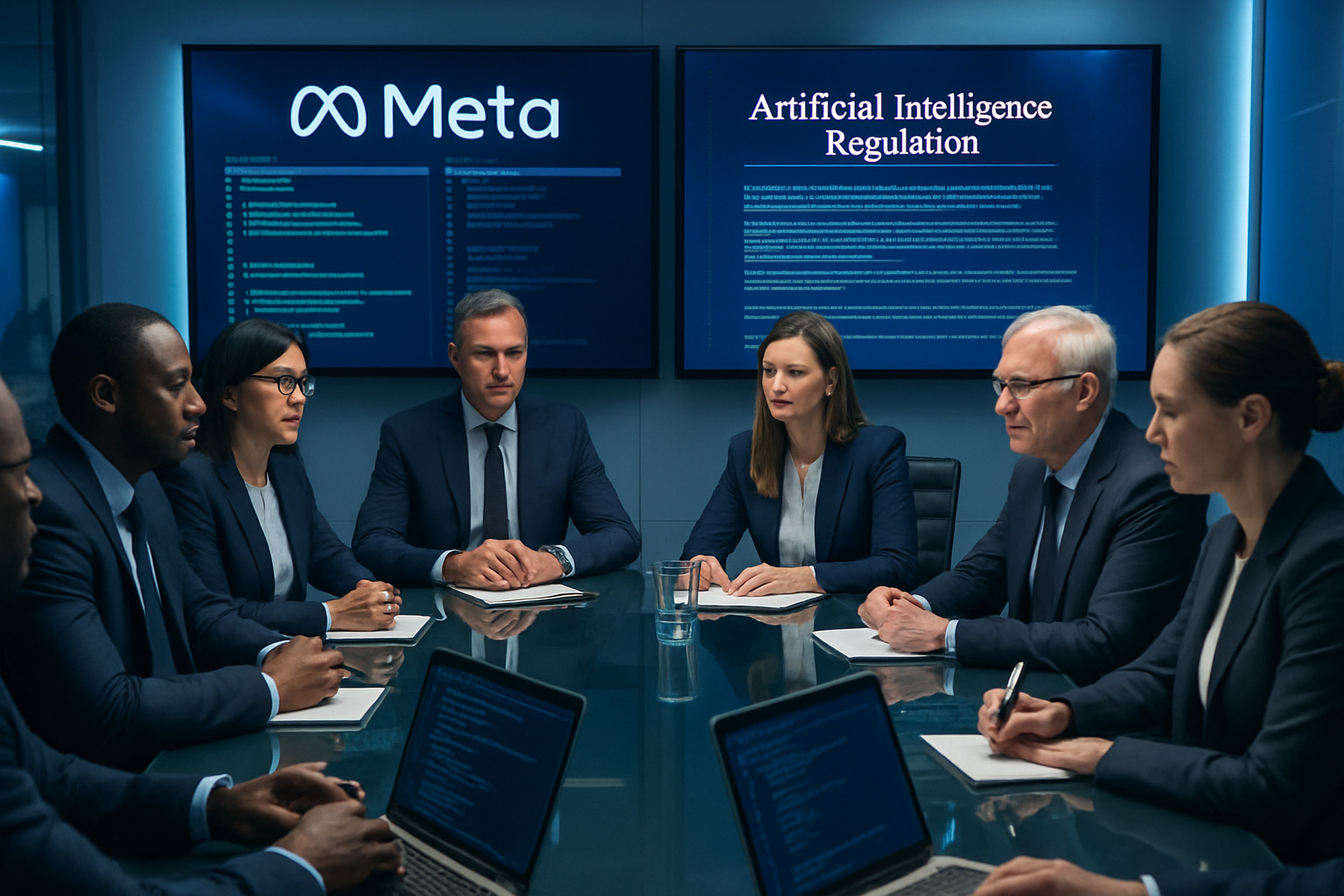
April 2026 marks a pivotal "civilizational choice point" in artificial intelligence development as Meta unveils its mysterious Muse Spark project, educational institutions worldwide embrace AI integration, and international regulators coordinate unprecedented governance frameworks that will determine whether AI serves human flourishing or becomes an exploitation tool beyond democratic accountability.
Meta's Enigmatic Muse Spark Project
Meta has triggered intense speculation across the AI community with the announcement of "Muse Spark," a project shrouded in secrecy that the company describes as "small and fast by design, yet capable of handling complex questions in specialized domains." The mysterious nature of this initiative has positioned it as Meta's potential trump card in the intensifying global AI competition.
According to Egyptian sources familiar with the development, Muse Spark represents a significant departure from Meta's previous AI approaches, though specific technical details remain closely guarded. The project emerges at a critical time when Meta faces mounting regulatory pressure and fierce competition from established players like OpenAI's ChatGPT and Google's Gemini, as well as emerging challengers including Elon Musk's Grok AI, which has surged to become the world's third-largest AI platform with 314 million monthly visits.
"The company emphasizes that the model is small and fast by design, but capable of handling complex questions in specialized fields."
— Meta Internal Statement
The timing of Muse Spark's development coincides with what industry experts characterize as the most critical AI inflection point since the technology boom began. This "experimental to essential infrastructure" transition is occurring amid global semiconductor constraints that have driven memory chip prices up sixfold, affecting major suppliers Samsung, SK Hynix, and Micron, with shortages expected to persist until 2027 when new fabrication facilities come online.
Global Educational AI Renaissance
While Meta develops Muse Spark in secrecy, educational institutions worldwide are experiencing what researchers term the "2026 Educational Technology Renaissance" – a coordinated global phenomenon emphasizing thoughtful AI integration with traditional educational values.
Estonian Language Model Breakthrough
The University of Tartu has achieved a significant milestone in developing effective Estonian-language AI models despite limited data availability through cross-lingual transfer learning. This breakthrough demonstrates that smaller nations can leverage AI for educational advancement without sacrificing cultural authenticity or linguistic heritage.
The research reveals how artificial intelligence can enhance rather than replace fundamental educational relationships, providing a template for culturally sensitive AI deployment that preserves local identity while embracing technological advancement.
Cyprus Skills-Knowledge Intelligence System
Cyprus has launched an ambitious three-year research project using artificial intelligence to align the nation's education system with labor market needs. The CySKILLS-AI initiative, developed through collaboration between Artemis Intelligence, CYENS Centre of Excellence, and government ministries, represents a sophisticated approach to addressing the skills gap that plagues many modern economies.
Launched on March 20, 2026, at the CYENS Centre of Excellence in Nicosia, the project demonstrates how AI can serve strategic national development goals while maintaining human-centered educational approaches. The initiative is funded by the Republic of Cyprus through the Research and Innovation Foundation under the AI in Government programme.
International Success Models
The global educational transformation features several standout models that demonstrate successful human-AI collaboration:
- Malaysia: Operates the world's first AI-integrated Islamic school, combining artificial intelligence with traditional religious and academic learning while achieving a remarkable 97.82% teacher placement rate
- Singapore: WonderBot 2.0 provides conversational AI for heritage education, preserving cultural knowledge while leveraging advanced technology
- Canada: Universities have implemented AI teaching assistants that maintain critical thinking standards while providing personalized learning support
These success stories share common characteristics: treating AI as amplification tools rather than replacement mechanisms, sustaining human development commitments, engaging comprehensive stakeholders, and maintaining cultural sensitivity.
Regulatory Revolution and Democratic Governance
As AI development accelerates, governments worldwide are implementing unprecedented regulatory frameworks that represent the most sophisticated global technology governance attempt since internet commercialization.
Spain's Criminal Executive Liability Framework
Spain has emerged as a global leader by implementing the world's first criminal executive liability framework for technology platforms, creating potential imprisonment risks for tech executives. This revolutionary approach shifts accountability from corporate penalties to personal responsibility, fundamentally altering how technology companies must consider their actions.
European Coordination Efforts
The European response demonstrates unprecedented coordination to prevent "jurisdictional shopping" where companies relocate to avoid regulation:
- France: Conducting AI cybercrime raids and issuing formal summons to tech executives
- Austria: Proposing legislation to ban misuse of deepfakes and strengthen penalties for digital violence
- European Commission: Threatening billions in penalties for Digital Services Act violations
UN Global AI Assessment
The United Nations has established an Independent Scientific Panel comprising 40 global experts under Secretary-General António Guterres, creating the first fully independent international AI assessment body. This initiative represents recognition that AI governance requires unprecedented international cooperation, though coordination remains challenged by national security and economic competitiveness concerns.
Journalism and Media Industry Transformation
The AI revolution is fundamentally reshaping journalism and media production, creating both opportunities for enhanced storytelling and serious concerns about professional standards and job security.
Italian media reports reveal that ProPublica journalists have gone on strike over disagreements about AI use in newsrooms, demanding contract provisions for pay increases and protections against AI-related layoffs. This labor action highlights the tension between technological efficiency and preserving the human elements that define quality journalism.
The strike reflects broader industry anxieties about AI's impact on editorial integrity, fact-checking processes, and the fundamental relationship between journalists and their work. Professional organizations worldwide are grappling with how to integrate AI tools while maintaining the critical thinking, cultural understanding, and ethical reasoning that distinguish human journalism from algorithmic content generation.
Infrastructure Challenges Drive Innovation
Paradoxically, the global semiconductor crisis is spurring innovation in memory-efficient algorithms and sustainable AI deployment strategies. The sixfold increase in memory chip prices is forcing organizations to develop more thoughtful approaches to AI implementation, potentially democratizing advanced AI access by requiring less computational power.
Despite infrastructure constraints, massive corporate investments continue. Alphabet has committed $185 billion to AI infrastructure in 2026 – the largest single-year corporate technology investment in history – while Amazon has announced plans exceeding $1 trillion for AI development. The World Bank projects that AI water demand could reach 4.2-6.6 billion cubic meters by 2027 for data center cooling, equivalent to 4-6 times Denmark's annual water consumption.
The "SaaSpocalypse" Market Disruption
The traditional software market is experiencing what analysts term the "SaaSpocalypse" – the elimination of hundreds of billions in market capitalization as AI demonstrates direct replacement capabilities for conventional software solutions. This fundamental shift from software-as-a-service to AI-based alternatives is reshaping entire industries.
Microsoft's Mustafa Suleyman has predicted that AI will replace the majority of office workers within two years and lawyers and auditors within 18 months. However, regional variations are emerging, with Indian IT giants like Infosys, Wipro, and HCL implementing comprehensive worker transition programs rather than mass layoffs, demonstrating alternative approaches to workforce transformation.
Human-Centered AI Success Models
The most promising AI implementations share a common thread: they enhance rather than replace human capabilities while preserving creativity, cultural understanding, and ethical reasoning that define human potential.
Prevention-First Approaches
Countries implementing prevention-first AI strategies are demonstrating superior economic outcomes through reduced crisis intervention costs, improved workforce productivity, and enhanced international competitiveness. Educational investments are increasingly viewed as strategic 21st-century infrastructure that creates self-reinforcing cycles where excellence supports economic development, enabling further human capital investment.
Cultural Sensitivity and Local Adaptation
Successful AI integration requires adaptation to specific cultural, economic, and social contexts rather than standardized global solutions. The diverse approaches observed across different nations – from Estonia's linguistic preservation to Cyprus's labor market alignment – suggest that effective AI deployment must respect existing traditions while preparing communities for technological advancement.
Critical Challenges and Future Trajectories
The convergence of supply chain constraints, regulatory intensification, massive corporate investments, and international cooperation requirements creates unprecedented coordination challenges that will determine AI's trajectory for decades.
Democratic Governance Test
April 2026 represents a fundamental test of whether democratic institutions can effectively regulate multinational technology platforms while preserving the beneficial aspects of digital connectivity. The stakes extend beyond individual privacy concerns to the foundations of democratic society itself, as algorithmic manipulation increasingly influences public opinion and political participation.
Employment and Social Transformation
The employment implications of AI advancement require sophisticated policy responses that balance innovation with human welfare. The emerging "productivity paradox" – where AI implementation often creates more work rather than reducing it – suggests that successful integration requires comprehensive change management rather than simple technology adoption.
Looking Ahead: The Civilizational Choice Point
Industry experts characterize April 2026 as a critical juncture determining whether AI serves human flourishing or becomes an exploitation tool beyond democratic accountability. Success requires unprecedented coordination between governments, technology companies, educational institutions, and civil society to balance innovation acceleration with responsible development.
The window for coordinated action is narrowing rapidly. The decisions made in 2026 will establish human-AI relationship patterns that persist for decades. The challenge lies in ensuring that AI serves humanity's highest aspirations while addressing pressing global challenges through democratic governance and human-centered values.
"The most promising path involves sophisticated human-AI collaboration that amplifies capabilities while preserving the creativity, cultural understanding, and ethical reasoning that define human potential."
— Global AI Policy Expert
As Meta's Muse Spark project continues to develop behind closed doors, educational institutions worldwide demonstrate the potential for thoughtful AI integration, and regulators coordinate unprecedented governance frameworks, the coming months will prove crucial in determining whether the AI revolution enhances human potential or fundamentally disrupts the social, economic, and political foundations upon which modern civilization rests.
The stakes could not be higher: the future of work, education, governance, and human agency itself hangs in the balance as we navigate this pivotal moment in technological history. Success will require technological wisdom to prevail over technological dominance, ensuring that artificial intelligence serves democratic values and human welfare rather than corporate interests that prioritize engagement and profit over human flourishing.