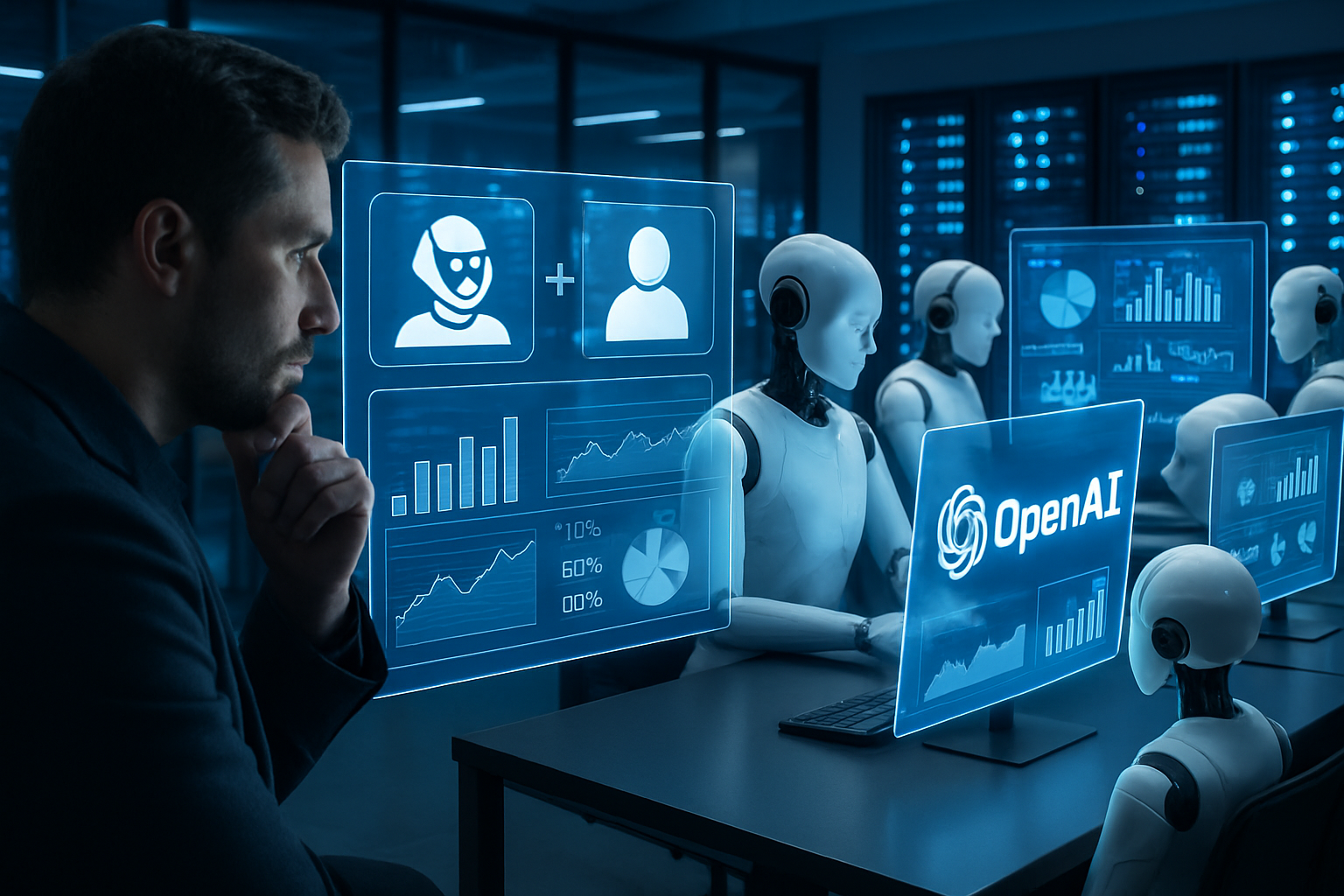
The artificial intelligence landscape continues its rapid transformation as OpenAI introduces enterprise-focused AI agent orchestration capabilities, while educational experts raise urgent concerns about AI's potential impact on human critical thinking abilities and creativity.
OpenAI has unveiled its latest innovation for enterprise clients through the OpenAI Frontier platform, enabling companies to orchestrate multiple AI agents—including those not developed by OpenAI itself. This development represents a significant shift toward integrated AI ecosystems where businesses can manage diverse artificial intelligence tools through a single platform, according to reports from Azerbaijan's technology sector.
Enterprise AI Agent Orchestration
The Frontier platform addresses a growing corporate need for AI system integration as businesses increasingly deploy multiple specialized AI tools across different departments and functions. Rather than requiring companies to rely solely on OpenAI's proprietary solutions, the platform allows coordination of various AI agents, creating a more flexible and comprehensive approach to enterprise artificial intelligence deployment.
This strategic move by OpenAI comes amid the broader "SaaSpocalypse" market disruption that has erased hundreds of billions in traditional software company valuations. As AI capabilities advance, traditional software business models face unprecedented challenges, with companies seeking integrated solutions rather than disparate tools.
Critical Thinking Crisis Warning
Simultaneously, educational experts in Slovakia have issued stark warnings about AI's potential impact on human cognitive development. Research indicates that widespread AI adoption may threaten an entire generation's ability to develop creative and critical thinking skills, despite students' confidence in their technological abilities.
"In practice, there is a risk of a generational problem of loss of creative and critical thinking. Despite students' confidence, this could significantly impact the economy."
— Slovak Educational Researchers, TREND.sk
The concern extends beyond individual learning to potential economic consequences. As AI systems become more capable of performing complex cognitive tasks, the premium on uniquely human skills—creativity, critical analysis, and innovative problem-solving—increases dramatically. However, if educational systems fail to develop these capabilities in students who become overly dependent on AI assistance, the economic implications could be severe.
Digital Transformation Strategy Shift
Contrary to technology-first approaches, Slovak experts emphasize that successful digital transformation begins with analysis, not technology selection. Organizations are being advised that effective AI implementation requires understanding internal processes, data flows, and strategic objectives before choosing specific tools.
This insight reflects broader lessons from the ongoing AI memory crisis, where infrastructure constraints have forced companies to prioritize efficiency and strategic planning over rapid technology adoption. The sixfold surge in memory prices affecting major manufacturers Samsung, SK Hynix, and Micron has created bottlenecks that extend AI deployment timelines into 2027.
Asia's XR and AI Convergence
The recent conclusion of AWE Asia 2026 in Singapore highlighted a significant trend in the technology sector: AI's evolution from screen-based interfaces to real-world environmental integration through extended reality (XR) technologies. The three-day conference emphasized how artificial intelligence is moving beyond traditional computing paradigms into physical spaces.
This convergence represents what industry analysts describe as a "more grounded phase" for both XR and AI development. Rather than pursuing abstract technological capabilities, companies are focusing on practical applications that enhance human productivity and decision-making in real-world contexts.
Educational AI Integration Models
The debate over AI's educational impact occurs against the backdrop of successful AI integration examples worldwide. Malaysia's pioneering AI-integrated Islamic school combines artificial intelligence with traditional religious and academic learning, demonstrating how technology can enhance rather than replace human-centered education.
Canadian universities have implemented AI-powered teaching assistants while maintaining strict standards for critical thinking development. These implementations suggest that the key lies not in avoiding AI but in designing educational frameworks that preserve and strengthen uniquely human cognitive capabilities.
Market and Infrastructure Challenges
The global AI industry continues grappling with significant infrastructure constraints. The ongoing memory crisis has forced companies to explore alternative approaches, with OpenAI reportedly seeking alternatives to Nvidia chips amid supply limitations. This shortage is expected to persist until new manufacturing facilities come online in 2027.
Meanwhile, regulatory pressures are intensifying across multiple jurisdictions. European authorities have launched investigations into AI platform accountability, while Spain has implemented unprecedented social media regulations with executive criminal liability provisions. These developments suggest a coordinated international response to AI governance challenges.
Future Implications
The developments outlined represent a critical inflection point in AI evolution. As enterprise adoption accelerates through platforms like OpenAI Frontier, the technology moves from experimental applications to essential business infrastructure. However, this transition must be balanced against legitimate concerns about human skill development and cognitive autonomy.
The emphasis on analysis-first digital transformation approaches suggests that successful AI adoption requires sophisticated strategic thinking—precisely the type of critical reasoning that educational experts worry may be undermined by overreliance on artificial intelligence systems.
Success in navigating this transition will likely depend on organizations and educational institutions that can harness AI's capabilities while deliberately preserving and strengthening uniquely human cognitive abilities. The companies and societies that achieve this balance will be positioned advantageously in an increasingly AI-integrated economy.
As the industry moves forward, the challenge extends beyond technical implementation to fundamental questions about human-AI collaboration models. The AWE Asia 2026 emphasis on real-world integration suggests that the most successful applications will be those that enhance rather than replace human judgment and creativity—exactly the capabilities that educational experts are working to protect.