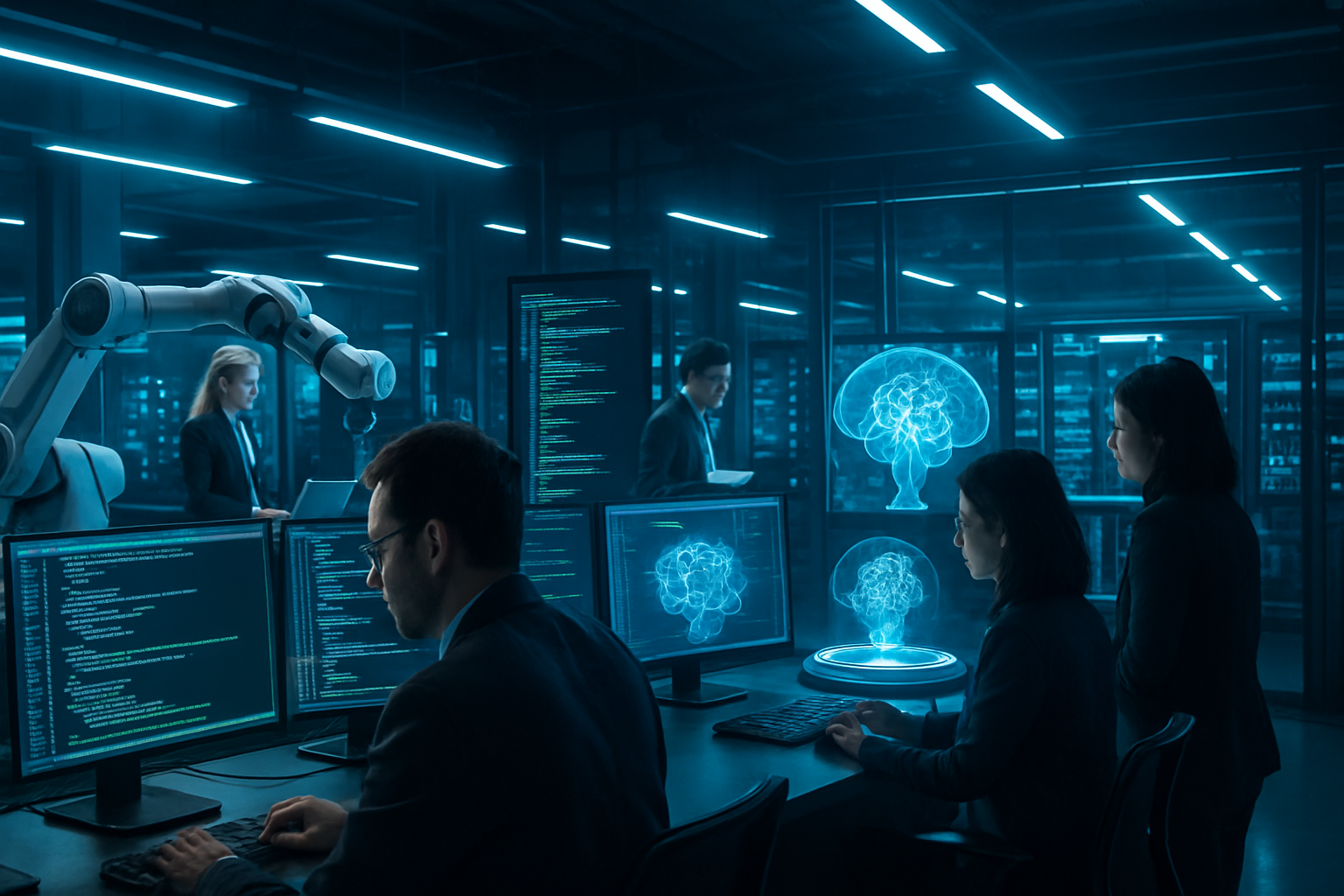
The artificial intelligence industry has reached a critical inflection point in February 2026, marked by escalating competition between OpenAI and Chinese rival DeepSeek, widespread military adoption of AI systems, and mounting infrastructure challenges that threaten to reshape the global technology landscape.
OpenAI Confronts Chinese Challenge
OpenAI has formally accused Chinese startup DeepSeek of "consistent attempts" to copy and distill its AI models through circumventing access restrictions, according to a letter to the U.S. Congress. The allegations represent the latest escalation in the intensifying technological rivalry between American and Chinese AI companies, with DeepSeek's breakthrough achievements challenging long-held assumptions about U.S. dominance in artificial intelligence.
The controversy comes as DeepSeek has achieved remarkable progress in AI development, triggering what analysts have termed the "SaaSpocalypse" - massive market volatility that has erased hundreds of billions in technology stock valuations. Indian IT giants including Infosys, Wipro, and HCL Technologies saw 6% declines, while the Nasdaq experienced a 1.4% drop, eliminating approximately $300 billion in market capitalization.
"This represents the most significant challenge to U.S. technological leadership in the AI sector since the race began."
— Technology Industry Analyst
Military AI Integration Accelerates Globally
The Pentagon has begun integrating Anthropic's Claude AI system into military operations, including reports of its use in the capture of Nicolás Maduro, despite the company's terms of service prohibiting use in violence or surveillance applications. This development highlights the expanding role of AI in defense operations worldwide, as the U.S. Department of Defense actively pursues partnerships with leading AI companies to incorporate their tools into classified military networks.
Ukrainian forces have deployed AI-enhanced drone systems with improved vision capabilities for low-light operations, while multiple nations participate in discussions about AI warfare governance. However, significant divisions remain, with the United States and China abstaining from comprehensive commitments to international AI weapons control frameworks.
Infrastructure Crisis Threatens Development
A global memory semiconductor shortage has created severe bottlenecks for AI development, with prices surging sixfold and affecting major manufacturers including Samsung, SK Hynix, and Micron. These companies are operating at full capacity but cannot meet the explosive demand from AI development projects. The crisis has increased consumer electronics costs by 20-30% and is expected to persist until new fabrication facilities come online in 2027.
The infrastructure challenges are compounded by environmental concerns, with the World Bank projecting that AI water demand could reach 4.2-6.6 billion cubic meters annually by 2027 - equivalent to four to six times Denmark's total water withdrawal - primarily for data center cooling requirements.
Regulatory Response Intensifies
European authorities have escalated their oversight of AI platforms, with Spain implementing the world's first criminal executive liability framework for social media platform violations. France has conducted cybercrime raids on AI platforms, while the United Nations has established an Independent International Scientific Panel on Artificial Intelligence comprising 40 experts, marking the first fully independent global body for AI impact assessment.
These regulatory developments occur amid growing concerns about AI safety and social impact. Swedish researchers have warned about AI's capability to distort reality and influence human decision-making, while Slovak scientists have identified a potential generational critical thinking crisis as AI becomes ubiquitous.
Applications Across Sectors
Despite challenges, successful AI integration models are emerging across various sectors. Canadian universities have implemented AI teaching assistants while maintaining critical thinking standards, and Malaysia has opened the world's first AI-integrated Islamic school, combining artificial intelligence with traditional religious and academic learning.
In the creative sector, Chinese companies have made significant advances in AI-powered content generation. ByteDance's Seedance 2.0 has created viral video content, including celebrity deepfakes that have prompted copyright concerns from the Motion Picture Association. Finland and Sweden are considering AI-generated music integration in their radio industries.
Investment and Market Dynamics
Major technology companies continue massive AI investments despite market volatility. Alphabet has committed $180 billion to AI infrastructure in 2026, representing the largest single-year technology investment in corporate history, while Amazon has announced development plans exceeding $1 trillion. SoftBank Group reported $19.8 billion in investment gains from OpenAI, validating its AI investment strategy.
However, the market remains volatile, with the "SaaSpocalypse" phenomenon demonstrating how AI capabilities can rapidly threaten traditional software business models. German analysts have described it as an "apocalypse for software houses," with traditional software companies experiencing 20% stock declines.
Global Competition and Sovereignty
The AI landscape has evolved from U.S.-centric development to a multipolar competitive environment. European initiatives include Deutsche Telekom's Industrial AI Cloud in Munich, representing regional technological sovereignty efforts. China has established multiple AI research programs and computing centers, while other nations pursue strategic partnerships to avoid dependence on dominant platforms.
Singapore has positioned itself as an AI hub with comprehensive budget measures including business tax incentives and free public AI tool access. India is preparing to host the first major Global South AI summit in February, featuring leaders from Google, OpenAI, and Nvidia.
Looking Ahead
The convergence of technological breakthroughs, infrastructure constraints, regulatory pressures, and geopolitical competition has created what many observers consider the most critical moment in the AI revolution since its inception. Success in navigating these challenges will require unprecedented coordination between innovation and safety governance, international cooperation on regulatory frameworks, and sustainable business models that prioritize human welfare alongside technological advancement.
The decisions made in 2026 regarding AI development, regulation, and international cooperation will likely determine whether artificial intelligence fulfills its transformative promise for humanity or creates systemic risks requiring dramatic corrections. As the industry transitions from experimental applications to essential infrastructure, the balance between innovation acceleration and responsible development remains precarious but essential for the technology's long-term success and societal acceptance.