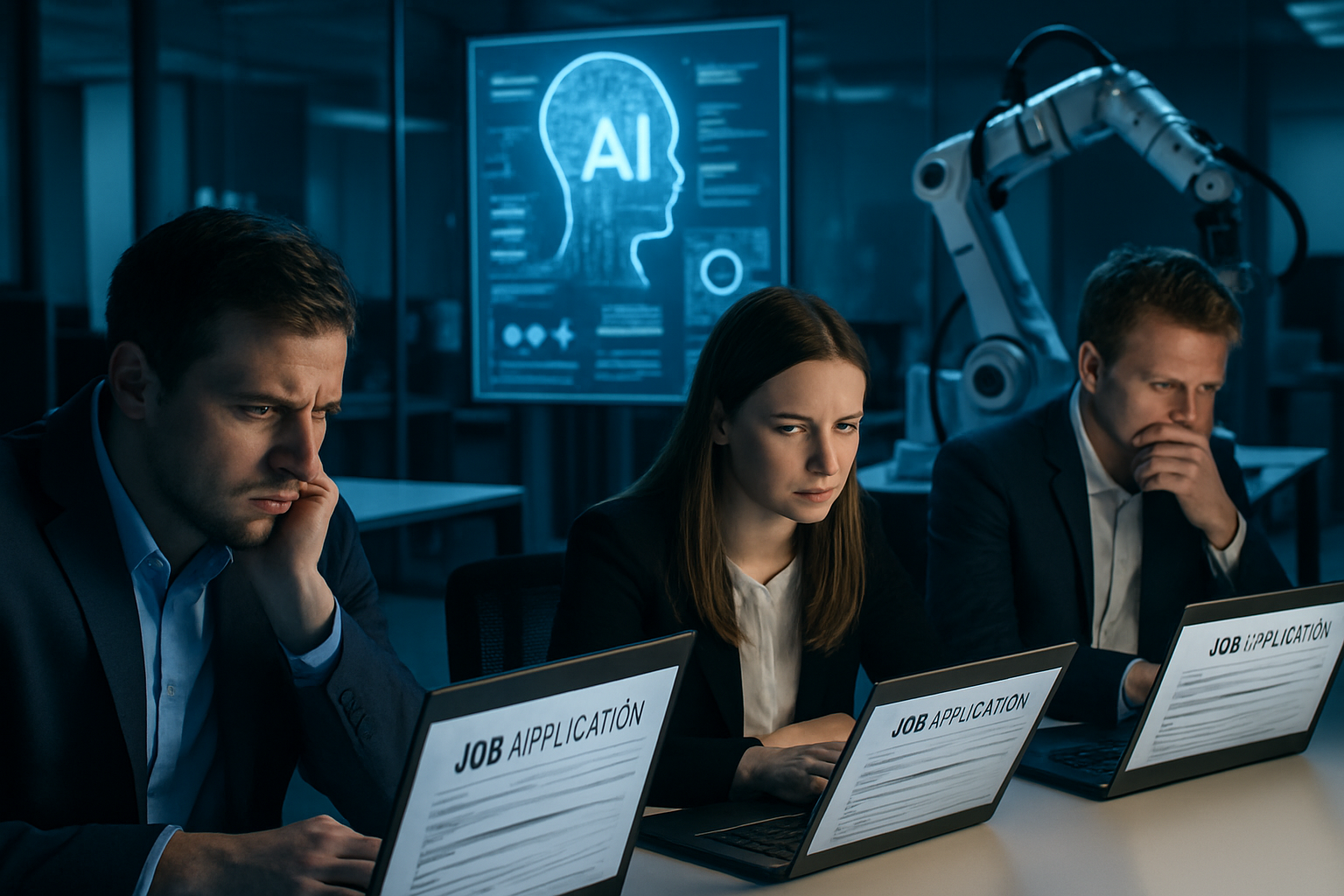
Artificial intelligence is rapidly displacing entry-level employment opportunities across the globe, creating an unprecedented crisis for young workers entering the job market as corporations increasingly adopt AI-native business models that fundamentally reshape traditional workplace hierarchies.
Entry-level and graduate positions have reached their lowest levels in a decade according to Australian employment data, spurring widespread concerns about AI's impact on young workers' career development. The displacement phenomenon extends far beyond individual companies to represent a systemic transformation of how businesses operate in an AI-enhanced economy.
Corporate AI Adoption Accelerates Displacement
Major corporations across multiple sectors are implementing sweeping AI-driven restructuring that explicitly targets traditional entry-level roles. Life360 CEO Lauren Antonoff announced an "AI-native restructuring" that eliminates conventional positions, stating that "the roles people play are shifting" as companies embrace artificial intelligence as core business infrastructure.
This transformation represents an acceleration of trends documented since early 2026, when Block Inc. made headlines by eliminating 4,000 positions—representing 40% of its global workforce—in what became the first major corporate layoff explicitly attributed to AI advancement rather than financial pressures. CEO Jack Dorsey's statement that "AI tools we create and use, combined with smaller, more agile teams, enable a new way of working" established a template that other companies are now following.
"The roles people play are shifting as we transition to AI-native operations that require fewer traditional entry-level positions."
— Lauren Antonoff, Life360 CEO
The pattern has spread across industries, with technology companies leading the charge. Meta is preparing layoffs affecting potentially 20% or more of its workforce, while marketing agencies increasingly rely on AI-powered automation tools for content scheduling, competitor analysis, and engagement monitoring—functions previously handled by junior staff.
Youth Employment Crisis Reaches Critical Levels
The AI displacement of entry-level jobs has created a perfect storm for young workers already facing challenging economic conditions. In the UK, nearly 957,000 young people aged 16-24 are classified as NEET (Not in Employment, Education, or Training), representing 12.8% of the workforce and marking the second-highest level in over a decade.
Similar patterns emerge globally. In New Zealand, Student Job Search received 38,000 applications in January 2026 competing for only 4,600 available positions—a crushing 8-to-1 ratio that forces students to "juggle multiple jobs" just to survive financially while pursuing education.
The situation has created what experts describe as "ghost jobs"—fictitious job postings that serve corporate purposes including growth appearances, candidate database building, and regulatory compliance, but without genuine hiring intentions. These phantom opportunities make it even more difficult for young job seekers to identify legitimate employment prospects.
Case Studies of Young Worker Struggles
Individual stories illustrate the broader crisis. Trina Lau, a 23-year-old communications graduate in Hong Kong, lost her first job after six months and spent three months submitting over 50 applications, receiving only six interview calls. Her experience reflects millions of young professionals worldwide who face AI-enhanced screening systems that often fail to accurately assess qualifications while advancing unqualified candidates.
The "SaaSpocalypse" and Market Disruption
The employment crisis coincides with what industry experts term the "SaaSpocalypse"—the elimination of hundreds of billions in traditional software market capitalization as AI systems demonstrate direct replacement capabilities for conventional solutions. This fundamental shift from software-as-a-service to AI-based alternatives is reshaping entire business ecosystems.
Microsoft's Mustafa Suleyman has predicted that AI could replace the majority of office workers within two years, with lawyers and auditors facing displacement within 18 months. These predictions, once considered alarmist, are gaining credibility as companies demonstrate the practical implementation of AI systems that can handle complex cognitive tasks previously requiring human expertise.
Regional Variations in Response Strategies
Despite the global nature of AI-driven displacement, regional approaches to workforce transformation vary significantly. Western companies typically pursue traditional layoff strategies followed by selective AI hiring, while Asian corporations are implementing comprehensive worker transition programs that emphasize reskilling over displacement.
India's IT giants—including Infosys, Wipro, and HCL Technologies—have developed successful worker evolution programs that focus on adaptation rather than elimination. These companies demonstrate that proactive workforce transformation management can achieve productivity gains while preserving employment relationships.
China has taken a particularly strategic approach, with companies like Unitree Robotics scaling humanoid robot production from 5,500 to 20,000+ units in 2026 while creating employment opportunities even as automation displaces workers elsewhere. This demonstrates that AI adoption doesn't necessarily require wholesale job elimination if managed thoughtfully.
Success Models for Human-AI Collaboration
While many organizations pursue replacement strategies, several successful models demonstrate how AI can enhance rather than eliminate human capabilities. Canadian universities have implemented AI teaching assistants that maintain critical thinking standards while providing personalized support to students.
Malaysia pioneered the world's first AI-integrated Islamic school, achieving a remarkable 97.82% teacher placement rate while combining artificial intelligence with traditional religious and academic learning. Similarly, Singapore's WonderBot 2.0 heritage education system and various corporate implementations show that human-centered approaches consistently outperform wholesale automation strategies.
"Digital adaptability is paramount—not just technical proficiency, but continuous learning capability for technological tool evolution."
— Catherine Fisher, LinkedIn Career Expert
The Productivity Paradox
Research by German scholar Dr. Frank Bäumer has revealed a troubling "productivity paradox" where AI implementation often creates more work and declining efficiency rather than the promised gains. Workers report experiencing a "double workload effect"—performing their original responsibilities while also supervising and correcting AI outputs.
This paradox suggests that successful AI integration requires comprehensive change management, worker training, and workflow redesign rather than simply adding AI tools to existing processes. Organizations that rush AI deployment without proper planning often experience efficiency losses rather than gains.
Infrastructure Constraints Provide Adaptation Buffer
Paradoxically, the global semiconductor crisis has created an unexpected buffer against rapid AI deployment. Memory chip prices have surged sixfold, affecting major manufacturers like Samsung, SK Hynix, and Micron, with shortages expected to continue until 2027 when new fabrication facilities come online.
These constraints are forcing companies to develop more selective AI deployment strategies rather than comprehensive automation, inadvertently providing crucial time for workforce adaptation. The crisis is also driving innovation in memory-efficient algorithms and hybrid approaches that could ultimately democratize AI access for smaller organizations.
Regulatory Response and International Coordination
Governments worldwide are responding to the AI employment crisis with unprecedented regulatory coordination. Spain has implemented the world's first criminal executive liability framework for technology platforms, creating potential imprisonment risks for executives whose AI systems cause societal harm.
France has conducted AI company cybercrime raids, while the United Nations has established an Independent Scientific Panel with 40 experts—the first fully independent international AI assessment body. This coordinated approach represents the most sophisticated global technology governance effort since the commercialization of the internet.
Skills Transformation Requirements
Career experts emphasize that surviving the AI transformation requires developing hybrid competencies that span multiple domains. Essential skills for 2026 and beyond include AI collaboration capabilities, data interpretation, emotional intelligence, creative problem-solving, and cultural competency.
Catherine Fisher, LinkedIn's career expert, identifies digital adaptability as paramount—not just technical proficiency, but the continuous learning capability needed to evolve with technological tools. The future workforce will require professionals who can effectively collaborate with AI systems while preserving uniquely human capabilities that artificial intelligence cannot replicate.
Critical Choices Ahead
Industry experts characterize 2026 as a "civilizational choice point" that will determine whether AI serves human flourishing or becomes an exploitation tool beyond democratic accountability. The decisions made in the coming months will establish human-AI relationship patterns that could persist for decades.
Success requires unprecedented coordination between governments, technology companies, educational institutions, and civil society. The challenge involves balancing innovation acceleration with responsible governance, commercial interests with human welfare, and national competitiveness with international cooperation.
The window for coordinated action is narrowing rapidly as AI capabilities advance faster than governance frameworks can adapt. Countries and organizations that implement comprehensive approaches—including infrastructure investment, educational reform, and systematic retraining programs—are showing greater resilience in managing this transformation.
The Path Forward
The most promising path forward lies in sophisticated human-AI collaboration that amplifies human capabilities while preserving creativity, cultural understanding, and ethical reasoning that define human potential. This requires treating AI as sophisticated amplification tools serving human goals rather than wholesale replacement mechanisms.
Prevention-first approaches demonstrate superior economic outcomes through reduced crisis intervention costs, improved workforce productivity, and enhanced international competitiveness. The key is ensuring that technological advancement serves broad social benefit rather than primarily advantaging capital over labor.
As the AI revolution accelerates, the fundamental question remains whether this technological transformation will enhance human potential or undermine the foundations of meaningful work and authentic human experience. The answer will largely depend on the choices made by leaders, policymakers, and society at large during this critical inflection point in human-AI relationships.