Artificial intelligence is experiencing a transformative moment in March 2026, as groundbreaking research achieves unprecedented miniaturization of AI systems while educational institutions worldwide grapple with establishing comprehensive frameworks for responsible AI integration in academic settings.
Two major developments are simultaneously reshaping the AI landscape: scientists have successfully created pocket-sized AI systems using insights from monkey neurons, while universities and businesses continue to navigate the complex challenge of integrating AI tools into their operations three years after ChatGPT's debut.
Scientists Achieve AI Miniaturization Breakthrough
Researchers have accomplished a remarkable feat in artificial intelligence development by creating AI vision models that are 1/1000th the size of their original counterparts. This groundbreaking achievement, utilizing data derived from macaque monkey research, represents a significant leap forward in making AI systems more efficient and accessible.
The miniaturization breakthrough addresses one of AI's most pressing challenges: computational efficiency. Traditional AI models require massive amounts of processing power and memory, limiting their deployment in resource-constrained environments. By studying how biological neural networks process visual information with remarkable efficiency, scientists have developed techniques to dramatically reduce AI model sizes while maintaining performance.
"This research demonstrates that AI systems could be significantly more efficient than current implementations,"
— Lead Research Team, Nature Study
The implications extend far beyond technical achievement. Smaller, more efficient AI models could enable widespread deployment of artificial intelligence in mobile devices, embedded systems, and environments where computational resources are limited. This development occurs during a global semiconductor shortage that has driven memory chip prices up sixfold, making efficient AI architectures increasingly valuable.
Educational Institutions Navigate AI Integration Challenges
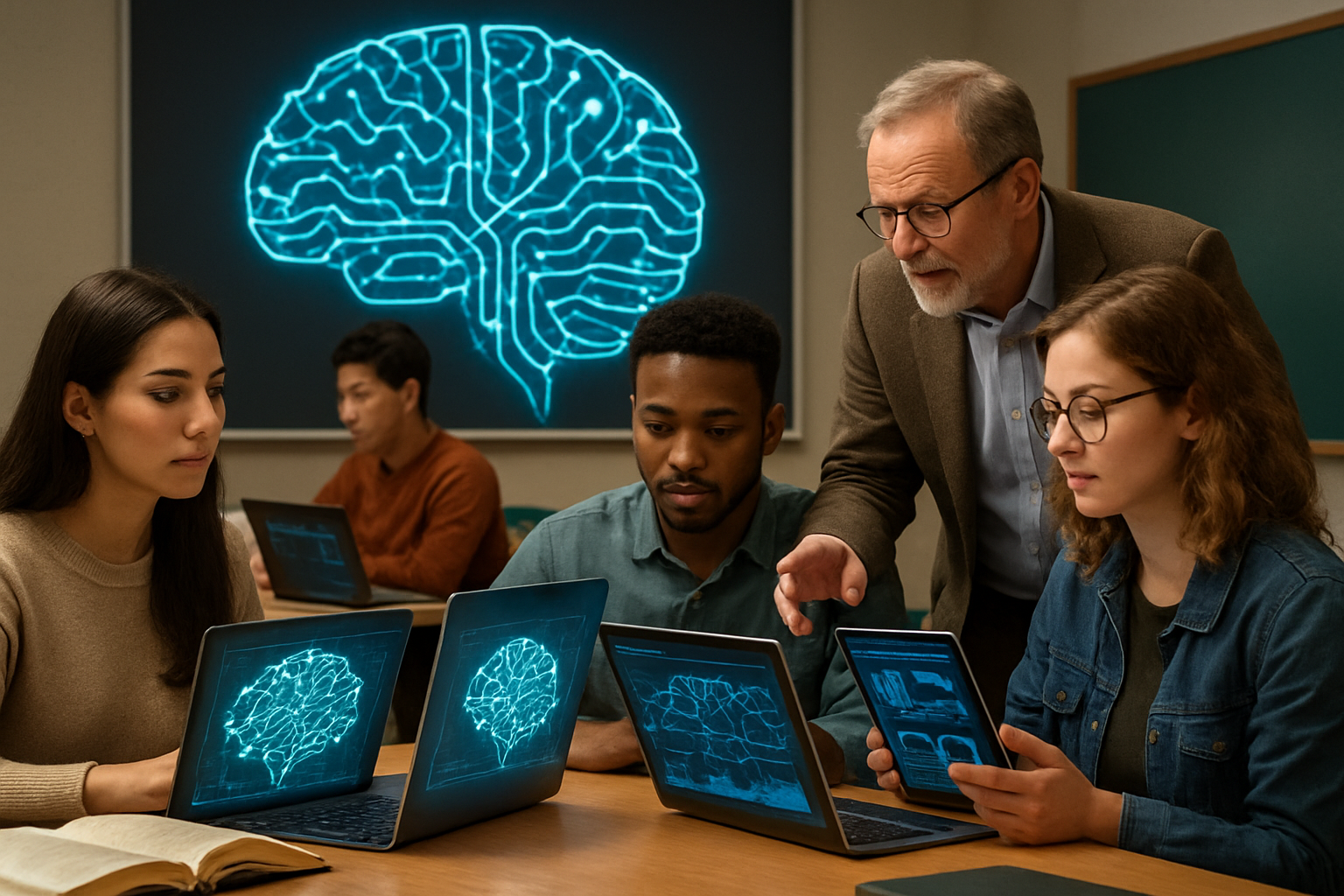
While technical breakthroughs continue, educational institutions face the complex reality of integrating AI into academic life. More than three years after ChatGPT's introduction, professors and students are still establishing guidelines for appropriate AI usage in educational settings.
The challenge reflects a broader tension between embracing technological innovation and maintaining academic integrity. Universities worldwide are discovering that blanket prohibitions prove ineffective, while unrestricted access raises concerns about authentic learning and assessment validity.
The Global Educational Technology Renaissance
Educational institutions are experiencing what experts term the "2026 Educational Technology Renaissance" – a coordinated international movement toward thoughtful digital tool integration with traditional educational values. This approach emphasizes enhancement rather than replacement of fundamental human relationships in learning.
Several successful models have emerged globally:
- Malaysia operates the world's first AI-integrated Islamic school, combining artificial intelligence with traditional religious and academic learning
- Canadian universities have successfully implemented AI teaching assistants while maintaining critical thinking standards
- Singapore's WonderBot 2.0 demonstrates effective conversational AI for heritage education
- European institutions are developing comprehensive AI literacy programs for both faculty and students
These implementations share common success factors: sustained institutional commitment, comprehensive teacher training, clear pedagogical objectives, and cultural sensitivity in adaptation approaches.
Business Applications Transform Commercial Operations
The business sector is simultaneously experiencing profound AI-driven transformation. Organizations across industries are implementing AI solutions for customer service automation, predictive analytics, supply chain optimization, and strategic decision-making processes.
Recent developments show AI transitioning from experimental applications to essential business infrastructure. Companies are discovering that successful AI adoption requires comprehensive training programs, governance frameworks, and gradual implementation strategies that allow organizational adaptation.
Economic Implications and Market Disruption
The widespread adoption of AI is creating what analysts call the "SaaSpocalypse" – the elimination of hundreds of billions in traditional software market capitalization as AI systems replace conventional business solutions. This disruption particularly affects legal technology, document analysis, and routine administrative functions.
However, successful companies are adapting through employee transition programs rather than mass layoffs. Indian IT giants including Infosys, Wipro, and HCL Technologies are leading this approach, retraining workers for AI-enhanced roles that combine human judgment with artificial intelligence capabilities.
Infrastructure Challenges and Global Coordination
Both educational and business AI adoption face significant infrastructure constraints. The global memory semiconductor shortage, with prices increasing sixfold and affecting major manufacturers including Samsung, SK Hynix, and Micron, is creating bottlenecks expected to persist until 2027 when new fabrication facilities come online.
These constraints are paradoxically driving innovation in efficient AI deployment. Organizations are developing memory-efficient algorithms, hybrid approaches combining AI with traditional methods, and cloud-based solutions that optimize resource utilization.
International Regulatory Framework Development
Governments worldwide are establishing comprehensive AI governance frameworks. The United Nations has created an Independent International Scientific Panel with 40 global experts to provide the first fully independent AI impact assessment. European authorities are implementing unprecedented oversight measures, including criminal executive liability frameworks and coordinated enforcement actions.
This regulatory intensification reflects growing recognition that AI governance requires international cooperation and coordinated approaches balancing innovation with social responsibility.
Looking Forward: Human-AI Collaboration Models
The most successful AI implementations in both education and business emphasize human-AI collaboration rather than replacement. These models treat artificial intelligence as sophisticated tools that amplify human capabilities while preserving essential human elements like creativity, critical thinking, emotional intelligence, and cultural understanding.
In educational contexts, this means using AI to enhance personalized learning, automate administrative tasks, and provide intelligent tutoring while maintaining the irreplaceable value of human mentorship and social interaction in the learning process.
For businesses, successful AI integration involves augmenting human decision-making with data-driven insights, automating routine processes to free human workers for higher-value activities, and creating new roles that combine technical AI proficiency with uniquely human skills.
The Path Ahead
March 2026 represents a critical inflection point in AI development and adoption. The combination of technical breakthroughs like pocket-sized neural networks and systematic institutional adaptation in education and business is creating a foundation for sustainable AI integration across society.
Success in this transformation requires unprecedented coordination between governments, technology companies, educational institutions, and civil society organizations. The challenge lies in harnessing AI's transformative potential while preserving human agency, creativity, and the fundamental relationships that define authentic learning and meaningful work.
As artificial intelligence continues evolving from experimental technology to essential infrastructure, the decisions made in 2026 will significantly influence whether AI fulfills its promise of enhancing human capabilities or creates systemic disruptions requiring dramatic corrections.
The evidence from successful implementations across education and business suggests that thoughtful, human-centered approaches to AI integration offer the most sustainable path forward – one that leverages technological advancement while preserving the creativity, empathy, and wisdom that define human potential.