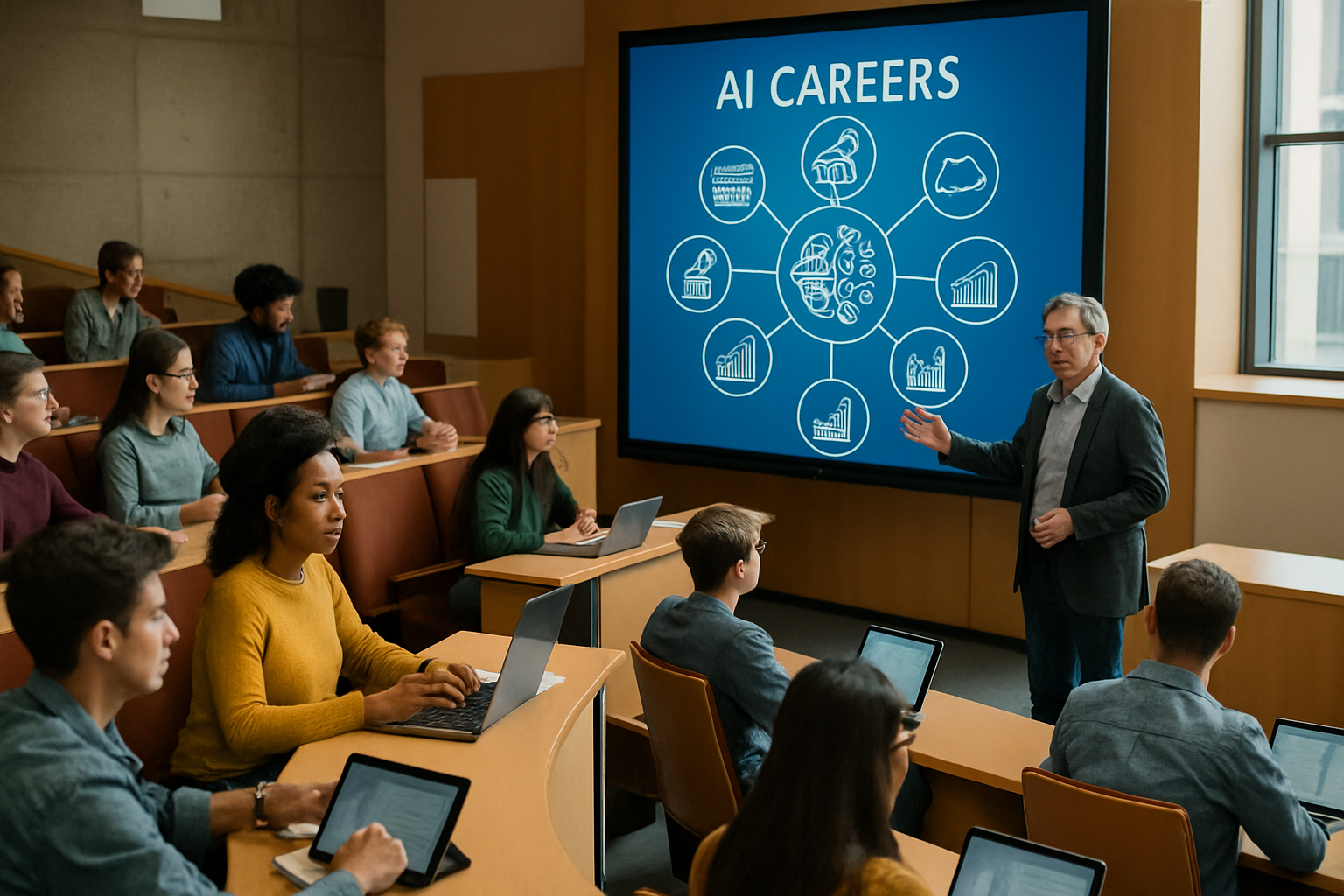
As artificial intelligence continues its unprecedented disruption across industries, a critical question emerges from universities and colleges worldwide: which degrees will survive the AI revolution, and how should educational institutions prepare students for a future where human-AI collaboration becomes the norm rather than the exception?
Recent developments from Australia and the United States reveal a complex landscape where traditional academic pathways are being challenged by technological advancement, while innovative educational approaches are emerging to address the changing needs of the modern workforce.
The Great Educational Reckoning
Australia's Sydney Morning Herald has identified a crucial inflection point in higher education, emphasizing that selecting degrees capable of withstanding AI disruption has become "increasingly important" for student success. This mirrors similar concerns expressed by educators across the globe as artificial intelligence demonstrates capabilities once thought to be exclusively human domains.
The urgency of this transformation is underscored by findings from Columbia University, where freshman Maximilian Milovidov's experience in an "AI writing" course represents a new frontier in academic curriculum. Rather than prohibiting AI use, Columbia's approach emphasizes critical engagement with these tools, teaching students to harness artificial intelligence capabilities while maintaining academic integrity and human creativity.
"Instead of banning AI, why don't schools teach students to use it critically?"
— Columbia University Student Perspective
Global Educational Technology Renaissance
The developments in Australia and the United States are part of what educational analysts are calling the "2026 Educational Technology Renaissance" – a coordinated international movement toward thoughtful digital integration with traditional educational values. This transformation extends far beyond simple technology adoption, representing a fundamental reimagining of what constitutes effective preparation for the modern workforce.
Malaysia has pioneered the world's first AI-integrated Islamic school, combining artificial intelligence with traditional religious and academic learning. This groundbreaking approach demonstrates how educational institutions can embrace technological advancement while preserving cultural authenticity and core educational principles.
Similarly, Singapore's WonderBot 2.0 heritage education program and Canadian universities' implementation of AI teaching assistants show how artificial intelligence can enhance rather than replace fundamental human capabilities in learning environments. These successful models share common characteristics: sustained political commitment, comprehensive stakeholder engagement, and a focus on using AI as an amplification tool serving educational goals rather than an end in itself.
The Productivity Paradox Challenge
However, the integration of AI into education and careers is not without complications. German research by Dr. Frank Bäumer has documented a "productivity paradox" where AI implementation often creates "mehr Arbeit und nachlassender Effizienz" (more work and declining efficiency) rather than the promised gains.
This phenomenon, described as a "double workload effect," occurs when students and workers must perform their original responsibilities while also supervising and correcting AI outputs. The challenge highlights the critical importance of proper implementation strategies that prioritize human-AI collaboration over wholesale technological replacement.
Degrees and Careers That Will Thrive
Based on global analysis of employment trends and educational reforms, several degree categories are positioning themselves as AI-resistant or AI-enhanced:
Human-Centered Professions
- Healthcare and Medicine: While AI assists with diagnostics and treatment planning, human empathy, complex decision-making, and patient care remain irreplaceable.
- Education and Training: Teachers who can effectively integrate AI tools while maintaining critical thinking and human connection will be in high demand.
- Social Work and Counseling: Emotional intelligence and human relationship skills cannot be replicated by artificial systems.
Creative and Strategic Fields
- Creative Arts and Design: AI tools enhance creative capabilities but cannot replace human imagination and cultural understanding.
- Strategic Management: Complex business strategy requires human judgment, cultural awareness, and ethical decision-making.
- Research and Development: Innovation requires human curiosity, critical thinking, and the ability to ask the right questions.
Technical Integration Specialists
- AI Engineering and Ethics: Professionals who can develop, implement, and govern AI systems responsibly.
- Human-Computer Interaction: Specialists who design interfaces between human needs and technological capabilities.
- Data Analysis and Interpretation: Experts who can translate AI-generated insights into human-understandable recommendations.
Infrastructure and Implementation Challenges
The global transition to AI-integrated education faces significant infrastructure constraints. A worldwide semiconductor crisis has driven memory chip prices up sixfold, affecting companies like Samsung, SK Hynix, and Micron until 2027. This shortage creates bottlenecks for AI-powered educational systems while simultaneously forcing institutions to develop more efficient, thoughtful deployment strategies.
Despite these constraints, massive investments continue. Alphabet has committed $185 billion to AI infrastructure in 2026, while Amazon has announced over $1 trillion in development plans. These investments signal that the AI transformation of education and careers is not a temporary trend but a permanent shift requiring strategic adaptation.
International Regulatory Framework Evolution
The educational AI revolution is occurring alongside unprecedented regulatory development. Spain has implemented the world's first criminal executive liability framework for tech platforms, while France has conducted cybercrime enforcement actions against AI companies. The United Nations has established an Independent Scientific Panel with 40 experts under Secretary-General António Guterres, representing the first fully independent global AI assessment body.
These regulatory developments indicate that successful AI integration in education will require not just technological capability but also ethical frameworks, transparency measures, and democratic oversight ensuring that artificial intelligence serves human flourishing rather than replacing human agency.
Success Models and Best Practices
The most successful AI integration examples prioritize human-centered approaches. Canadian AI teaching assistants maintain critical thinking standards while providing enhanced learning support. Malaysia's AI-integrated educational model preserves traditional values while embracing technological advancement. Singapore's heritage education program demonstrates how AI can amplify cultural understanding rather than diminish it.
"The future lies in sophisticated human-AI collaboration rather than replacement scenarios."
— Educational Technology Analysis, 2026
These models share key success factors:
- Clear pedagogical objectives ensuring technology serves educational goals
- Comprehensive teacher training and professional development
- Cultural sensitivity and community engagement
- Balance between innovation and preservation of human relationships
- Sustained political and institutional commitment
Employment Transformation Timeline
Industry predictions suggest rapid transformation ahead. Microsoft's Mustafa Suleyman forecasts that AI could replace the majority of office workers within two years, with lawyers and auditors facing replacement within 18 months. However, regional variations show different approaches: while Western companies often implement mass layoffs, Asian firms like India's major IT companies (Infosys, Wipro, HCL) are successfully managing transitions through comprehensive retraining programs.
The "SaaSpocalypse" phenomenon has already eliminated hundreds of billions in traditional software market capitalization as AI systems demonstrate direct replacement capabilities for conventional solutions. This market disruption provides a preview of broader employment transformation across sectors.
Critical Skills for the AI Era
Career experts emphasize that digital adaptability has become the paramount skill for professional success – not just technical proficiency, but the continuous learning capability required to evolve with technological tools. Key competency categories include:
Technical Skills
- AI collaboration and prompt engineering
- Data interpretation and analysis
- Digital communication and cybersecurity awareness
Human-Centered Skills
- Emotional intelligence and empathy
- Critical thinking and creative problem-solving
- Cultural competency for global work environments
Hybrid Competencies
- Complex project management combining human and AI capabilities
- Ethical technology deployment and governance
- Cross-disciplinary integration and systems thinking
The Path Forward
The evidence suggests that effective preparation for the AI era requires educational transformation that thoughtfully integrates technological tools while preserving essential human capabilities. Success depends on choosing educational paths that enhance rather than compete with artificial intelligence capabilities.
Degrees and careers that will thrive combine technical competence with uniquely human abilities: creativity, empathy, cultural understanding, ethical reasoning, and complex relationship management. The future belongs not to those who can outcompete AI systems, but to those who can collaborate effectively with artificial intelligence while maintaining the distinctly human qualities that provide meaning, connection, and wisdom.
As we navigate this unprecedented transformation, the critical insight emerges that educational success requires balance – embracing technological advancement while preserving human development, global competitiveness while maintaining local identity, innovation while respecting cultural authenticity. The institutions and individuals who master this balance will not merely survive the AI revolution but will lead it toward outcomes that serve human flourishing.
The window for proactive adaptation is narrowing rapidly as AI development accelerates. The choices made in educational policy, curriculum development, and career preparation today will determine whether artificial intelligence becomes a tool for human empowerment or a source of widespread displacement. The evidence from successful international models suggests that with thoughtful implementation, the former outcome remains not only possible but probable.