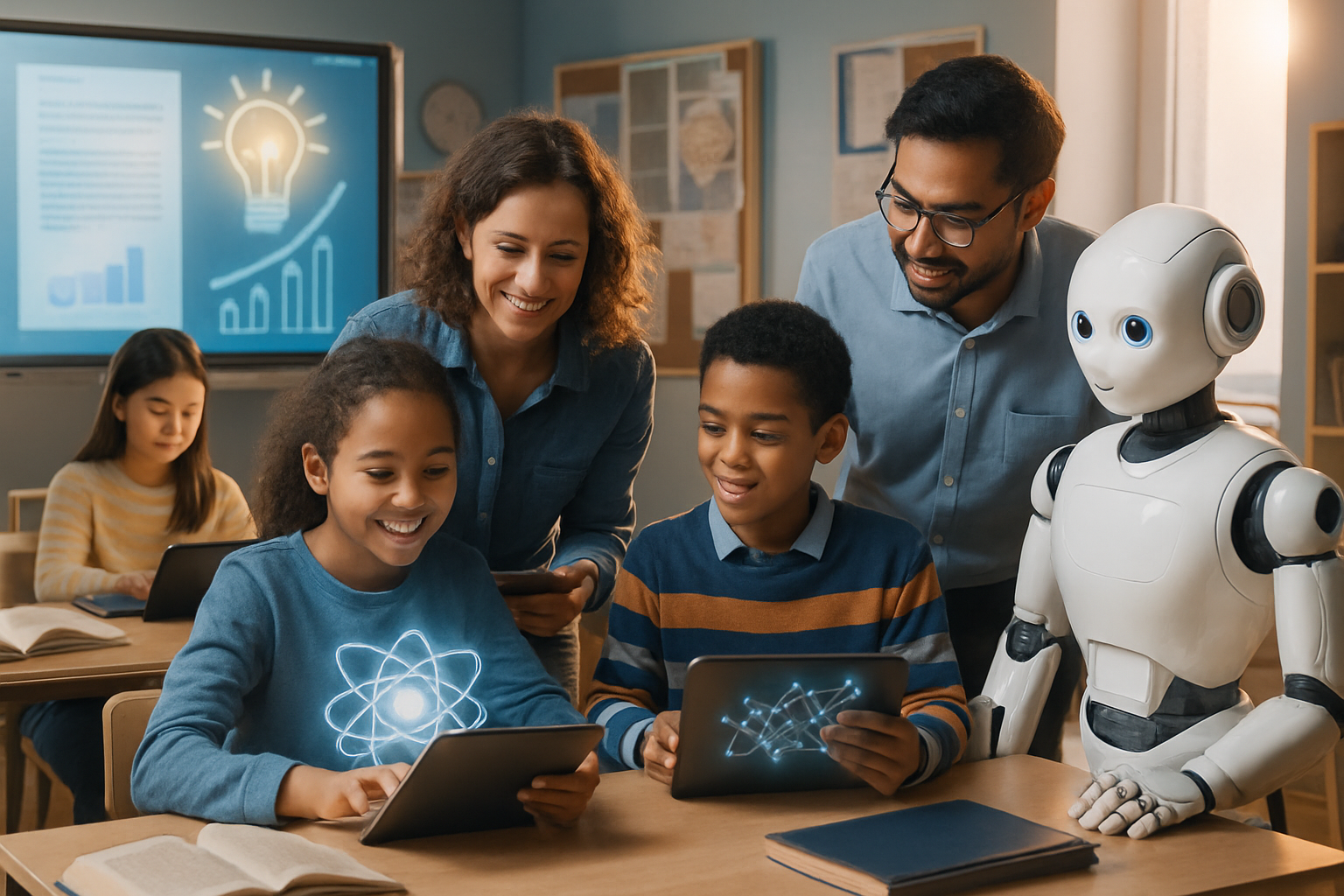
March 2026 represents a pivotal moment in global artificial intelligence development, as educational institutions worldwide integrate AI technologies while China's comprehensive strategy challenges US technological dominance through a powerful combination of open-source models and manufacturing expertise.
China's Strategic AI Advantage Emerges
A groundbreaking US congressional advisory report reveals that China's approach to artificial intelligence development has evolved into a "mutually reinforcing feedback loop" that poses the most serious long-term challenge to American AI leadership. According to the United States-China Economic and Security Review Commission, China's strategy combines two powerful elements: promoting open artificial intelligence models and leveraging manufacturing dominance.
"It is the intersection of these two loops – one digital, one physical – that gives China's open strategy its compounding force and poses the most serious long-term challenge to US AI leadership," the report states. This comprehensive approach represents a fundamental shift from competing directly with Western models to creating entirely new development frameworks.
Educational AI Integration Accelerates Globally
Meanwhile, educational systems across the globe are experiencing unprecedented transformation. Italy has announced sweeping changes to its national curriculum, introducing artificial intelligence alongside traditional subjects while maintaining "centrality of the Western" approach in history education. The reforms include the integration of graphic novels and scripts in Italian, while philosophy moves away from purely historical approaches.
This transformation is part of what experts are calling the "2026 Educational Technology Renaissance" – a coordinated global shift toward thoughtful digital tool integration that enhances rather than replaces fundamental educational relationships.

Sweden Shows Mixed AI Adoption Patterns
Swedish data reveals the complex nature of AI adoption, with increasing numbers of citizens using AI chatbots weekly while simultaneously expressing growing concerns about AI-generated disinformation ahead of elections. This pattern reflects a broader global trend where enthusiasm for AI capabilities coexists with legitimate concerns about potential misuse.
The Swedish experience highlights a critical challenge facing governments worldwide: how to harness AI's benefits while mitigating risks to democratic processes and social cohesion.
Infrastructure Challenges Drive Innovation
Despite these advances, the global technology sector faces significant constraints. The ongoing memory semiconductor crisis has driven chip prices to increase sixfold, affecting major manufacturers including Samsung, SK Hynix, and Micron. These shortages are expected to persist until 2027 when new fabrication facilities come online.
Paradoxically, these constraints are spurring innovation in memory-efficient algorithms and sustainable deployment strategies, potentially democratizing AI access by forcing developers to create more efficient solutions.
"The semiconductor shortage is actually driving more thoughtful, sustainable AI deployment versus resource-intensive implementations."
— Industry Analysis Report, March 2026
Successful Human-AI Collaboration Models
Several nations have emerged as leaders in demonstrating effective AI integration that enhances rather than replaces human capabilities. Canada has successfully implemented AI teaching assistants in universities while maintaining critical thinking standards. Malaysia operates the world's first AI-integrated Islamic school, combining artificial intelligence with traditional religious and academic learning.
Singapore's WonderBot 2.0 conversational AI system for heritage education has gained international recognition for its culturally sensitive approach to technology integration. These success stories share common characteristics: AI serves as an amplification tool for human capabilities rather than a replacement mechanism.
Employment and Economic Implications
The economic implications of AI integration are profound and varied. The "SaaSpocalypse" – the elimination of hundreds of billions in traditional software market capitalization – demonstrates AI's direct replacement capabilities for conventional solutions. Microsoft's Mustafa Suleyman predicts that AI will replace the majority of office workers within two years, with lawyers and auditors following within 18 months.
However, regional variations in response strategies are emerging. While Western companies often pursue traditional layoff strategies, Asian corporations are implementing comprehensive worker transition programs that emphasize reskilling over displacement.
Regulatory Frameworks Take Shape
Governments worldwide are responding with increasingly sophisticated regulatory approaches. Spain has implemented the world's first criminal executive liability framework for tech platforms, creating imprisonment risks for executives. France has escalated enforcement through cybercrime raids on AI companies, while the European Commission investigates potential billion-dollar Digital Services Act penalties.
The United Nations has established an Independent International Scientific Panel with 40 experts under Secretary-General António Guterres, representing the first fully independent global AI assessment body. This coordinated international response represents the most sophisticated global technology governance effort since internet commercialization.
Investment Surge Despite Constraints
Despite infrastructure challenges, massive investments continue to flow into AI development. Alphabet has committed $185 billion to AI infrastructure in 2026 – the largest single-year corporate technology investment in history. Amazon has announced over $1 trillion in AI development plans extending through the decade.
The World Bank projects that AI will require 4.2-6.6 billion cubic meters of water annually by 2027 for data center cooling – equivalent to 4-6 times Denmark's total annual water consumption. This environmental challenge is driving unprecedented investment in renewable energy and efficient computing architectures.
A Critical Civilizational Choice Point
Industry experts characterize March 2026 as a critical juncture that will determine whether AI serves human flourishing or becomes a tool for exploitation and control. The decisions made regarding infrastructure development, international cooperation frameworks, and sustainable business models will establish decades-long patterns for human-AI relationships.
A multipolar AI landscape is emerging, with Chinese technological advancement, European regulatory frameworks, and American corporate investments creating distributed capabilities that prevent single-entity dominance while enabling culturally sensitive development approaches.
The Path Forward
The most promising path forward involves sophisticated human-AI collaboration that amplifies human capabilities while preserving the creativity, cultural understanding, and ethical reasoning that define human potential. Organizations that treat AI as amplification tools for human capabilities, rather than wholesale replacement systems, consistently achieve superior outcomes in productivity, employee satisfaction, and long-term sustainability.
Success requires unprecedented coordination among governments, technology companies, educational institutions, and civil society. The window for proactive adaptation is narrowing rapidly as development accelerates, making 2026 decisions crucial for determining the trajectory of human-AI relationships for the remainder of the 21st century.
As artificial intelligence transitions from experimental applications to essential infrastructure across all sectors, the choices made today will determine whether this transformative technology serves humanity's highest aspirations or creates new forms of inequality and social disruption that require dramatic corrections in the future.