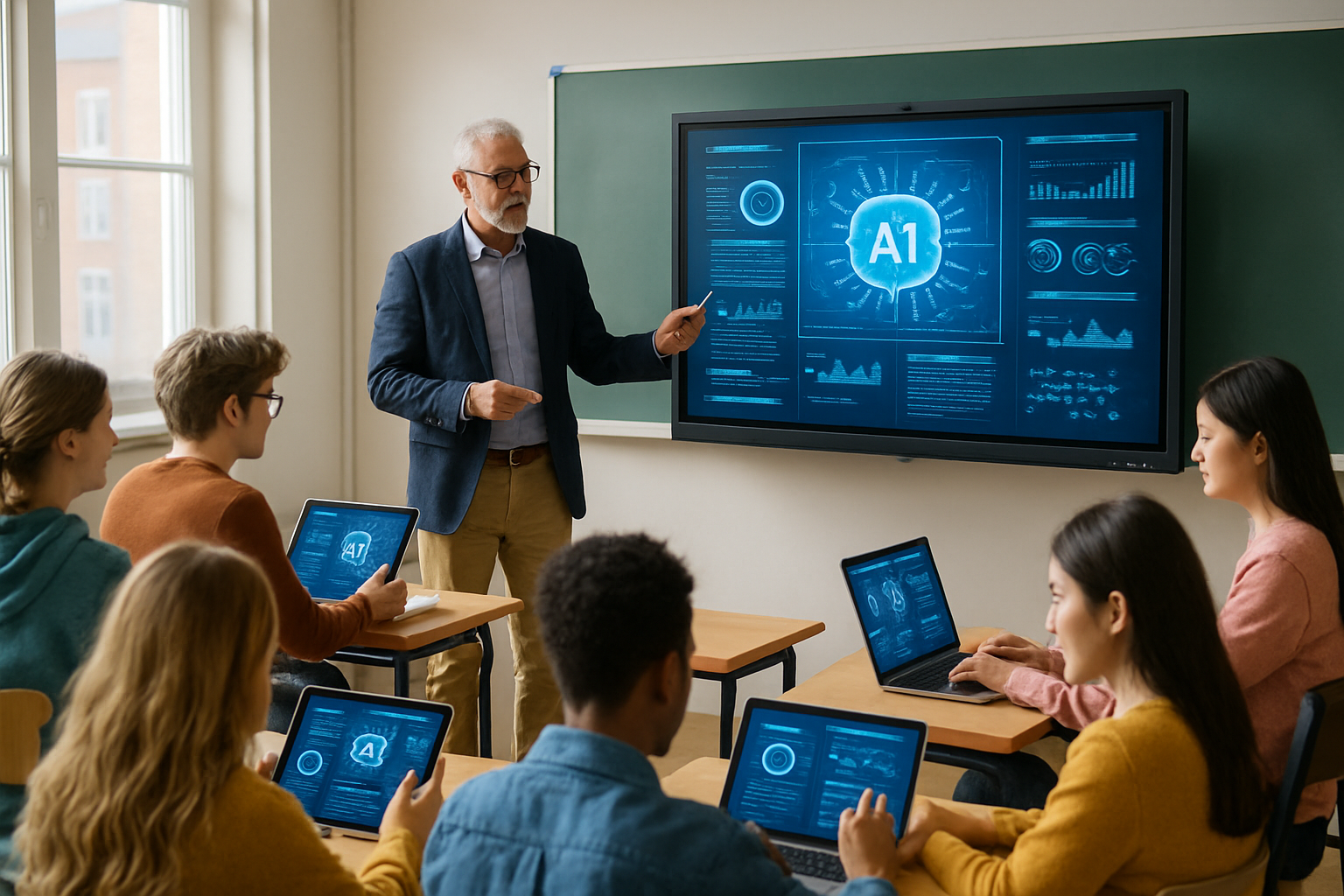
Artificial intelligence is fundamentally transforming higher education worldwide, creating both unprecedented opportunities and significant challenges as institutions race to integrate AI technologies while preserving the essential human elements of learning and academic integrity.
From Malaysia's groundbreaking AI-integrated Islamic schools to Canadian universities implementing sophisticated AI teaching assistants, the global education sector is witnessing what experts term the "2026 Educational Technology Renaissance" – a coordinated international movement toward thoughtful digital tool integration with traditional educational values.
The Integration Revolution Across Continents
The scope of AI adoption in education has reached critical mass, with over 50% of teenagers worldwide now regularly using artificial intelligence tools to complete homework assignments, according to comprehensive research by the Pew Research Center. This represents a seismic shift from experimental curiosity to essential academic infrastructure occurring at unprecedented speed.
Malaysia leads the charge with the world's first AI-integrated Islamic school combining artificial intelligence with traditional religious and academic learning. The innovative approach demonstrates that technological advancement can enhance rather than replace cultural transmission, creating globally competitive yet culturally grounded graduates.
Meanwhile, Canadian universities including UQAM, Concordia, University of Toronto, and University of Lethbridge have successfully implemented AI teaching assistants while maintaining critical thinking standards. These institutions serve as models for responsible AI integration, showing how technology can amplify human capabilities without replacing the fundamental teacher-student relationship.
The Infrastructure Crisis Constraining Progress
However, ambitious AI education programs face significant obstacles. A global memory crisis has driven semiconductor prices up sixfold, affecting major manufacturers including Samsung, SK Hynix, and Micron. This shortage is creating infrastructure bottlenecks that are expected to persist until 2027 when new fabrication facilities come online.
The crisis forces educational institutions to develop more efficient, sustainable technology integration approaches rather than wholesale digital replacement. Many schools are adopting hybrid approaches that combine AI tools with traditional methods, memory-efficient algorithms, and cloud-based solutions to overcome hardware limitations.
Regional Responses to Global Challenges
Different regions are developing distinct approaches to AI integration challenges. European institutions emphasize regulatory enforcement and safety protocols, while Asian countries focus on education and awareness strategies. For instance, Malaysia emphasizes parental responsibility in digital safety campaigns versus blanket technology bans, while Oman promotes "Smart tech, safe choices" through conscious awareness education.
The Productivity Paradox Emerges
Despite AI's promise of enhanced efficiency, research is revealing what German expert Dr. Frank Bäumer calls the "double workload" effect. Students are performing their original responsibilities plus supervising and correcting AI outputs, often creating more work with declining efficiency rather than promised productivity gains.
"Students are spending dramatically more time on their work, but not necessarily learning more effectively. The technology requires constant supervision and refinement."
— Dr. Frank Bäumer, German Educational Technology Research Institute
This phenomenon highlights a critical insight: effective AI integration requires careful consideration of how technology serves educational goals rather than simply automating existing processes.
Success Models and Best Practices
Despite challenges, several success patterns have emerged from institutions worldwide. Singapore's WonderBot 2.0 demonstrates successful conversational AI for heritage education, while the Philippines' Department of Education partnership with the National Artificial Intelligence Center emphasizes "safe, fair, responsible" AI usage through structured governance frameworks.
The most successful programs share common characteristics:
- Sustained political commitment that survives electoral cycles
- Comprehensive stakeholder engagement including educators, students, families, and communities
- Cultural sensitivity and local adaptation rather than standardized solutions
- Clear pedagogical objectives ensuring technology serves educational goals
- Balanced implementation that monitors both academic outcomes and student wellbeing
The Academic Integrity Crisis
Universities worldwide are grappling with fundamental questions about academic integrity as AI capabilities become increasingly sophisticated. Australia reports a shift from traditional contract cheating to AI-generated content that challenges existing detection methods, forcing institutions to redesign assessments to focus on critical thinking and analysis rather than information regurgitation.
Faculty development has become crucial as educators must design AI-aware curricula and understand how to leverage these tools while maintaining academic standards. Student AI literacy education is now considered as important as traditional digital literacy, requiring comprehensive training on both capabilities and limitations.
International Governance and Regulation
The rapid adoption of AI in education has prompted international regulatory responses. The UN has established an Independent International Scientific Panel on Artificial Intelligence with 40 global experts, representing the first fully independent global AI impact assessment body. Spain has implemented the world's first criminal executive liability framework for social media platforms, while France has conducted cybercrime raids on AI companies.
This coordinated European approach aims to prevent jurisdictional shopping and represents the most sophisticated global technology governance framework since internet commercialization.
Economic Implications and Future Workforce
The transformation carries significant economic implications. Countries implementing comprehensive, prevention-focused educational approaches demonstrate superior outcomes through reduced crisis intervention costs, decreased unemployment rates, and improved workforce productivity. Educational investments are generating multiplier effects including enhanced community resilience, reduced social service demands, and improved international competitiveness.
The future workforce will require hybrid competencies spanning technical AI proficiency with uniquely human capabilities including emotional intelligence, creative problem-solving, and cultural competency.

Environmental and Sustainability Concerns
The World Bank projects AI water demand could reach 4.2-6.6 billion cubic meters by 2027 for data center cooling – equivalent to four to six times Denmark's annual water withdrawal. This environmental impact adds urgency to developing efficient AI deployment strategies in educational settings.
The Path Forward: Balance and Wisdom
February 2026 represents a critical inflection point in global educational policy development. The decisions made today will determine educational trajectories for the coming decade, affecting global capacity to address climate change, technological disruption, and social cohesion through quality educational systems serving as strategic infrastructure for 21st-century prosperity.
Success requires unprecedented coordination between governments, technology companies, educational institutions, and civil society. The challenge involves ensuring AI serves human flourishing while preserving creativity, empathy, and cultural wisdom that define human potential.
"We must remember that no artificial intelligence or any other technology can replace the concern of teachers for their students. Technology should enhance, not replace, the fundamental human relationships that define authentic education."
— President Ferdinand Marcos Jr., Philippines
The evidence suggests that effective AI-age educational reform requires thoughtful adaptation of technological tools to serve specific cultural, economic, and social needs rather than standardized global solutions. The window for effective action is narrowing as technology advances rapidly, requiring immediate coordinated responses that balance innovation with educational wisdom.
Conclusion: A Transformative Moment
The AI revolution in education represents more than technological change – it's a fundamental reimagining of how humans learn, teach, and develop. The most successful institutions are those that treat AI as a powerful amplification tool serving educational goals rather than an end in itself.
As higher education institutions worldwide navigate this transformation, the key lies in maintaining human creativity, critical thinking, and cultural knowledge while preparing students for an interconnected global economy that requires both technical competence and cultural authenticity. The future belongs not to institutions that choose between human and artificial intelligence, but to those that thoughtfully integrate both in service of human flourishing.