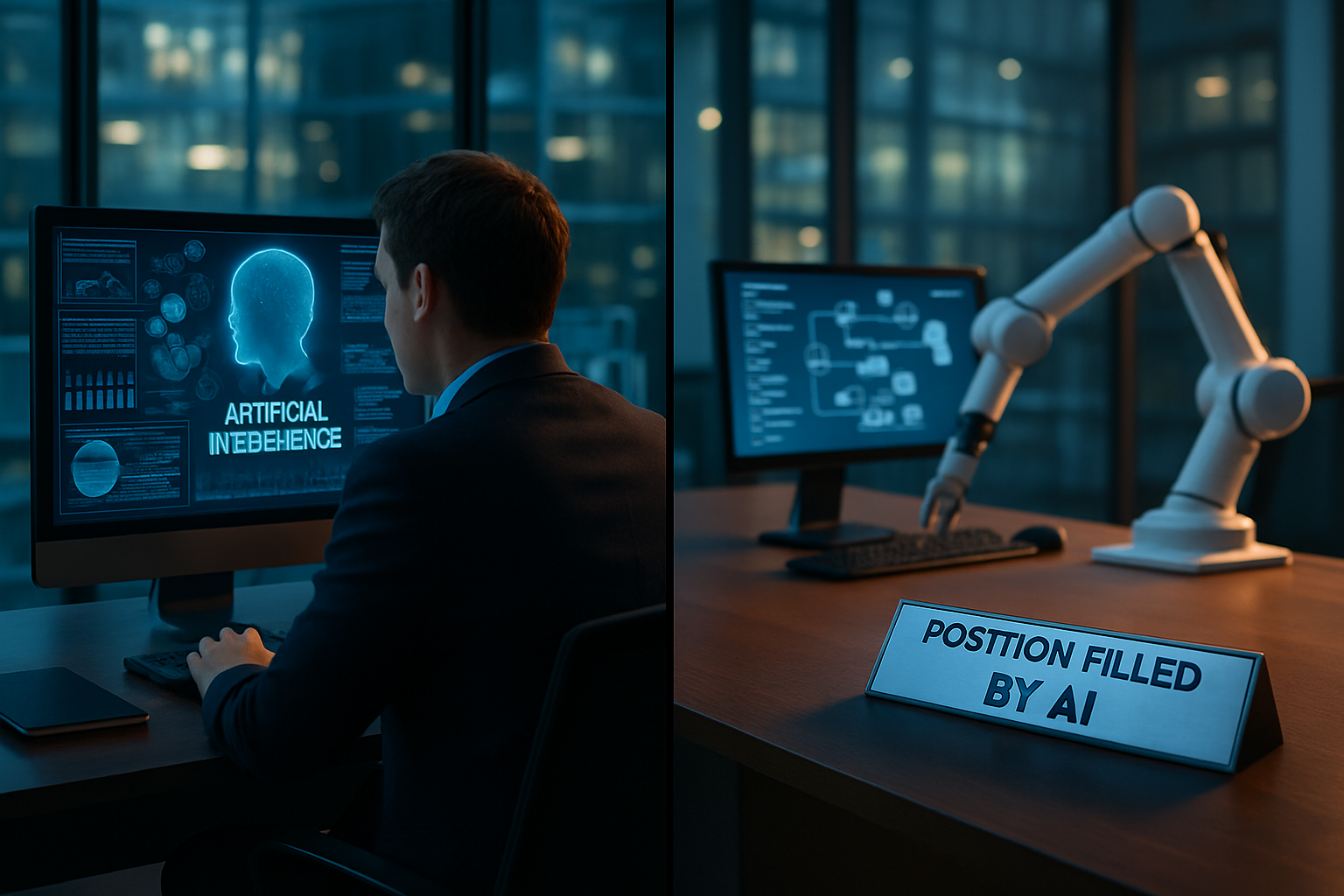
Artificial intelligence is fundamentally reshaping the global employment landscape in ways that exceed even the most aggressive predictions, with new evidence revealing both immediate displacement concerns and systemic market manipulations that are deceiving job seekers worldwide.
Slovak sources report a disturbing trend where companies are increasingly purchasing AI hardware to activate "digital employees" who then delegate tasks to human workers—a complete inversion of traditional workplace hierarchies. This phenomenon, spreading rapidly across North America, represents one of the most tangible examples of AI's transition from workplace assistant to direct supervisor.
The Reality of AI Job Displacement
Recent analysis from Citrini Research presents compelling evidence that AI will fundamentally alter employment structures far beyond current predictions. The research challenges economists who have historically dismissed technological unemployment concerns, arguing that this AI revolution differs significantly from previous technological disruptions due to its scope and speed.
Microsoft's Mustafa Suleyman's prediction that AI could replace the majority of office workers within two years, and lawyers and auditors within 18 months, is now being validated by real corporate decisions. Block Inc.'s announcement in February 2026 of eliminating 4,000 positions—40% of its global workforce—marked the first major tech layoff explicitly attributed to AI advancement rather than financial pressures.
"AI tools we create and use, combined with smaller, more agile teams, enable a new way of working," said Block CEO Jack Dorsey, representing the first major corporate acknowledgment of AI as a direct employment replacement tool.
The "Ghost Jobs" Phenomenon
Compounding the employment crisis is the emergence of "ghost jobs"—fictitious job postings that don't represent real employment opportunities. Experts warn that job seekers are increasingly submitting applications for positions that exist only on paper, creating false hope in an already challenging market.
This practice, documented across multiple industries, serves various corporate purposes: maintaining an appearance of growth, building candidate databases for future needs, or simply meeting regulatory posting requirements while having no intention to hire. The result is a job market where genuine opportunities become increasingly difficult to identify.
Industrial Automation Accelerates
Slovakia's industrial sector exemplifies the broader automation trend affecting manufacturing globally. Labor unions are raising urgent concerns about workers without adequate skills or retraining opportunities facing heightened risk of job loss as automation systems become more sophisticated and cost-effective.
The challenge extends beyond individual job losses to entire communities dependent on traditional manufacturing employment. Unlike previous industrial transitions that occurred over decades, current AI-driven automation is compressing transformation timelines, preventing the gradual workforce adaptation that economists typically assume will occur.
The Economics of AI Adoption
Perhaps most concerning is the economic paradox surrounding AI implementation. While generative AI experiences unprecedented user growth, the technology faces a fundamental profitability challenge: the more people use AI systems, the less profitable they become due to massive computational costs.
This creates a dangerous dynamic where AI companies must choose between limiting access (reducing social impact) or expanding usage while facing unsustainable economics. The infrastructure demands are staggering—the World Bank projects AI will require 4.2-6.6 billion cubic meters of water annually by 2027 just for data center cooling, equivalent to four to six times Denmark's entire water consumption.
Regional Variations in Response
Different regions are adopting markedly different approaches to AI-driven employment challenges. Western companies typically implement traditional layoffs followed by selective AI-related hiring, while Asian companies are investing in comprehensive worker transition programs.
Indian IT giants like Infosys, Wipro, and HCL Technologies are pioneering worker evolution strategies rather than wholesale elimination, providing templates for managing technological transitions. Chinese company Unitree Robotics is scaling humanoid robot production from 5,500 to potentially 20,000 units, creating employment opportunities even as automation displaces jobs elsewhere.
Successful Integration Models
Despite widespread concerns, several successful human-AI collaboration models offer hope for balanced integration. Canadian universities have implemented AI teaching assistants that maintain critical thinking standards while enhancing educational capabilities. Malaysia operates the world's first AI-integrated Islamic school, combining advanced technology with traditional learning approaches.
Singapore's WonderBot 2.0 heritage education program demonstrates how AI can preserve cultural knowledge while making it more accessible. These examples emphasize AI serving as amplification tools rather than replacement technologies.
The Infrastructure Reality Check
A global memory semiconductor crisis has created an unexpected buffer against rapid AI deployment. With chip prices surging sixfold and shortages expected until 2027, companies are forced to implement selective AI strategies rather than comprehensive automation. This constraint paradoxically provides crucial time for workforce adaptation that might not otherwise exist.
Despite these limitations, major corporations continue massive AI investments: Alphabet has committed $185 billion in 2026 alone, while Amazon's AI development plans exceed $1 trillion. These investments signal corporate confidence in AI's eventual dominance across business operations.
Regulatory Responses Intensify
Governments worldwide are responding to AI employment challenges with unprecedented regulatory frameworks. Spain implemented the world's first criminal executive liability system for tech platform violations, while France has conducted cybercrime raids on AI companies. The United Nations established an Independent Scientific Panel with 40 experts to provide the first fully independent global AI impact assessment.
These coordinated international responses represent the most sophisticated attempt at global technology governance since internet commercialization, aimed at preventing regulatory arbitrage while addressing AI's societal implications.
The Critical Choice Ahead
March 2026 represents what experts describe as a "civilizational choice point" determining whether AI serves human flourishing or becomes primarily an exploitation tool. The decisions made in the coming months will establish patterns for human-AI relationships that could persist for decades.
Success requires unprecedented coordination between governments, technology companies, educational institutions, and civil society. The challenge involves balancing innovation acceleration with responsible development, commercial interests with human welfare, and national competitiveness with international cooperation.
As Cyprus Finance Minister Makis Keravnos recently emphasized, AI adoption must be accompanied by appropriate investments in skills, education, and worker retraining. The technology's dual capacity to enhance productivity while creating significant labor market challenges demands proactive adaptation rather than reactive crisis management.
The evidence suggests that the window for proactive workforce adaptation is narrowing rapidly. Countries implementing comprehensive approaches—combining infrastructure investment, educational reform, and systematic retraining programs—demonstrate greater resilience in navigating this transformation. The future belongs to societies that can leverage AI effectively while preserving human creativity, empathy, and cultural understanding that define our highest potential.