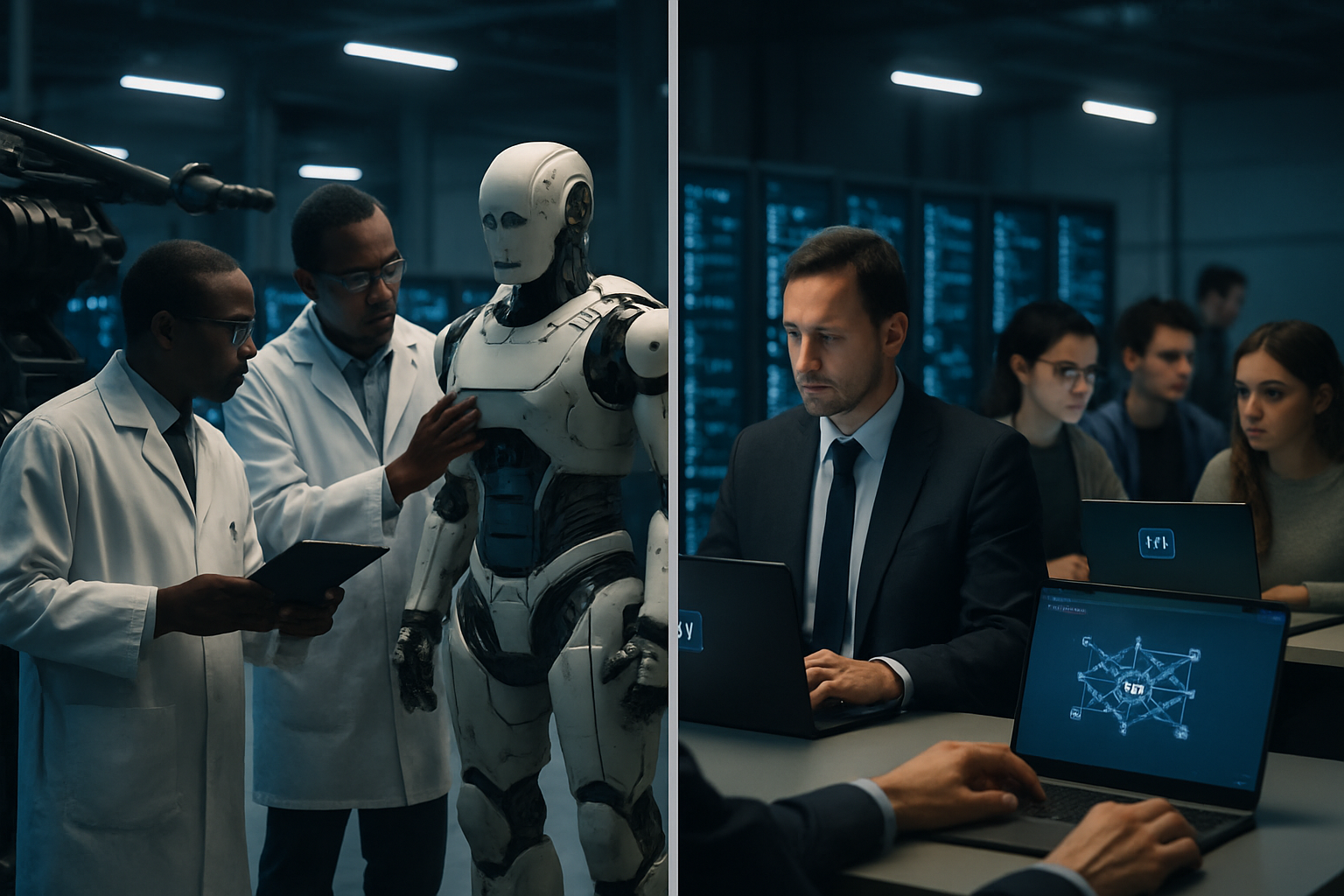
Artificial intelligence has reached a critical inflection point in April 2026, with developments spanning controversial weapon systems, revolutionary business applications, and transformative educational initiatives that are fundamentally reshaping societies across the globe. From Trump's ambitious defense plans to copyright disputes and university AI integration, the technology stands at a crossroads between promise and peril.
Trump's AI-Powered Defense Vision
The Trump administration has unveiled plans for an ambitious AI-powered missile defense system dubbed the "Golden Dome," with defense contractor Anduril Industries leading development alongside satellite startup partnerships. The system would station AI-controlled interceptor missiles in space, representing a dramatic escalation in militarized artificial intelligence applications.
However, industry experts express significant skepticism about the project's feasibility. The proposal comes amid ongoing tensions between the Pentagon and AI companies over military applications, particularly following Anthropic's designation as a "supply chain risk" after the company refused to remove safety restrictions on its Claude AI system for military use.
"Whether this ambitious space-based defense system will ever become reality remains highly questionable given the current infrastructure constraints and technical challenges."
— Defense Industry Analyst
Chinese Tech Competition Intensifies
Chinese technology companies are engaged in an unprecedented battle to capitalize on Anthropic's decision to withdraw its industry-leading Claude models from the open-source AI agent tool OpenClaw. This development highlights the growing global competition for AI supremacy as demand for AI tokens – the core metric of AI usage – surges worldwide.
The competition comes as the world faces a mounting computational power crisis, with global semiconductor shortages driving memory chip prices to unprecedented levels. Samsung, SK Hynix, and Micron are operating at full capacity but cannot meet growing AI infrastructure demands, creating bottlenecks that may favor entities willing to compromise safety protocols for computational access.
Business Productivity Revolution
The French media landscape reveals a critical debate about AI's economic viability in business applications. Industry leaders question whether the promised productivity gains from AI implementation will be sufficient to solve the technology sector's profitability challenges through massive productivity transfers.
This scrutiny comes as businesses worldwide grapple with what experts call the "productivity paradox" – where AI implementation often creates additional work rather than the efficiency gains initially promised. Companies are discovering that successful AI integration requires comprehensive change management, worker training, and workflow redesign rather than simply adding AI tools to existing processes.
Copyright Controversy Erupts
French technology giant Hugging Face, a cornerstone of the AI industry, faces intense criticism for allegedly distributing hundreds of thousands of copyrighted documents through its open-source library. Investigation by French media outlet Mediapart detected nearly half a million protected books and scientific articles being used to train AI models without proper authorization.
This revelation adds to growing concerns about AI companies' use of copyrighted material for training purposes, echoing similar disputes that have emerged across the entertainment and publishing industries. The controversy highlights the urgent need for clearer intellectual property frameworks governing AI development.
Educational AI Integration Success
In a positive development, Singapore's Nanyang Technological University (NTU) announced an ambitious initiative to embed AI into 40% of its courses by 2030, up from just 5% currently. The university has partnered with Google to provide all students access to premium AI tools as part of a comprehensive curriculum overhaul.
This represents part of what education experts are calling the "2026 Educational Technology Renaissance" – a global movement toward thoughtful AI integration in learning environments. Success stories include Malaysia's world-first AI-integrated Islamic school, Canadian universities' AI teaching assistants that maintain critical thinking standards, and Singapore's WonderBot 2.0 heritage education program.
"The goal is to prepare students for an AI-integrated economy while preserving human creativity, critical thinking, and cultural knowledge that define authentic educational excellence."
— NTU Education Official
Infrastructure Crisis Drives Innovation
The global semiconductor shortage, with memory chip prices surging sixfold, is paradoxically driving innovation toward more efficient AI algorithms and sustainable deployment strategies. Companies are developing memory-efficient solutions that democratize AI access by requiring less computational power.
Despite these constraints, major technology companies continue massive investments in AI infrastructure. Alphabet has committed $185 billion to AI development in 2026 – the largest single-year corporate technology investment in history – while Amazon plans over $1 trillion in AI investments over the coming decade.
International Governance Frameworks
The United Nations has established an Independent Scientific Panel comprising 40 global experts under Secretary-General António Guterres, representing the first fully independent international AI assessment body. This initiative reflects growing recognition that AI governance requires unprecedented coordination between governments, technology companies, educational institutions, and civil society.
Regulatory frameworks are intensifying globally, with Spain implementing the world's first criminal executive liability framework for tech platforms, France conducting cybercrime raids on AI companies, and the European Union investigating potential billion-dollar penalties for Digital Services Act violations.
Future Implications
Industry experts characterize April 2026 as a "civilizational choice point" that will determine whether AI serves human flourishing and democratic values or becomes a tool for surveillance and control. The convergence of military applications, business transformation, educational integration, and regulatory responses creates an unprecedented coordination challenge.
Success requires balancing innovation acceleration with safety governance, commercial interests with human welfare, and national competitiveness with international cooperation. The decisions made in 2026 will establish precedents for human-AI relationships that will echo through the remainder of the 21st century.
As the technology transitions from experimental to essential infrastructure across all sectors of society, the window for coordinated action is rapidly narrowing. The challenge ahead involves ensuring that artificial intelligence serves humanity's highest aspirations while preserving the creativity, empathy, and wisdom that define human potential.