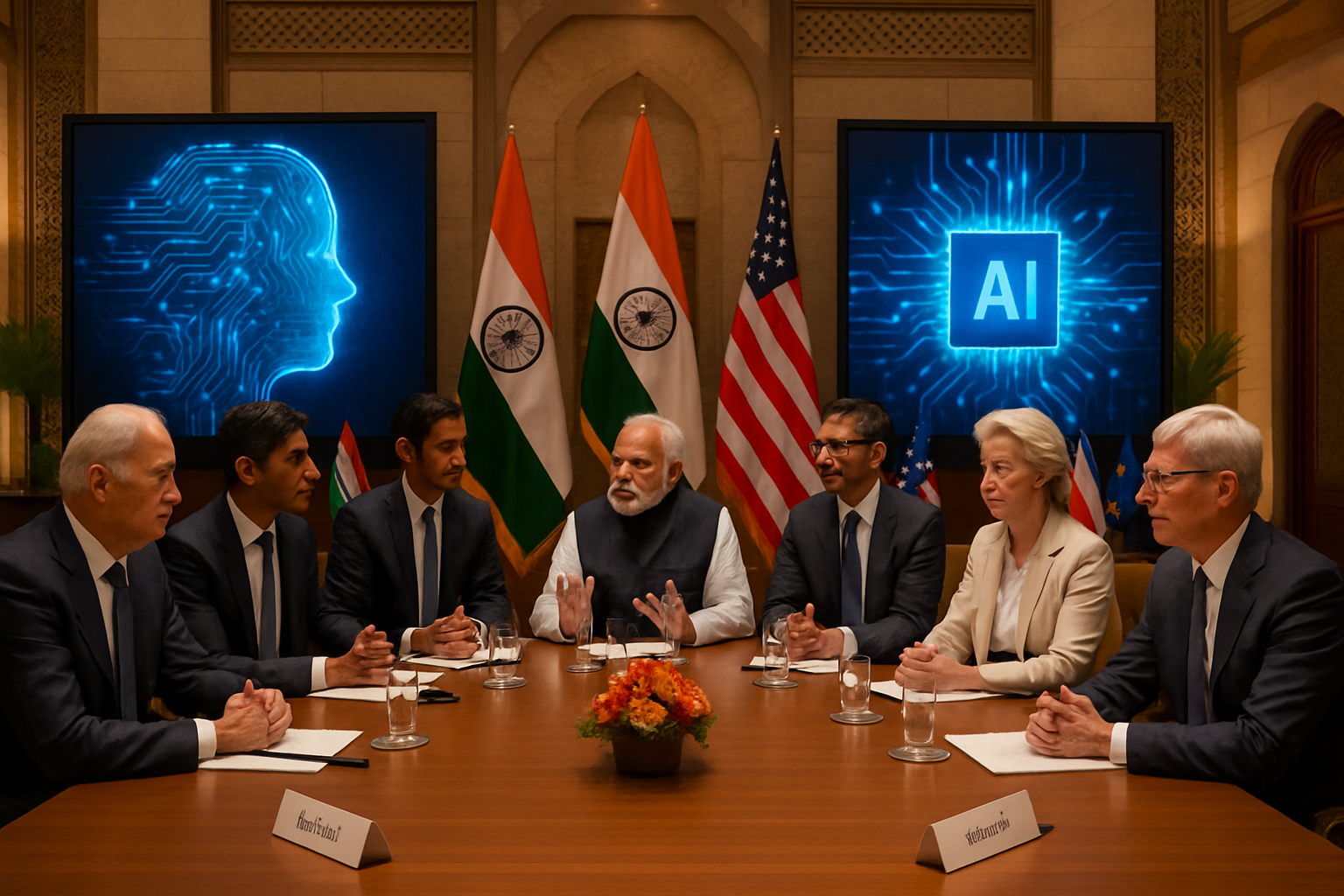
World leaders convened in New Delhi for the historic AI Impact Summit as Google DeepMind CEO Sir Demis Hassabis issued stark warnings about artificial intelligence threats, declaring that more research on AI dangers "needs to be done urgently" while the United States rejected calls for centralized global governance.
The February 16-20 summit at New Delhi's Bharat Mandapam marked the first major AI conference hosted in the Global South, bringing together over 250,000 delegates including tech industry leaders like Google's Sundar Pichai, OpenAI's Sam Altman, and Nvidia's Jensen Huang alongside government officials from more than 100 countries.
Urgent Research Warnings from AI Leadership
In an exclusive interview at the AI Impact Summit, Sir Demis Hassabis emphasized the industry's desire for "smart regulation" targeting "the real risks" posed by artificial intelligence technology. His warnings came as experts highlighted growing concerns about AI threats and the amplification of user biases through algorithmic systems.
The summit featured discussions on how AI systems can amplify existing biases of users, with experts examining the complex relationship between artificial intelligence and human prejudices. These concerns have intensified as AI adoption accelerates across sectors without comprehensive safety frameworks.
"Smart regulation for the real risks posed by the tech is what the industry wants."
— Sir Demis Hassabis, CEO, Google DeepMind
The warnings from Google DeepMind's leadership reflect broader industry tensions between rapid AI development and safety considerations. Former Anthropic researchers have also resigned with warnings that "the world is in peril" over AI development outpacing safety measures.
US Rejects Global AI Governance Framework
Despite calls from many tech leaders and politicians for enhanced global AI governance, the United States firmly rejected centralized regulatory approaches. White House technology adviser Michael Kratsios delivered a clear message opposing bureaucratic oversight.
"AI adoption cannot lead to a brighter future if it is subject to bureaucracies and centralised control."
— Michael Kratsios, White House Technology Adviser
This position puts the US at odds with numerous other nations seeking coordinated international AI governance frameworks. The disagreement highlights the fundamental challenge of regulating a technology that transcends national boundaries while respecting different philosophical approaches to innovation and oversight.
India Positions Itself as Global South AI Leader
Prime Minister Narendra Modi positioned India as a bridge between advanced and developing economies through the summit's "People, Planet, Progress" framework. The initiative encompasses seven working groups addressing AI safety, skills development, inclusion, and economic growth.
India's strategic positioning comes as the country rises to third place in global AI power rankings, surpassing South Korea and Japan. The nation announced massive AI "data city" infrastructure projects in Visakhapatnam, Andhra Pradesh, representing a significant challenge to traditional technology centers.
The Delhi Declaration expected from the summit aims to establish new frameworks for international AI cooperation, positioning developing nations as equal partners in AI governance rather than passive recipients of Western or Chinese technology.
Infrastructure Crisis Constrains AI Development
The summit discussions occurred against a backdrop of severe global infrastructure challenges. A critical memory crisis has driven semiconductor prices up sixfold, affecting major manufacturers Samsung, SK Hynix, and Micron, with shortages expected to continue until 2027 when new fabrication facilities come online.
The World Bank projects that AI water demand could reach 4.2-6.6 billion cubic meters by 2027—equivalent to four to six times Denmark's annual water withdrawal—primarily for data center cooling requirements. This environmental challenge adds urgency to discussions about sustainable AI development.
Despite these constraints, major corporations continue massive investments. Alphabet has committed $185 billion to AI infrastructure in 2026, while Amazon plans over $1 trillion in AI development through the decade.
Regulatory Revolution Across Multiple Jurisdictions
The summit occurred amid unprecedented regulatory intensification across multiple jurisdictions. Spain has implemented the world's first criminal executive liability framework for social media platforms, creating personal legal risks for technology executives beyond traditional corporate penalties.
France has conducted cybercrime raids on AI companies, while the European Union established strict Digital Services Act enforcement mechanisms. The UN has created an Independent International Scientific Panel on Artificial Intelligence with 40 experts, led by Secretary-General António Guterres, marking the first fully independent global AI assessment body.
Military AI Applications Create New Tensions
Military applications of artificial intelligence have created significant tensions between civilian oversight and national security requirements. The Pentagon has integrated ChatGPT into military systems and pressures AI companies to deploy tools in classified networks without civilian safety restrictions.
Anthropic has resisted Pentagon demands for unrestricted military use of its Claude AI system, opposing autonomous weapons development while the Defense Department seeks classified network access. This tension exemplifies the complex intersection of AI safety, democratic governance, and national security imperatives.
Ukrainian forces have deployed AI-enhanced drone systems with improved low-light vision capabilities, while approximately one-third of countries have agreed to AI warfare governance frameworks. However, the US and China have abstained from comprehensive commitments, highlighting the geopolitical complexity of military AI regulation.
Successful Integration Models Emerge
Despite challenges, several successful AI integration models have emerged that balance technological advancement with human-centered approaches. Canadian universities have implemented AI teaching assistants while maintaining critical thinking standards, demonstrating how AI can enhance rather than replace fundamental educational relationships.
Malaysia launched the world's first AI-integrated Islamic school, combining artificial intelligence with traditional religious and academic learning. Singapore's WonderBot 2.0 has achieved success in heritage education, providing conversational AI systems that respect cultural values while delivering educational content.
These models suggest that effective AI integration requires cultural sensitivity, comprehensive stakeholder engagement, and clear pedagogical objectives ensuring technology serves educational goals rather than replacing human connections.
Market Disruption and Economic Transformation
The AI revolution has triggered significant market disruption, with the "SaaSpocalypse" eliminating hundreds of billions in market capitalization as AI systems replace traditional software solutions. Indian IT giants including Infosys, Wipro, and HCL Technologies are adapting through worker transition programs to AI-enhanced roles rather than implementing mass layoffs.
Chinese breakthroughs, particularly DeepSeek's technological advances, have challenged assumptions about US dominance in AI development, creating a more multipolar competitive landscape. European initiatives like Deutsche Telekom's Industrial AI Cloud in Munich represent efforts to establish digital sovereignty independent of US and Chinese systems.
Critical Inflection Point for Global AI Governance
February 2026 represents what experts describe as the most critical AI inflection point since the technology boom began. The transition from experimental applications to essential infrastructure across sectors requires unprecedented coordination between governments, technology companies, educational institutions, and civil society.
Success depends on resolving infrastructure constraints, establishing international cooperation frameworks, and developing sustainable business models that prioritize human welfare alongside technological advancement. The decisions made in 2026 will largely determine whether AI fulfills its transformative promise or creates systemic risks requiring dramatic corrections.
The New Delhi summit highlighted both the enormous potential and significant challenges of artificial intelligence governance in an interconnected world. As Sir Demis Hassabis emphasized the need for urgent research on AI threats while the US rejected centralized control, the global community faces the complex task of balancing innovation with safety, competition with cooperation, and national interests with collective human welfare.