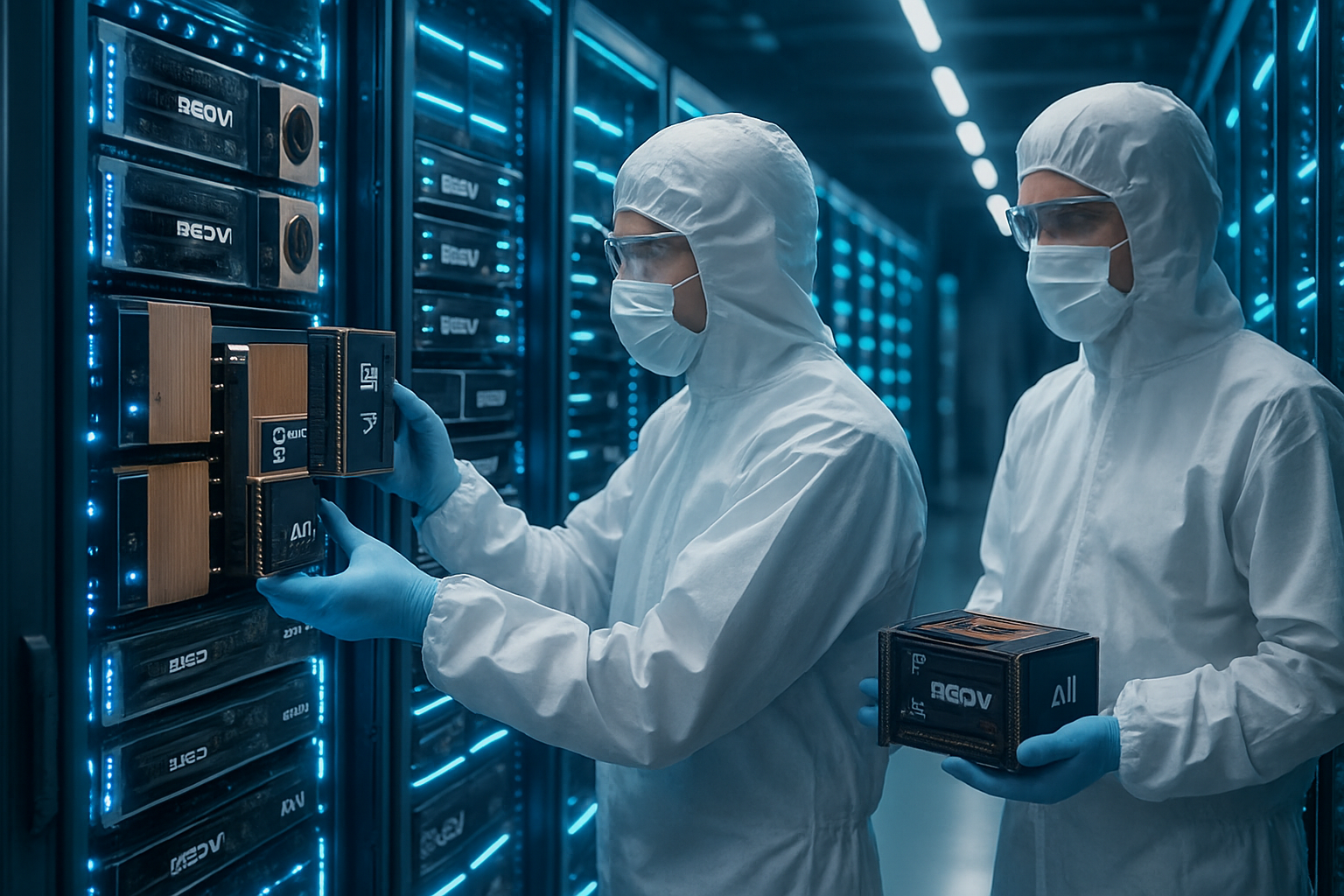
A revolutionary new graphics card architecture promises to dramatically outperform NVIDIA's flagship RTX 5090, while artificial intelligence transitions from revolutionary technology to routine workplace tool, and shocking surveys reveal one in four people never clean their keyboards.
Three major technology developments converged in late April 2026, painting a complex picture of an industry in rapid transformation. At the forefront, the Bolt Zeus graphics card, built on the open RISC-V instruction set, has entered test production with promises to "massively exceed" NVIDIA's most powerful consumer GPU. Simultaneously, AI technologies are becoming so commonplace that they're losing their novelty in professional environments, even as basic computer hygiene remains alarmingly neglected.
Breakthrough Graphics Architecture Ready for Testing
The most significant development comes from an unnamed manufacturer developing the Bolt Zeus graphics card, which represents a fundamental shift away from traditional GPU architectures. Based on the open RISC-V instruction set rather than proprietary designs, this "wonder graphics card" is now ready for test production after years of development.
According to industry sources, the Bolt Zeus utilizes a free, open-source processor instruction set that could democratize high-performance computing. Unlike NVIDIA's closed ecosystem, RISC-V allows any manufacturer to develop chips without licensing fees or architectural restrictions. This approach has gained momentum as companies seek alternatives to traditional suppliers amid ongoing global semiconductor shortages.
"The platform is designed to massively exceed NVIDIA's flagship RTX 5090 performance while maintaining cost-effectiveness through open architecture."
— Industry Source, Hardware Development
The timing proves crucial as memory chip prices have surged sixfold over the past year, affecting major manufacturers including Samsung, SK Hynix, and Micron. These shortages, expected to persist until 2027 when new fabrication facilities come online, have forced innovation in memory-efficient algorithms and alternative processing architectures.
AI Becomes Routine Despite Revolutionary Potential
While graphics hardware advances dramatically, artificial intelligence appears to be experiencing a paradoxical "normalization" effect. France 24's investigation reveals that despite AI's transformative potential across white-collar work, poverty reduction, and even existential risks to humanity, the technology is becoming increasingly mundane in workplace environments.
This development reflects what technology experts have identified as the "2026 AI Infrastructure Inflection Point" – a critical moment when experimental AI transitions to essential business infrastructure. Major corporations including Alphabet ($185 billion AI investment) and Amazon ($1+ trillion development plans) continue massive investments despite supply chain constraints.
The workplace integration follows documented patterns from successful AI implementation models globally. Canada's universities have deployed AI teaching assistants while maintaining critical thinking standards, Malaysia operates the world's first AI-integrated Islamic school, and Singapore's WonderBot 2.0 demonstrates successful heritage education applications.
Hardware Hygiene Crisis Reveals Hidden Health Risks
Amid these technological advances, a concerning survey reveals fundamental neglect of basic computer hardware maintenance. According to Austrian research, one in four computer users never cleans their keyboards, while screen cleaning practices show significant room for improvement.
This finding gains urgency as workplaces become increasingly AI-dependent, with employees spending more time at computer workstations. The integration of advanced AI systems with dirty, contaminated hardware creates potential health and performance issues that organizations have largely overlooked.

Technology industry experts warn that inadequate hardware maintenance can lead to reduced system performance, shortened equipment lifespan, and potential health risks from bacterial accumulation on frequently-touched surfaces. As AI systems require more computational resources and extended operation periods, these maintenance issues become increasingly critical.
Infrastructure Challenges Drive Innovation
The convergence of these trends occurs within a complex infrastructure landscape. Global semiconductor shortages have paradoxically driven innovation in memory-efficient algorithms and sustainable deployment strategies. Companies are developing hybrid processing approaches that maximize AI capabilities while minimizing hardware requirements.
This constraint-driven innovation potentially democratizes access to advanced AI technologies, allowing smaller organizations and developing nations to participate in the AI revolution through more efficient systems. The Bolt Zeus graphics card's RISC-V architecture exemplifies this trend, offering high performance through open standards rather than expensive proprietary solutions.
Regulatory frameworks are simultaneously intensifying globally. Spain has implemented the world's first criminal executive liability framework for technology platforms, France has conducted AI cybercrime raids, and the United Nations has established an Independent Scientific Panel with 40 experts for comprehensive AI assessment.
Successful Human-AI Collaboration Models
Despite concerns about AI replacing human workers, successful implementations consistently demonstrate enhancement rather than replacement approaches. These models treat AI as sophisticated amplification tools serving human goals while preserving creativity, cultural understanding, and ethical reasoning that define human potential.
The transition from experimental to essential AI infrastructure requires unprecedented coordination between governments, technology companies, educational institutions, and civil society. Success depends on balancing innovation acceleration with responsible development, commercial interests with human welfare, and national competitiveness with international cooperation.
Market Transformation and Future Implications
The technology sector is experiencing systematic elimination of traditional software-as-a-service models as AI demonstrates direct replacement capabilities. This "SaaSpocalypse" has eliminated hundreds of billions in market capitalization, fundamentally reshaping business ecosystems.
However, the hardware hygiene crisis reveals that technological advancement must be accompanied by basic maintenance practices. As AI systems become more sophisticated and ubiquitous, the human interface with technology – including physical cleanliness and ergonomic considerations – becomes increasingly important.
"The most promising path involves sophisticated human-AI collaboration amplifying capabilities while preserving distinctly human qualities that artificial intelligence cannot replicate."
— Technology Policy Expert
The April 2026 developments represent a critical juncture determining whether AI serves human flourishing versus becoming a surveillance or control mechanism beyond democratic accountability. The window for coordinated action is narrowing rapidly as development accelerates faster than governance frameworks can adapt.
Global Coordination Requirements
The convergence of breakthrough graphics hardware, AI normalization, and basic hygiene concerns illustrates the complex coordination required for successful technology integration. Infrastructure constraints are forcing thoughtful deployment strategies while international frameworks develop to manage AI's transformative potential.
Success models consistently emphasize human-centered approaches that enhance rather than replace fundamental human capabilities. Educational institutions report superior outcomes when AI serves as amplification tools supporting learning objectives rather than replacing human instruction and relationships.
As the Bolt Zeus graphics card prepares for mass production and AI becomes increasingly mundane, the challenge lies in ensuring technological transformation serves humanity's highest aspirations while maintaining the distinctly human qualities – wisdom, empathy, and cultural understanding – that provide meaning to human experience.
The stakes extend beyond technological advancement to fundamental questions about how societies organize around human wellbeing versus technological metrics. The decisions made in 2026 regarding AI implementation, hardware infrastructure, and even basic hygiene standards will establish human-technology relationship patterns persisting for decades to come.