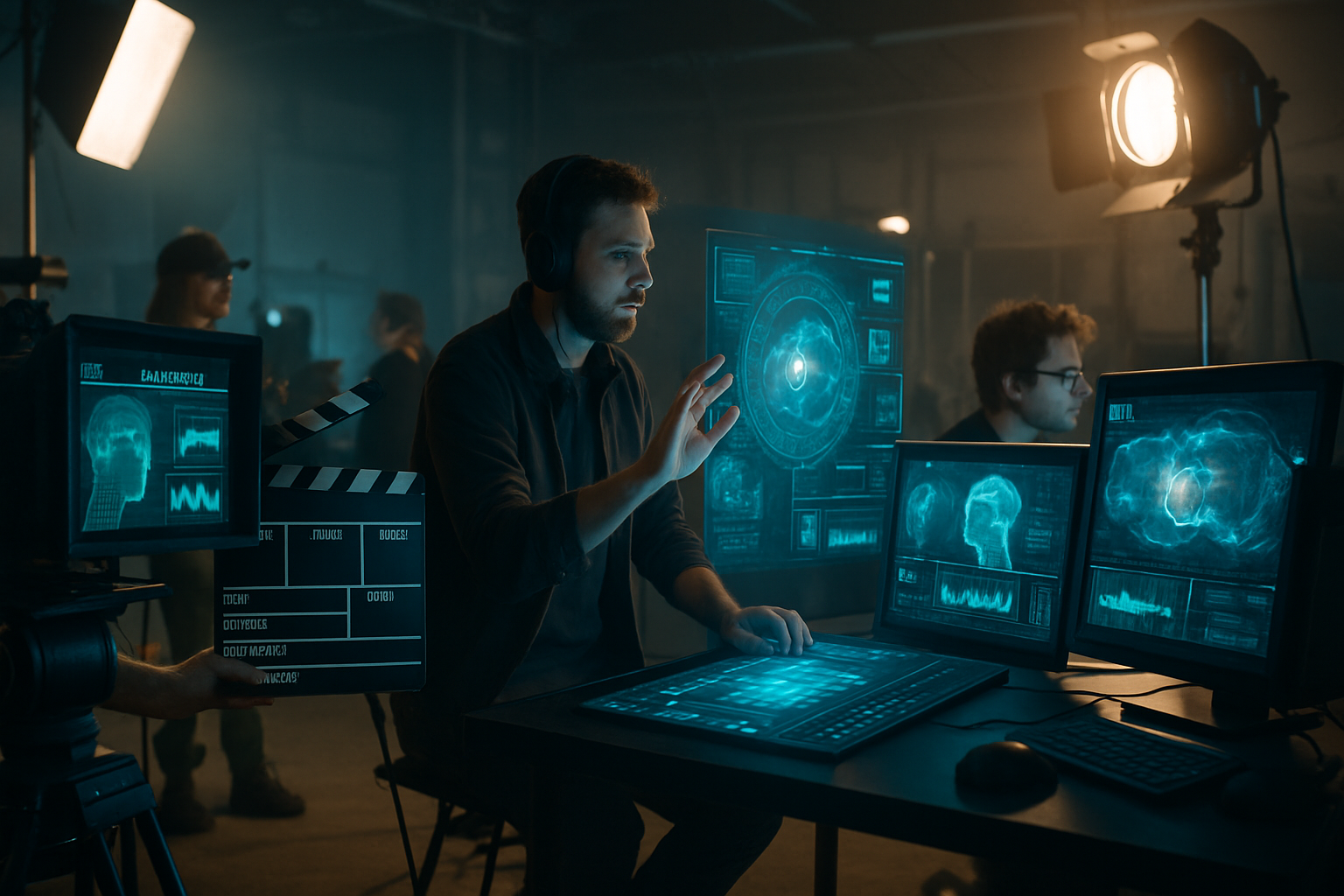
Artificial intelligence has moved from Hollywood's experimental margins to its creative core, fundamentally transforming film production as the industry enters the most significant technological revolution since the advent of digital cinematography. For the first time in Academy Awards history, films utilizing AI in their creation process are eligible for Oscar nominations, marking a watershed moment that signals AI's permanent integration into mainstream filmmaking.
The transformation is visible across every aspect of production, from pre-visualization to post-production, as studios and independent filmmakers alike embrace AI tools that promise both creative enhancement and cost efficiency. However, this technological revolution comes with significant growing pains, as traditional industry professionals face displacement while new forms of creative collaboration emerge.
AI Gains Oscar Recognition Amid Industry Transformation
The Academy of Motion Picture Arts and Sciences' decision to allow AI-assisted films in competition represents a formal acknowledgment of technology's irreversible role in modern filmmaking. German broadcaster Tagesschau reports that while AI cannot yet create entire feature films independently, its presence in contemporary cinema continues to expand dramatically.
This milestone coincides with what industry observers are calling the "2026 AI Revolution in Cinema," a period characterized by rapid technological adoption across all production phases. From script development using natural language processing to sophisticated visual effects generation, AI tools are becoming integral to filmmakers' creative arsenals.
The change extends beyond technical capabilities to fundamental questions about artistic authenticity and creative ownership. As French outlet Le Monde noted, the industry faces a "systematic plundering" concern among traditional professionals who worry about AI reproducing voices and images without proper compensation or consent.
Digital Extras Replace Human Performers
One of the most visible impacts of AI integration appears in background performer roles, where digital extras generated by artificial intelligence are increasingly replacing human actors. This shift, particularly evident in large-scale productions requiring crowd scenes, represents significant cost savings for studios while creating employment concerns for traditional extras and supporting cast members.
The technology has advanced to a point where AI-generated background performers are virtually indistinguishable from their human counterparts, enabling filmmakers to populate scenes with digital crowds that can be customized, multiplied, or modified during post-production without the logistical challenges of managing large groups of human performers.
French industry professionals have been particularly vocal about these changes, with over 4,000 actors and filmmakers condemning what they describe as AI tools' "systematic plundering" of their likenesses and performances. This resistance reflects broader anxieties about technological displacement that extend far beyond the entertainment industry.
Creative Enhancement vs. Human Displacement
The AI transformation in Hollywood presents a complex dual narrative of creative enhancement and professional displacement. While AI tools enable previously impossible visual effects and streamline production workflows, they also challenge traditional employment structures that have sustained the film industry for decades.
"The industry is searching for economies, and seems fascinated by the prospects offered by artificial intelligence."
— Le Monde, French Media Analysis
Studios report significant efficiency gains from AI integration, particularly in pre-production planning, script analysis, and visual effects creation. These tools allow filmmakers to experiment with concepts and iterate on ideas more rapidly than traditional methods permit, potentially leading to more innovative and ambitious projects.
However, these advantages come at the cost of traditional jobs across multiple departments. Visual effects artists, editors, script readers, and production assistants find their roles either eliminated or fundamentally altered as AI systems assume responsibilities previously requiring human expertise.
Industry Adaptation and Workforce Evolution
The film industry's response to AI integration varies significantly across different sectors and geographic regions. While some production companies pursue wholesale adoption of AI tools, others maintain more cautious approaches that emphasize human-AI collaboration rather than replacement.
Educational institutions have begun adapting to this new reality, with programs like Curious Refuge's AI film academy, launched in May 2023, becoming essential training grounds for industry professionals. Visual effects veteran Michael Eng represents thousands of workers acquiring machine learning skills to remain relevant in an increasingly AI-integrated production environment.
The success of human-centered AI integration models in other industries provides potential templates for Hollywood. Canadian universities' implementation of AI teaching assistants while maintaining critical thinking standards, and Malaysia's AI-integrated educational programs that preserve traditional learning relationships, demonstrate that technology can enhance rather than replace human creativity when implemented thoughtfully.
Technical Infrastructure and Creative Possibilities
Despite rapid advancement, AI implementation in film production faces significant infrastructure constraints. The global memory semiconductor crisis, with prices increasing sixfold affecting major manufacturers Samsung, SK Hynix, and Micron, creates bottlenecks that will persist until new manufacturing facilities come online in 2027.
These constraints paradoxically drive innovation toward more efficient AI deployment strategies. Production companies are developing memory-efficient algorithms and hybrid processing approaches that maximize AI capabilities while minimizing hardware requirements, leading to more democratized access to advanced filmmaking tools.
The technological limitations also provide time for workforce adaptation that might not otherwise be available. Rather than facing immediate wholesale automation, industry professionals have opportunities to develop new skills and find niches where human creativity remains irreplaceable.
Global Regulatory and Cultural Responses
The international film community's response to AI integration reflects broader global tensions around artificial intelligence governance. European countries have taken particularly strong regulatory stances, with Spain implementing criminal executive liability frameworks for tech platforms and France conducting cybercrime raids on AI companies.
Cultural institutions worldwide are grappling with how to preserve authentic artistic expression while embracing technological innovation. The Belgian Atomium's AI-enhanced digital art programming demonstrates one successful model of technology-tradition synthesis that amplifies rather than replaces human artistic vision.
International film festivals, including the Berlin International Film Festival, report AI having a "looming" presence throughout the industry, though traditional storytelling continues to dominate competitive categories. This suggests a maturation process where AI becomes a tool within established creative frameworks rather than a replacement for human narrative sensibilities.
Economic Impact and Market Dynamics
The economic implications of AI integration in film production extend far beyond immediate cost savings from reduced personnel requirements. The technology enables new forms of content creation, international co-productions, and distribution strategies that could fundamentally alter industry business models.
Smaller production companies and independent filmmakers gain access to capabilities previously exclusive to major studios, potentially democratizing high-quality film production. However, this democratization comes alongside market consolidation as companies with superior AI integration capabilities gain competitive advantages.
The "SaaSpocalypse" phenomenon, where AI systems replace traditional software functions and eliminate hundreds of billions in market capitalization, affects film industry software providers and service companies that must adapt or face obsolescence.
Future Trajectory and Human-AI Collaboration
Industry experts increasingly advocate for sophisticated human-AI collaboration models rather than wholesale replacement approaches. Successful integration preserves uniquely human elements—imagination, cultural understanding, emotional depth, and authentic expression—while leveraging AI's computational advantages in data processing, pattern recognition, and routine automation.
The film industry's adaptation to AI serves as a crucial test case for other creative sectors facing similar technological transformations. Success depends on establishing guidelines that protect creative professionals and audiences while enabling innovation that enhances rather than diminishes the essentially human aspects of storytelling.
"AI cannot yet create entire feature films, but the AI content in films is growing significantly."
— Tagesschau, German Broadcasting Analysis
As the industry navigates this transformation, the decisions made in 2026 will likely determine the trajectory of human-AI relationships in creative industries for decades to come. The challenge involves harnessing AI's transformative potential responsibly while preserving the human elements that provide emotional resonance and cultural significance in cinema.
Looking Ahead: A New Creative Paradigm
The AI revolution in Hollywood represents more than technological advancement; it embodies a fundamental shift in how creative content is conceived, produced, and distributed. As Oscar eligibility for AI-assisted films signals mainstream acceptance, the industry must navigate complex questions about artistic authenticity, fair compensation, and the preservation of human creativity.
The path forward requires unprecedented coordination between studios, creative professionals, technology companies, and regulatory bodies. Success will be measured not merely by efficiency gains or cost reductions, but by the industry's ability to harness AI's capabilities while maintaining the distinctly human elements that make cinema a powerful form of cultural expression.
As 2026 progresses, Hollywood's response to AI integration will serve as a global template for creative industries facing similar technological disruption. The stakes extend beyond entertainment to fundamental questions about the role of human creativity in an increasingly automated world.