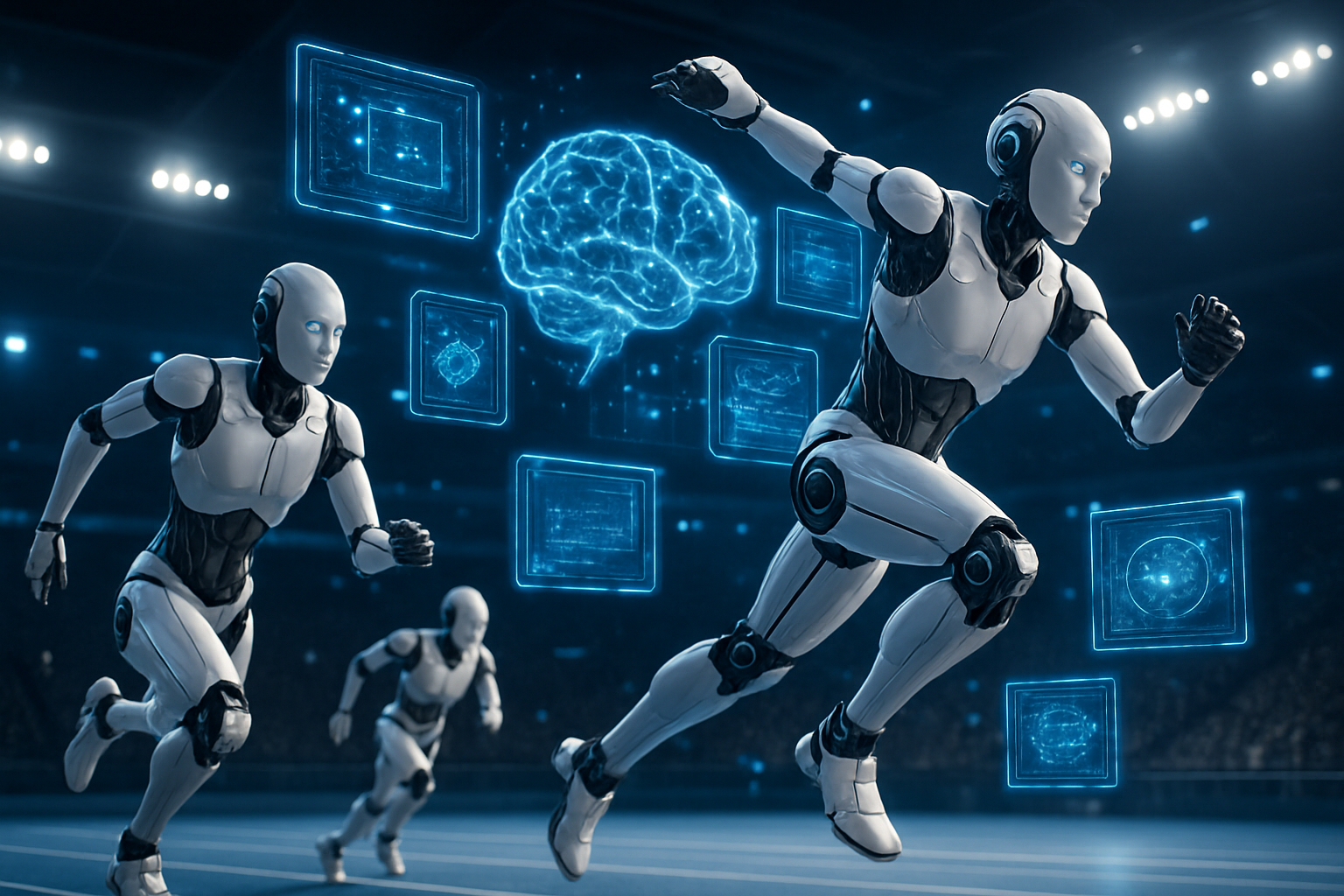
April 2026 represents a watershed moment in artificial intelligence and robotics development, as breakthrough achievements in humanoid robot competitions, mathematical problem-solving AI systems, and infrastructure expansion signal the transition from experimental technology to essential global infrastructure.
The convergence of multiple technological advances across different nations demonstrates what experts are calling the "April 2026 AI Inflection Point" - a critical juncture where artificial intelligence capabilities are fundamentally reshaping industries, solving complex problems, and creating new paradigms for human-machine collaboration.
China's Humanoid Robot Half-Marathon Showcases Technical Leaps
More than 300 humanoid robots participated in China's second robot half-marathon on Sunday, facing significantly more challenging terrain designed to test their technical advancements. The event represents Beijing's strategic effort to develop the robotics industry into a major pillar of its economy as the nation addresses its "4-2-1 demographic problem" - single children supporting four aging parents and grandparents.
The competition highlighted remarkable progress in Chinese humanoid robotics capabilities, with companies like Unitree Robotics having scaled production from 5,500 to over 20,000 humanoid units in 2026 alone. This represents one of the fastest laboratory-to-commercial transitions in global robotics history.
"This event demonstrates China's commitment to transitioning from experimental robotics to practical commercial deployment," noted analysts tracking the rapid development of China's AI and robotics sector.
— Industry Analysis
The half-marathon featured robots navigating complex obstacle courses, demonstrating advanced balance, coordination, and autonomous decision-making capabilities. Austrian sources report that the Unitree H1 humanoid robot achieved speeds approaching 36.36 km/h, nearing the performance levels of elite human athletes like Usain Bolt - a remarkable milestone for bipedal robotics engineering.
AI Solves Decade-Old Mathematical Mystery
In a stunning demonstration of artificial intelligence's problem-solving capabilities, an AI system successfully resolved a mathematical puzzle that had challenged researchers for an entire decade. The breakthrough, achieved in just 80 hours of computation, represents a significant milestone in AI's ability to tackle complex theoretical problems without human supervision.
Slovak sources document this achievement as a "breath-taking breakthrough for experienced mathematicians," highlighting how AI systems can now independently navigate complex mathematical landscapes that previously required years of human research. The system demonstrated autonomous reasoning, hypothesis generation, and proof validation - capabilities that suggest we're approaching artificial general intelligence in specialized domains.
This mathematical breakthrough builds on previous AI achievements in scientific research, including China's success in using AI to determine the chemical composition of the Moon's far side through Chang'e-6 sample analysis. Such developments demonstrate AI's growing role as a research amplifier, enabling discoveries that would take human researchers significantly longer to achieve.
Armenia Doubles AI Factory Capacity
During the AI Conf 2026 conference at Yerevan State University, Firebird co-founder Alexander Yesayan announced that the capacity of the AI Factory currently under construction in Armenia will double. This expansion represents Armenia's strategic positioning within the global AI infrastructure ecosystem.
The announcement reflects the broader trend of nations investing heavily in AI infrastructure to remain competitive in the emerging digital economy. Armenia's approach demonstrates how smaller nations can carve out significant roles in the global AI landscape through focused investments and strategic partnerships.

Global Context: The Infrastructure Challenge
These breakthrough achievements occur against the backdrop of significant infrastructure challenges. The global semiconductor crisis continues to drive memory chip prices up sixfold, affecting major manufacturers like Samsung, SK Hynix, and Micron. Shortages are expected to persist until new fabrication facilities come online in 2027.
Paradoxically, these constraints are spurring innovation in memory-efficient algorithms and sustainable deployment strategies. Companies are being forced to maximize AI capabilities while minimizing hardware requirements, potentially democratizing access to advanced AI technologies.
The World Bank projects that AI water demand for data center cooling will reach 4.2-6.6 billion cubic meters by 2027 - equivalent to 4-6 times Denmark's total annual consumption. This environmental challenge is driving innovations in sustainable computing and alternative energy solutions.
International Competition and Cooperation
The rapid advancement in AI and robotics is reshaping international competition dynamics. China's comprehensive approach combines demographic-driven innovation with massive infrastructure investments, while Western nations are responding with their own substantial commitments. Alphabet has committed $185 billion to AI infrastructure in 2026 - the largest single-year corporate tech investment in history - while Amazon has outlined over $1 trillion in AI development plans.
The United Nations has established an Independent Scientific Panel with 40 experts as the first fully independent international AI assessment body. This represents the most sophisticated attempt at global technology governance since the commercialization of the internet.
Success Models: Human-AI Collaboration
Amid concerns about AI displacement, several successful models have emerged that emphasize human-AI collaboration rather than replacement. Canada's AI teaching assistants maintain critical thinking standards in universities while providing personalized learning support. Malaysia operates the world's first AI-integrated Islamic school, combining advanced technology with traditional learning values. Singapore's WonderBot 2.0 heritage education program successfully preserves cultural knowledge while leveraging AI capabilities.
These models share common characteristics: they treat AI as amplification tools serving human goals, maintain sustained commitment to human development, and demonstrate cultural sensitivity in implementation.
Looking Ahead: The Civilizational Choice Point
Industry experts identify April 2026 as a "civilizational choice point" - a critical juncture determining whether AI serves human flourishing or becomes an exploitation tool beyond democratic accountability. The window for coordinated action is narrowing as AI capabilities advance faster than governance frameworks.
Success depends on unprecedented coordination between governments, companies, institutions, and civil society to balance innovation with safety governance, commercial interests with human welfare, and national competitiveness with international cooperation.
"The decisions we make in 2026 will establish decades-long patterns for human-AI relationships affecting billions of people globally."
— Technology Policy Experts
The most promising path forward involves sophisticated human-AI collaboration that amplifies human capabilities while preserving the creativity, cultural understanding, and ethical reasoning that define human potential. The challenge lies in ensuring that AI serves humanity's highest aspirations through democratic governance and human-centered values during this critical transition from experimental to essential infrastructure.
As we witness humanoid robots competing at superhuman speeds, AI systems solving decade-old puzzles in hours, and nations doubling their AI infrastructure capacity, the future is rapidly becoming the present. The question is no longer whether AI will transform our world, but how we can guide that transformation to benefit all of humanity.