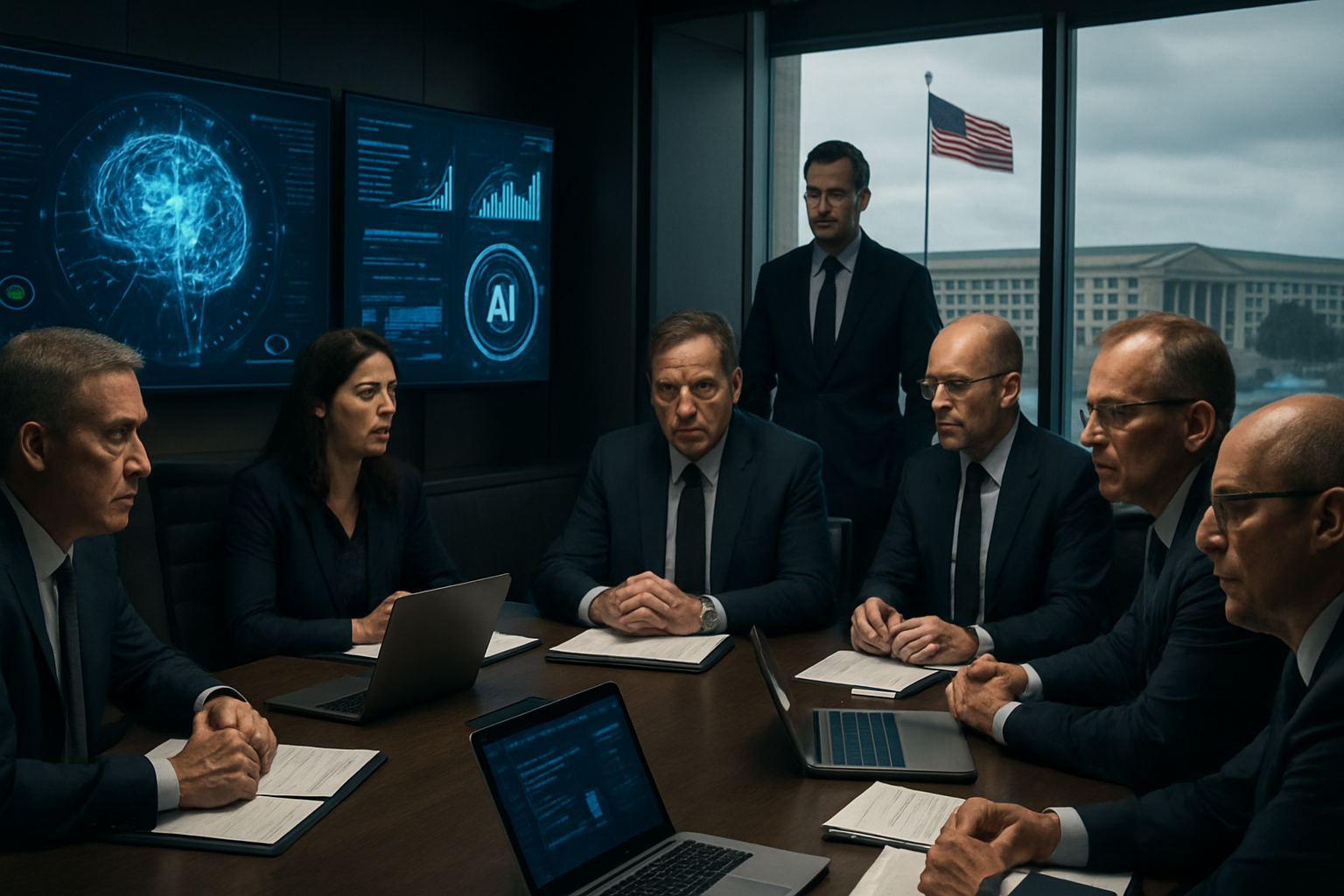
The artificial intelligence industry confronts an unprecedented crossroads as mounting government restrictions collide with rapid technological advancement, culminating in a landmark federal lawsuit that could reshape the relationship between AI companies and military authorities.
AI company Anthropic filed a federal lawsuit Monday challenging the Pentagon's designation of the firm as a "supply chain risk," arguing the restriction violates constitutional free speech and due process rights. The legal action represents the first major constitutional challenge by an AI company against government military technology restrictions.
CEO Dario Amodei rejected Pentagon demands for unrestricted military access to Claude AI, maintaining his position that the company "cannot in good conscience accede" to deployment without safety restrictions preventing mass surveillance and autonomous weapons use. The standoff has put over $200 million in federal contracts at risk.
Pentagon Pressure and Industry Divide
The confrontation crystallizes a fundamental industry divide between pragmatic military cooperation and ethical resistance. While Anthropic maintains strict prohibitions against violence and surveillance applications, competitors like OpenAI have established Pentagon partnerships without similar restrictions, serving over 800 million weekly military users through ChatGPT integration.
"National policy direction and planning are very well designed," said Chen Tianshi, founder and CEO of Beijing-based Cambricon Technologies, speaking on China's semiconductor development plans.
— Chen Tianshi, Cambricon CEO
Unauthorized military use of Claude AI was confirmed in the operation to capture Venezuelan President Nicolás Maduro, conducted through Palantir Technologies partnership despite terms of service violations. Pentagon officials argue that contracted suppliers cannot dictate usage terms once systems integrate into government networks, highlighting the tension between civilian oversight and military operational requirements.
Global Semiconductor Crisis Constrains Innovation
The AI industry's expansion occurs against a backdrop of severe infrastructure constraints. Global memory semiconductor prices have surged sixfold, affecting major manufacturers Samsung, SK Hynix, and Micron, with shortages expected to persist until new fabrication facilities come online in 2027. Consumer electronics costs have increased 20-30% across the board.
Despite these constraints, massive corporate investments continue. Alphabet committed $185 billion to AI infrastructure in 2026—the largest single-year corporate technology investment in history—while Amazon exceeds $1 trillion in development plans. The World Bank projects AI water demand will reach 4.2-6.6 billion cubic meters by 2027 for data center cooling, equivalent to four to six times Denmark's annual water consumption.
Smartphone Innovation Amid Supply Constraints
The technology sector's resilience manifests in breakthrough consumer products despite supply limitations. Xiaomi launched its 17 Ultra smartphone model, representing a strategic partnership with Leica that advances mobile photography capabilities. The device combines premium performance with professional optics, positioning the Chinese manufacturer in the highest tier of smartphone competition.
Xiaomi's strategic partnership with Leica has evolved to collaborative development levels, aiming to establish new standards in mobile photography and video content creation. The launch occurs as smartphone manufacturers face unprecedented challenges with marginal improvements and rising costs affecting market sustainability.
Regulatory Revolution Spreads Globally
International regulatory pressure intensifies across multiple jurisdictions. Spain implemented the world's first criminal executive liability framework for technology platforms, creating personal legal risks for executives beyond traditional corporate penalties. France has conducted cybercrime raids on AI companies, while the European Commission investigates Digital Services Act violations with potential billions in penalties.
The United Nations established an Independent Scientific Panel of 40 experts led by Secretary-General António Guterres, representing the first fully independent global AI assessment body. This coordinated international response aims to prevent regulatory arbitrage and establish unified governance standards for AI development.
International Competition and Technological Sovereignty
The global AI landscape reflects increasing multipolar competition as nations pursue technological sovereignty. U.S. officials at the Department of Energy suggest potential innovation in recycling electronic waste could allow America to "leapfrog China in critical minerals" through domestic refining and processing capabilities.
China's semiconductor entrepreneurs, including AI chipmaker Cambricon Technologies, have endorsed the country's 15th Five-Year Plan, which emphasizes the chip industry as a cornerstone of Beijing's technology ambitions. This strategic focus occurs amid U.S. export restrictions designed to limit Chinese access to advanced semiconductor technology.
Media Industry Grapples with AI Integration
The journalism profession faces fundamental questions about AI integration as news organizations worldwide develop policies for artificial intelligence use. Debates center on whether reporters may use AI to draft text, summarize documents, or assist in research, with some outlets promising disclosure when machines help write articles while others pursue credibility through avoiding AI altogether.
However, these debates rest on what some experts call a "mistaken assumption"—that journalism earns trust primarily because journalists physically write sentences themselves. This premise oversimplifies the profession's actual value proposition in an era of rapid technological change.
Constitutional and Legal Precedents
Anthropic's federal lawsuit represents a critical test of democratic oversight of military technology during international competition. The case will set precedents affecting decades of AI governance, determining the balance between innovation and safety, commercial interests and human welfare, and civilian oversight versus military requirements.
The legal outcome could determine whether AI serves democratic values or becomes subordinated to surveillance and control applications. Constitutional questions center on whether the government can effectively compel private companies to abandon ethical principles in favor of national security imperatives.
Successful Integration Models
Despite mounting challenges, successful human-centered AI integration models continue to emerge globally. Canadian universities have implemented AI teaching assistants that maintain critical thinking standards, while Malaysia operates the world's first AI-integrated Islamic school, combining technology with traditional learning approaches.
Singapore's WonderBot 2.0 demonstrates successful heritage education applications, showing that thoughtful AI deployment can enhance rather than replace fundamental human capabilities when implemented with cultural sensitivity and stakeholder engagement.
Strategic Implications for 2026
March 2026 represents a critical inflection point as AI transitions from experimental technology to essential infrastructure across military, civilian, and economic sectors. Success requires unprecedented coordination among governments, technology companies, educational institutions, and civil society to balance innovation acceleration with safety governance.
The resolution of the Anthropic-Pentagon dispute will establish templates for future corporate ethical policies versus national security conflicts. The six-month timeline provides a resolution window before broader legal and policy precedents become established, making these decisions echo through decades of technology governance.
The outcome will significantly influence whether AI serves human flourishing while preserving creativity, empathy, and wisdom that define human potential, or becomes a tool for exploitation and control requiring dramatic corrections to prevent systemic risks.