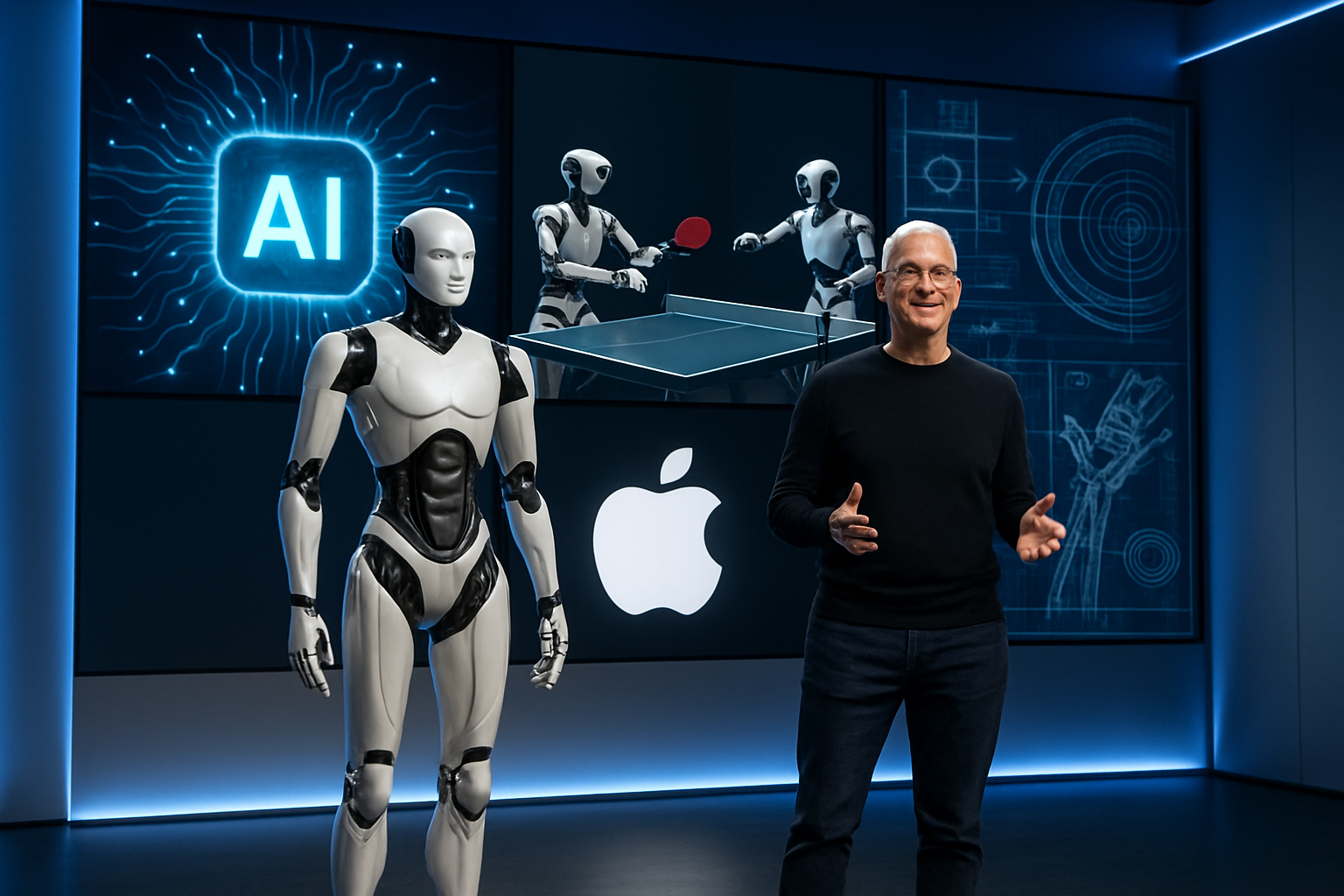
Artificial intelligence has reached a critical inflection point as Apple's leadership transition promises ten groundbreaking products and Chinese humanoid robots shatter athletic performance records, demonstrating AI's evolution from experimental technology to essential infrastructure reshaping global markets.
The convergence of corporate innovation and robotic achievement marks what industry experts are calling the "April 2026 Civilizational Choice Point" - a decisive moment determining whether AI serves human flourishing or becomes an exploitation tool beyond democratic accountability.
Apple's AI-Driven Renaissance Under New Leadership
Apple's transformation under new leadership represents a fundamental shift toward AI integration across its entire product ecosystem. The company's new CEO has announced an ambitious plan to launch ten new products, with artificial intelligence serving as the foundation for what industry analysts describe as the most significant product revolution since the iPhone's introduction.
This AI offensive aims to accelerate internal processes and embed intelligence deeply throughout the corporation, addressing what has historically been one of Apple's major weaknesses compared to competitors like Google and Microsoft. The strategic pivot comes as Apple struggles to maintain its position among the "Magnificent Seven" tech companies, having posted the second-worst performance since ChatGPT's launch.
"Eine KI-Offensive soll interne Prozesse beschleunigen und tief im Konzern verankert sein. Dieser Bereich war bislang einer der großen Schwachpunkte von Apple."
— Industry Analysis, Der Standard
The initiative reflects Apple's recognition that AI capabilities have become essential rather than optional for maintaining competitive advantage in an increasingly AI-driven market where traditional software solutions are being rapidly replaced.
Robotic Athletic Achievements Break New Ground
Meanwhile, revolutionary advances in robotics are demonstrating AI's expanding physical capabilities through unprecedented athletic achievements. Chinese humanoid robots recently achieved historic victories in marathon competitions, with the winning robot completing a 21.1-kilometer course in 50 minutes and 26 seconds - approximately seven minutes faster than the human world record.
Over 300 humanoid robots participated in what represents the largest competitive robotic athletic event in history, showcasing dramatic improvements from 2025 when many robots failed to complete courses. The success demonstrates transition from experimental robotics to superhuman athletic performance, with advanced balance, endurance, and AI decision-making capabilities navigating complex urban terrain and weather conditions.
Sony AI's breakthrough with its "Ace" robotic system has achieved remarkable success in defeating professional ping-pong players, demonstrating sophisticated real-time trajectory prediction and rapid response capabilities. This development has implications extending far beyond sports into industrial automation and human-robot collaboration scenarios.
Infrastructure Challenges Drive Innovation
The rapid advancement of AI technology occurs amid significant infrastructure constraints that paradoxically drive innovation toward more efficient solutions. Global semiconductor shortages have caused memory chip prices to surge sixfold, affecting major manufacturers including Samsung, SK Hynix, and Micron, with shortages expected to persist until 2027 when new fabrication facilities come online.
Despite these constraints, massive investments continue to flow into AI infrastructure. Alphabet has committed $185 billion to AI development in 2026 - the largest single-year corporate technology investment in history - while Amazon has outlined plans exceeding $1 trillion over the coming decade.
The semiconductor crisis has spurred the development of memory-efficient algorithms and sustainable deployment strategies that maximize AI capabilities while minimizing hardware requirements. This constraint-driven innovation is potentially democratizing AI access by reducing the computational power needed for advanced applications.
Human-AI Collaboration Models Show Promise
Successful AI implementations worldwide demonstrate that the most promising approach involves sophisticated human-AI collaboration rather than wholesale replacement of human capabilities. Leading examples include Canadian AI teaching assistants that maintain critical thinking standards, Malaysia's world-first AI-integrated Islamic school that combines technology with traditional learning, and Singapore's WonderBot 2.0 heritage education system.
These success stories share common characteristics: treating AI as amplification tools serving human goals while preserving creativity, cultural understanding, and ethical reasoning. The models emphasize enhancement of human capabilities rather than replacement, maintaining sustained commitment to human development and comprehensive stakeholder engagement.
Regulatory Frameworks Emerge Globally
The rapid advancement of AI technology has prompted unprecedented international coordination on governance frameworks. Spain has implemented the world's first criminal executive liability framework for technology platforms, while France has conducted AI cybercrime raids. The UN has established an Independent Scientific Panel with 40 global experts - the first fully independent international AI assessment body.
This represents the most sophisticated global technology governance effort since internet commercialization, designed to prevent regulatory arbitrage while enabling culturally sensitive development approaches across different nations and regions.
Economic Transformation Accelerates
The "SaaSpocalypse" - the elimination of hundreds of billions in traditional software market capitalization - continues as AI systems demonstrate direct replacement capabilities for conventional solutions. Microsoft's Mustafa Suleyman's predictions that majority office workers will be replaced within two years are gaining credibility as AI capabilities advance.
However, regional variations in response strategies are emerging. While Western companies often pursue traditional layoff approaches, Asian corporations are implementing comprehensive worker transition programs emphasizing reskilling rather than displacement. This human-centered approach to AI integration appears to yield superior long-term results.
Future Implications and Challenges
The convergence of breakthrough AI applications with existing challenges demands coordinated international response. Success in navigating this transformation requires resolving infrastructure constraints while maintaining innovation momentum, developing sustainable business models that prioritize human welfare, and establishing international cooperation frameworks that balance competitiveness with stability.
The World Bank projects that AI systems will require 4.2-6.6 billion cubic meters of water annually by 2027 for data center cooling - equivalent to four to six times Denmark's total annual consumption. This environmental challenge is driving investment in renewable energy and more efficient computing architectures.
A Civilizational Choice Point
Industry experts characterize April 2026 as a critical juncture determining whether AI serves democratic values and human flourishing or becomes an exploitation tool. The window for coordinated action is narrowing as AI capabilities advance faster than governance frameworks can adapt.
The decisions made in 2026 regarding AI development, deployment, and governance will establish decades-long patterns for human-AI relationships affecting civilization itself. The most promising path forward involves sophisticated collaboration that amplifies human capabilities while preserving the creativity, empathy, and cultural understanding that define human potential.
As Apple prepares to unveil its AI-powered product revolution and robotic achievements demonstrate superhuman capabilities, the challenge lies in ensuring that technological transformation serves humanity's highest aspirations while maintaining the distinctly human qualities that artificial intelligence cannot replicate: wisdom, empathy, and the cultural understanding that provides meaning to human experience.