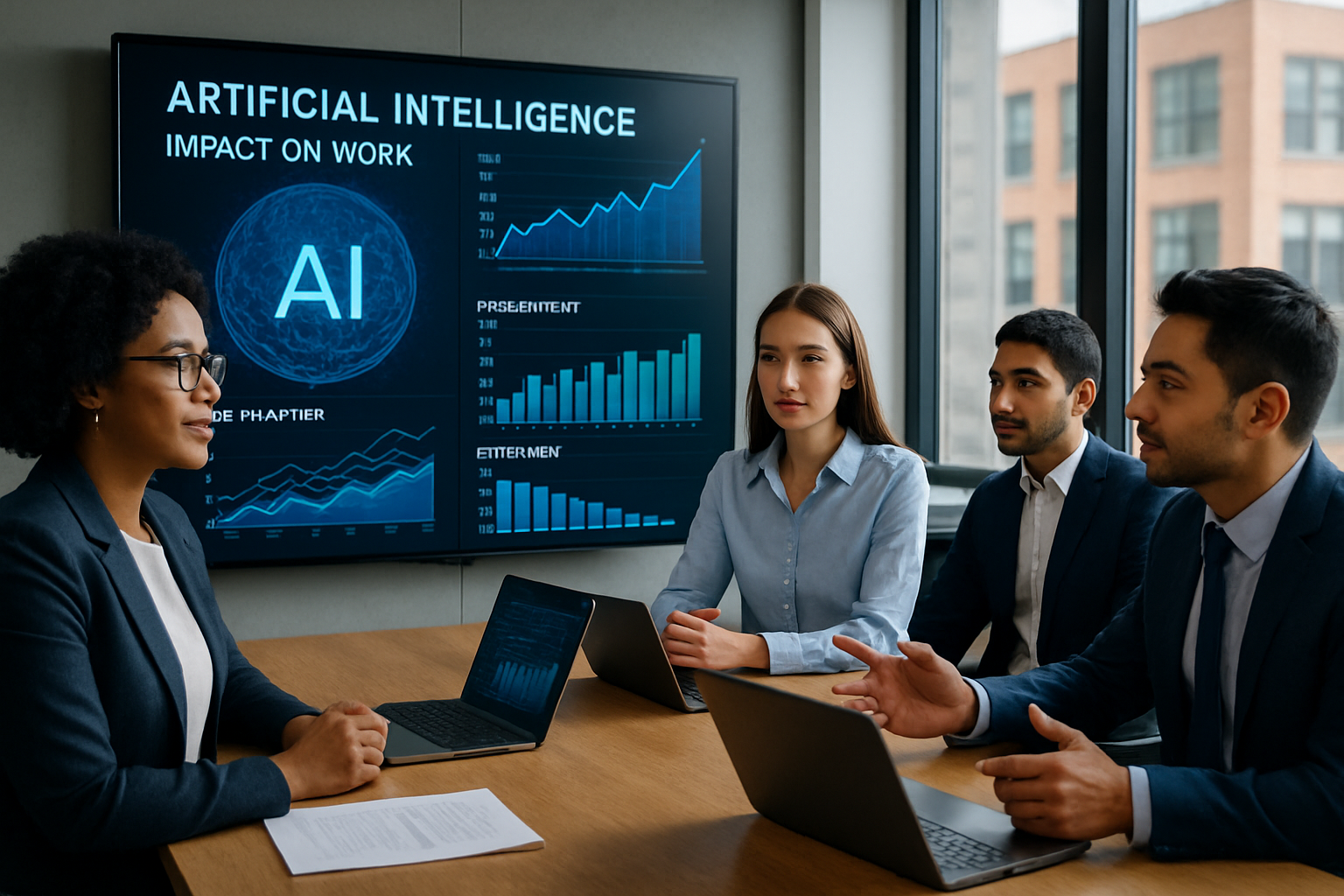
Cyprus Finance Minister Makis Keravnos declared that artificial intelligence adoption must be accompanied by appropriate investments in skills, education, and worker retraining, emphasizing AI's dual capacity to enhance productivity while creating significant challenges for labor markets and social cohesion.
Speaking amid a global inflection point in AI deployment, Keravnos highlighted the complex reality facing governments and businesses worldwide as artificial intelligence transitions from experimental technology to essential infrastructure across all sectors. His comments come as the technology demonstrates unprecedented capabilities while simultaneously disrupting traditional employment patterns on a massive scale.
The Productivity Promise and Employment Paradox
The Cyprus Finance Minister's warning reflects a growing understanding among policymakers that AI's impact on labor markets represents both unprecedented opportunity and systemic risk. While AI systems show remarkable capability to enhance productivity and efficiency, the same technologies are displacing workers at rates that exceed historical technological transitions.
Recent analysis by Microsoft's Mustafa Suleyman suggests AI could replace the majority of office workers within two years, with lawyers and auditors facing displacement within 18 months. This timeline represents a compression of technological change that prevents the gradual workforce adaptation economists typically assume during major technological shifts.
"AI tools we create and use, combined with smaller, more agile teams, enable a new way of working."
— Jack Dorsey, Block Inc. CEO
The statement accompanied Block Inc.'s decision to eliminate 4,000 positions – 40% of its global workforce – in what represents the largest corporate layoff explicitly attributed to AI replacement in tech industry history. This decision marks a watershed moment where tech executives are openly acknowledging AI's role in employment displacement rather than attributing cuts to financial pressures.
The Productivity Paradox: When AI Creates More Work
Contrary to industry promises, research by German economist Dr. Frank Bäumer reveals that AI implementation often creates "mehr Arbeit und nachlassender Effizienz" (more work and declining efficiency). Workers report experiencing a "double workload effect" – performing their original responsibilities while additionally supervising and correcting AI outputs.
This productivity paradox demonstrates that successful AI integration requires comprehensive change management, worker training, and workflow redesign rather than simply adding AI tools to existing processes. Organizations rushing AI deployment without proper human-centered implementation strategies are experiencing efficiency losses rather than gains.
Global Employment Transformation Patterns
The AI-driven employment transformation shows significant regional variations. Western companies are predominantly implementing traditional layoffs, while Asian companies are investing in comprehensive worker transition programs. Indian IT giants including Infosys, Wipro, and HCL Tech are prioritizing workforce evolution over elimination, providing templates for proactive adaptation strategies.
The phenomenon dubbed "SaaSpocalypse" has eliminated hundreds of billions in market capitalization from traditional software companies as AI systems demonstrate direct replacement capabilities rather than complementary functions. German analysts describe an "apocalypse for software houses" with 20% stock declines across the sector.
Success Models for Human-AI Integration
Despite the challenges, several global success models demonstrate effective human-AI collaboration. Malaysia operates the world's first AI-integrated Islamic school, combining artificial intelligence with traditional learning while maintaining cultural authenticity. Canadian universities have implemented AI teaching assistants that maintain critical thinking standards, and Singapore's WonderBot 2.0 has achieved remarkable success in heritage education.
These successful implementations share common characteristics: sustained political commitment, comprehensive stakeholder engagement, cultural sensitivity, and treating AI as an amplification tool serving human goals rather than an end in itself.
Infrastructure Constraints and Implementation Challenges
The global transformation is occurring amid significant infrastructure constraints. A semiconductor crisis has driven memory chip prices to surge sixfold, affecting Samsung, SK Hynix, and Micron operations until 2027. This creates supply bottlenecks that paradoxically provide workforce adaptation time through forced selective deployment rather than comprehensive automation.
The World Bank projects AI water demand could reach 4.2-6.6 billion cubic meters by 2027 for data center cooling – equivalent to 4-6 times Denmark's annual water withdrawal. These infrastructure challenges are spurring innovation in memory-efficient algorithms and sustainable deployment strategies.
Regulatory Response and International Coordination
Governments worldwide are intensifying regulatory responses to AI's rapid deployment. Spain has implemented the world's first criminal executive liability framework for tech platforms, creating imprisonment risks for executives beyond corporate penalties. France has conducted cybercrime raids on AI companies, while the European Union is investigating Digital Services Act violations with potential billion-dollar penalties.
The United Nations has established an Independent Scientific Panel with 40 experts as the first fully independent global AI impact assessment body, recognizing that AI governance requires unprecedented international cooperation. This represents the most sophisticated global technology governance effort since internet commercialization.
The Critical 2026 Inflection Point
March 2026 represents what experts describe as a "civilizational choice point" determining whether AI serves democratic values and human flourishing or becomes a tool for exploitation requiring dramatic corrections. The convergence of supply chain challenges, regulatory intensification, massive corporate investments, and employment transformation creates unprecedented coordination requirements.
Cyprus Finance Minister Keravnos's emphasis on skills investment and retraining reflects recognition that success depends on resolving infrastructure constraints while developing sustainable business models that prioritize human welfare alongside technological advancement.
Future Workforce Requirements
The transformation requires developing hybrid competencies that span technical AI proficiency with uniquely human capabilities. Future workforce success will depend on emotional intelligence, creative problem-solving, cultural competency, and the ability to collaborate effectively with AI systems rather than compete against them.
Educational institutions are adapting through comprehensive reforms. Ghana's 150,000-graduate Work Readiness Programme, Malaysia's teacher placement success rate of 97.82%, and breakthrough educational technology initiatives across multiple countries demonstrate coordinated international responses to workforce transformation challenges.
Economic Implications and Prevention-First Approaches
Countries implementing comprehensive, culturally-sensitive AI integration approaches report improved community resilience, reduced long-term social service demands, and enhanced international competitiveness through strategic human capital development. Prevention-first approaches generate measurable benefits including reduced crisis intervention costs, decreased unemployment, and improved workforce productivity.
The alternative – technological unemployment without corresponding economic benefits – could create self-reinforcing cycles where reduced consumer spending power leads to business revenue pressure, potentially limiting wage growth and creating economic stagnation.
The Path Forward
Cyprus Finance Minister Keravnos's call for accompanying AI adoption with skills investment reflects growing international consensus that technological advancement must serve broad social benefit rather than primarily advantage capital over labor. The success or failure of current AI integration efforts will likely influence industry practices and policy responses for decades.
The evidence suggests that the most promising path forward involves treating AI as sophisticated amplification tools for human capabilities while preserving creativity, cultural understanding, and democratic values. Success requires unprecedented coordination between governments, technology companies, educational institutions, and civil society to ensure AI serves humanity's highest aspirations while addressing pressing global challenges.
As Cyprus and nations worldwide navigate this critical transformation period, the decisions made in 2026 will determine whether artificial intelligence fulfills its transformative promise or creates systemic risks requiring dramatic corrections. The window for proactive adaptation is narrowing rapidly, making comprehensive approaches to skills development and worker support not just advisable, but essential for sustainable economic and social stability.