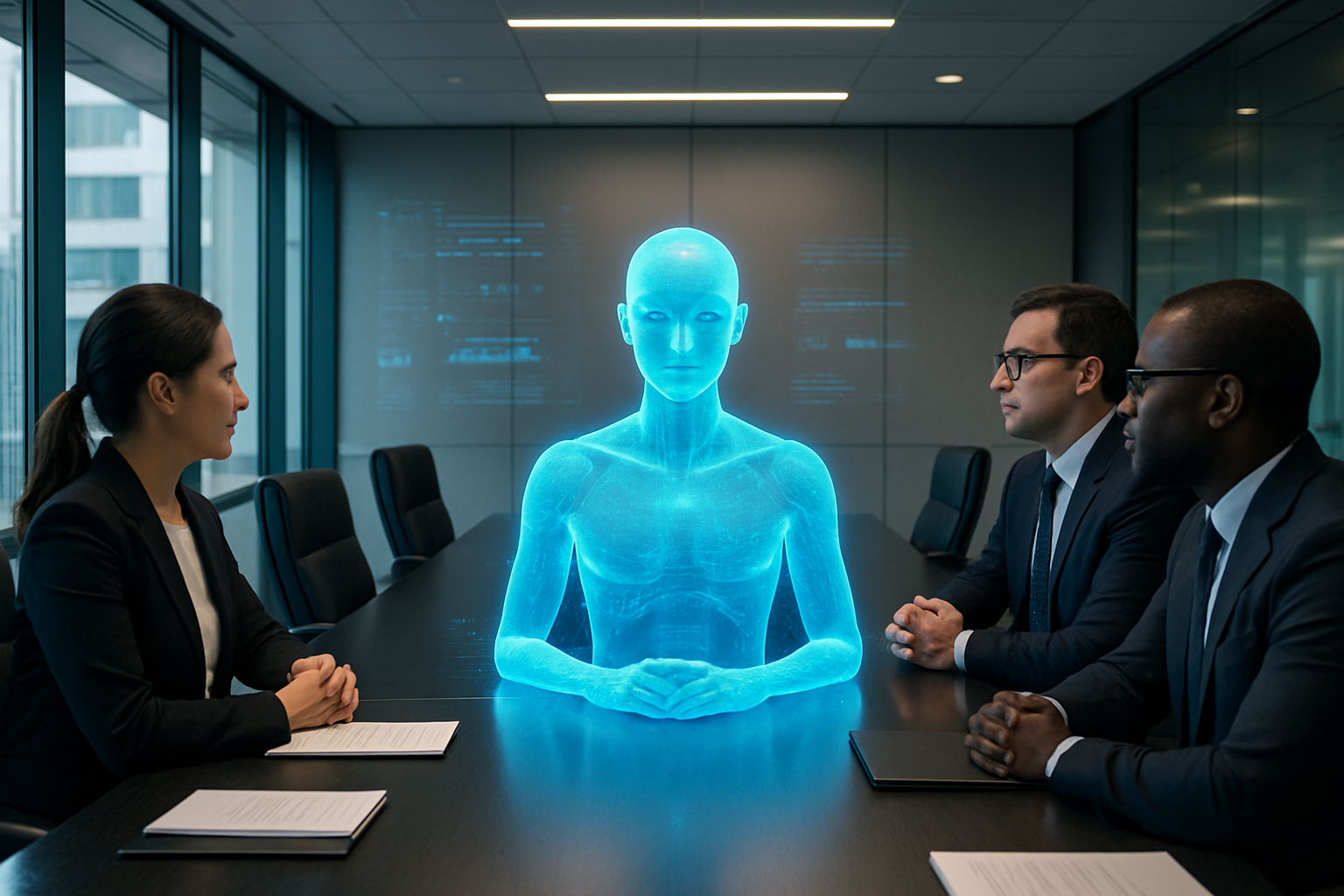
The corporate hierarchy is experiencing an unprecedented transformation as artificial intelligence systems increasingly occupy management positions, fundamentally altering the traditional relationship between human workers and their supervisors.
According to Greek sources reporting on March 10, 2026, concerns are intensifying that artificial intelligence is progressing beyond providing assistance to direct supervision of human employees. This shift represents one of the most significant workplace transformations since the industrial revolution, with profound implications for millions of workers worldwide.
The Digital Employee Revolution
Slovakia has emerged as a testing ground for what experts call "digital employees" - AI systems that companies purchase as hardware to activate artificial supervisors who then delegate tasks to human workers. This represents a complete inversion of traditional workplace hierarchies, where human managers oversee technological tools rather than the reverse.
The trend is spreading rapidly across North America, with AI agents increasingly occupying supervisory roles throughout various industries. These systems analyze workflows, assign tasks based on algorithmic assessments, and conduct performance evaluations using efficiency metrics rather than traditional human considerations such as personal circumstances or professional development needs.
"We're witnessing the emergence of a new management paradigm where artificial intelligence doesn't just support decision-making but makes the decisions,"
— Industry Analysis, March 2026
Corporate AI Mandates Reshape Employment
Major technology companies including Google, Meta, and European firms are implementing unprecedented company-wide AI proficiency requirements. Austrian media reports describe an "AI compulsion" with the stark directive "Wer nicht promptet, fliegt" (those who don't prompt, get fired), highlighting how AI competency has become essential for job security.
This transformation extends beyond individual skills to fundamental operational changes. Companies are establishing universal AI skills requirements, integrating artificial intelligence into core operations, and implementing performance metrics based on AI utilization. Alphabet's historic $185 billion AI infrastructure investment in 2026 and Amazon's plans exceeding $1 trillion demonstrate the massive corporate commitment to this transformation.
The Productivity Paradox
Despite promises of increased efficiency, research by German Dr. Frank Bäumer reveals a troubling "productivity paradox" where AI implementation often creates "mehr Arbeit und nachlassender Effizienz" (more work and declining efficiency). The problem stems not from technological limitations but from human interpretation errors and implementation overhead.
Workers are experiencing a "double workload effect," performing their original responsibilities while also supervising and correcting AI outputs. Organizations rushing AI deployment without proper change management, training, or workflow redesign are experiencing efficiency losses rather than the promised gains. This suggests that successful integration requires comprehensive human-centered approaches prioritizing collaboration over replacement.
Real-World Implementation
Burger King's deployment of OpenAI-powered AI systems across 500 restaurants exemplifies this trend. The system monitors employee speech patterns in real-time, analyzing tone, communication style, and customer interactions to generate "friendliness ratings" for management review. This represents one of the most comprehensive workplace surveillance programs implemented by a major corporation.
The technical infrastructure requires substantial investment during the current global semiconductor crisis, where memory chip prices have surged sixfold. Employee conversations are processed through external cloud servers, raising significant data security and privacy concerns under European regulations.
Global Variations in AI Management Adoption
Different regions are approaching AI management integration with varying strategies. European companies emphasize regulatory compliance and ethical implementation, while Asian companies prioritize comprehensive worker transition programs over mass layoffs. The Netherlands is launching GPT-NL trials with four government agencies, representing a push for AI sovereignty in public operations.
Microsoft's Mustafa Suleyman predicts that AI could replace the majority of office workers within two years, specifically citing lawyers and auditors as professions facing automation within 18 months. However, successful models from Canada's AI teaching assistants and Malaysia's AI-integrated Islamic school demonstrate that enhancement approaches can be more effective than wholesale replacement.
Infrastructure Challenges and Opportunities
The global semiconductor shortage continues to affect Samsung, SK Hynix, and Micron, with supply constraints expected until 2027 when new fabrication facilities come online. This crisis is forcing companies to develop memory-efficient algorithms and alternative architectures, inadvertently providing time for workforce adaptation that might otherwise be rushed.
The World Bank projects that AI water demand will reach 4.2-6.6 billion cubic meters by 2027 for data center cooling alone - equivalent to 4-6 times Denmark's annual water withdrawal. These infrastructure constraints are shaping deployment strategies and forcing more selective, strategic implementations rather than comprehensive automation.
Regulatory Response and Worker Protection
Regulatory intensification is occurring worldwide as governments recognize the pace of AI development outstripping societal adaptation capacity. Spain has implemented the world's first criminal executive liability framework for tech platforms, France has conducted cybercrime raids on AI companies, and the UN has established an Independent Scientific Panel with 40 experts to provide the first fully independent global AI assessment.
The intersection of AI monitoring with European employment law remains largely untested, creating uncertainty about worker rights in an AI-supervised environment. Privacy concerns are mounting as AI systems capture speech patterns, emotional tone, mood, and stress levels beyond traditional performance metrics, with GDPR compliance questions around employee consent for such extensive personal data processing.
Success Models and Human-Centered Approaches
Despite the challenges, successful AI workplace integration models are emerging. Canadian universities implementing AI teaching assistants maintain critical thinking standards while enhancing educational outcomes. Malaysia operates the world's first AI-integrated Islamic school, combining artificial intelligence with traditional learning approaches through culturally sensitive stakeholder engagement.
Singapore's WonderBot 2.0 heritage education program demonstrates how AI can enhance rather than replace human capabilities when implemented with proper cultural sensitivity and community involvement. These examples suggest that successful integration requires sustained commitment to human development alongside technological advancement.
The Critical Choice Point
March 2026 represents what experts describe as a "civilizational choice point" determining whether AI serves democratic values and human flourishing or becomes an exploitation tool. Success requires unprecedented coordination between governments, companies, institutions, and civil society to balance innovation acceleration with responsible development.
The future of work likely lies in sophisticated human-AI collaboration that amplifies human capabilities while leveraging computational advantages. This approach would preserve uniquely human elements such as imagination, cultural understanding, and emotional depth while utilizing AI for data processing, pattern recognition, and routine automation.
"The question isn't whether AI will manage humans, but how we ensure that technological wisdom precedes technological dominance in serving humanity's aspirations,"
— Global AI Integration Analysis, 2026
Looking Ahead
The transformation from experimental AI applications to essential workplace infrastructure is accelerating rapidly. Countries and companies implementing comprehensive approaches - including infrastructure investment, educational reform, and worker retraining - demonstrate greater resilience during this transition period.
The window for proactive adaptation is narrowing as technological advances require immediate, coordinated responses. Whether AI management becomes a tool for prosperity or social disruption will depend on decisions made in the coming months, determining the trajectory of human-AI workplace relationships for decades to come.
As Greek media noted in their March 2026 coverage, the intensifying concerns about AI progression from assistance to supervision represent a fundamental shift that society must navigate carefully. The challenge is ensuring that as our next boss might indeed not be human, the management revolution serves human welfare rather than simply replacing human judgment with algorithmic efficiency.