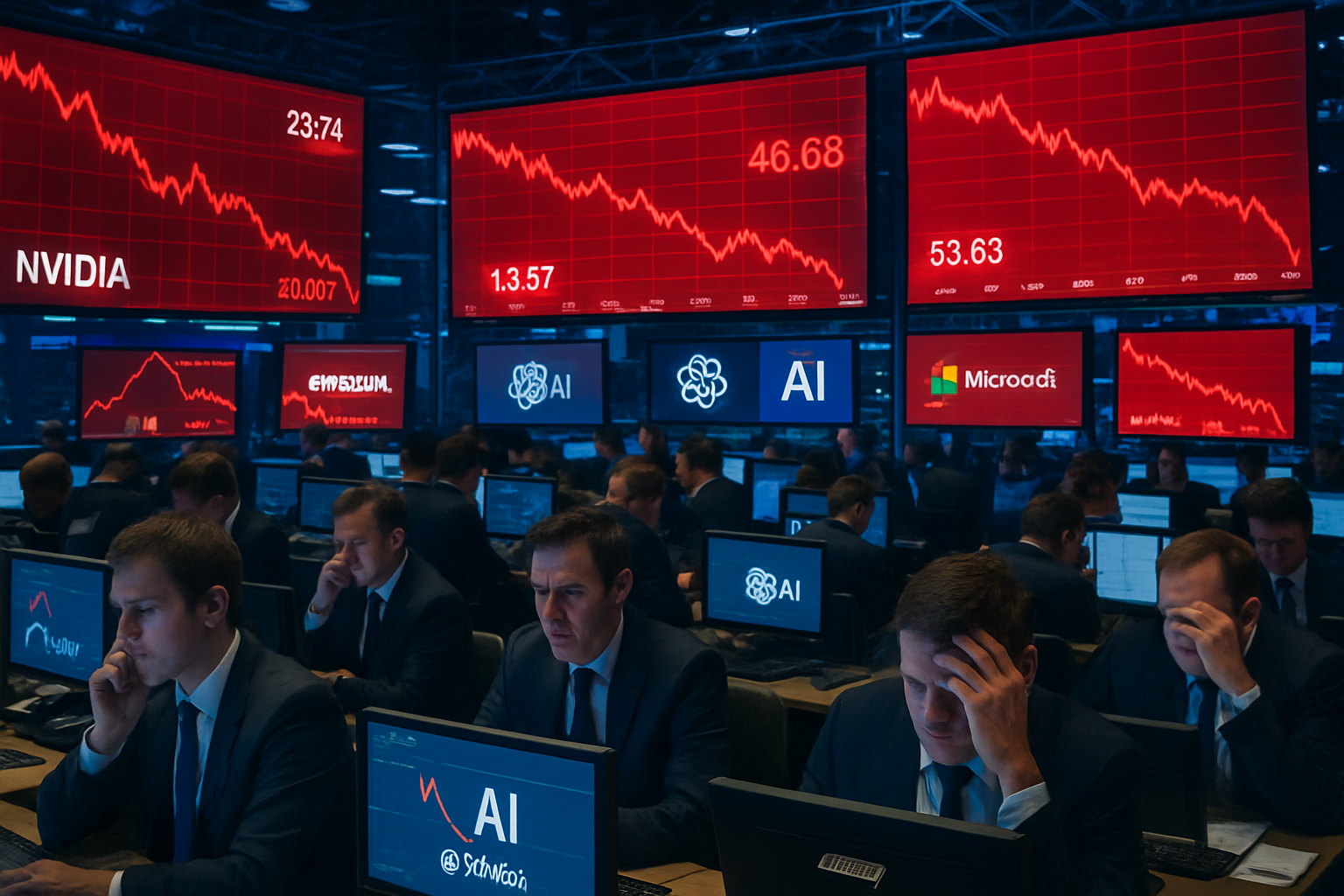
Global technology markets are experiencing unprecedented volatility as artificial intelligence development concerns intensify, with major tech stocks declining sharply amid conflicting signals about the sector's future and massive infrastructure investments.
The latest wave of market turbulence centers around Alphabet, Google's parent company, which announced a historic $180 billion AI infrastructure investment for 2026 - the largest single-year technology investment in corporate history. Despite reporting exceptional Q4 2025 results with $34.5 billion in profits and $113.8 billion in quarterly revenue, investors punished the stock over concerns about monetizing the massive chip and data center spending.
This announcement came as Elon Musk reached an unprecedented personal milestone of $800 billion in net worth, making him the first person to surpass this threshold. However, his subsequent comments about money's inability to buy happiness have sparked widespread online debate, highlighting the complex relationship between extreme wealth and market dynamics in the AI era.
Market Leaders Dismiss AI Plugin Panic
Google CEO Sundar Pichai and Nvidia's Jensen Huang have publicly dismissed the current market panic over AI capabilities as "overblown," specifically addressing concerns triggered by Anthropic's new AI tools. The reaction was particularly severe following demonstrations of Anthropic's advanced legal workflow automation capabilities, which sparked fears about AI replacing traditional software solutions.
"AI should be viewed as an enabling tool rather than a replacement threat. The market reaction doesn't reflect the actual technological reality."
— Sundar Pichai, Google CEO
Huang, CEO of Nvidia, has argued that AI will enhance rather than replace existing software systems, urging companies to focus on their core competencies while integrating AI capabilities. This perspective comes as his company continues to face supply constraints amid the ongoing global memory crisis.
Historical Context of AI Market Volatility
The current turmoil builds on a series of market disruptions that began with the "SaaSpocalypse" in early February 2026. This started with massive selloffs following Anthropic's Claude AI demonstrations of sophisticated legal work capabilities, which erased approximately $285 billion in market capitalization across the software sector.
The situation was further complicated by Chinese AI company DeepSeek's breakthrough advancement, which triggered additional $300 billion in tech stock losses. Indian IT giants including Infosys, Wipro, HCL Tech, and Persistent Systems saw their stocks decline by 6% during early trading periods.
German financial analysts have described the situation as an "apocalypse for software houses," with some stocks falling up to 20% as investors grappled with AI's potential to disrupt traditional software business models.
Infrastructure Crisis Compounds Market Concerns
The AI sector faces a critical infrastructure bottleneck that is significantly impacting market sentiment. Memory chip prices have surged sixfold due to generative AI development demand outstripping supply, with manufacturers Samsung, SK Hynix, and Micron operating at full capacity but unable to meet demand.
This memory crisis is expected to persist until 2027 when new fabrication facilities come online, creating a fundamental constraint on AI development and deployment. Consumer electronics, including smartphones, computers, and gaming consoles, are facing cost increases of 20-30% over the next 12-18 months.
OpenAI has expressed dissatisfaction with Nvidia chips and is exploring alternatives, adding another layer of uncertainty to the hardware ecosystem that supports AI development. The search for chip alternatives reflects the industry's struggle with supply chain dependencies and infrastructure limitations.
Regulatory Pressures Mount Globally
The market volatility occurs against a backdrop of intensifying regulatory scrutiny across multiple jurisdictions. French cybercrime units have raided X's Paris offices over Grok AI violations, while Spain has announced aggressive social media regulations including criminal liability for platform executives.
The European Union is coordinating an unprecedented regulatory response, with multiple countries implementing age restrictions for social media platforms and enhanced content moderation requirements. These regulatory developments add compliance costs and operational complexity for AI companies, contributing to investor uncertainty.
Investment Paradox: Record Spending Amid Market Skepticism
The current market situation presents a paradox where companies are making record investments in AI infrastructure while investors express growing skepticism about returns on these investments. Alphabet's $180 billion commitment represents a fundamental bet on AI as the dominant computing paradigm, but markets are questioning the timeline for monetization.
JPMorgan analysts have noted "intense scrutiny over AI's potential impact on business models," reflecting broader uncertainty about how traditional software and service companies will adapt to AI-powered alternatives. The scale of required investments is creating barriers for smaller competitors while raising questions about sustainable competitive advantages.
Global Market Implications
The AI market volatility has demonstrated significant global interconnections, with effects spreading beyond traditional technology hubs. Argentina's country risk indicator has surged above 500 points, while various emerging markets show mixed responses to the technology sector uncertainty.
Pakistan's KSE-100 provided a rare positive note with gains of over 1,100 points, while European markets prepare for continued turbulence. The situation highlights how sector-specific concerns in AI and technology can cascade through global financial systems.
Looking Forward: Infrastructure vs. Innovation
As the AI revolution transitions from experimental phase to essential infrastructure, the industry faces critical decisions about balancing innovation pace with sustainable business models. The current volatility reflects a fundamental reassessment of AI market leadership and competitive dynamics.
Companies must navigate supply chain constraints, regulatory compliance, and investor expectations while maintaining technological advancement. The memory shortage and infrastructure limitations suggest that success in the AI era will depend as much on operational excellence as on algorithmic innovation.
The market's response to Alphabet's massive investment will likely set precedents for how investors evaluate large-scale AI infrastructure commitments. Whether this volatility represents a temporary adjustment or signals deeper structural challenges for the AI sector remains to be seen as companies work to demonstrate sustainable returns on their unprecedented investments.