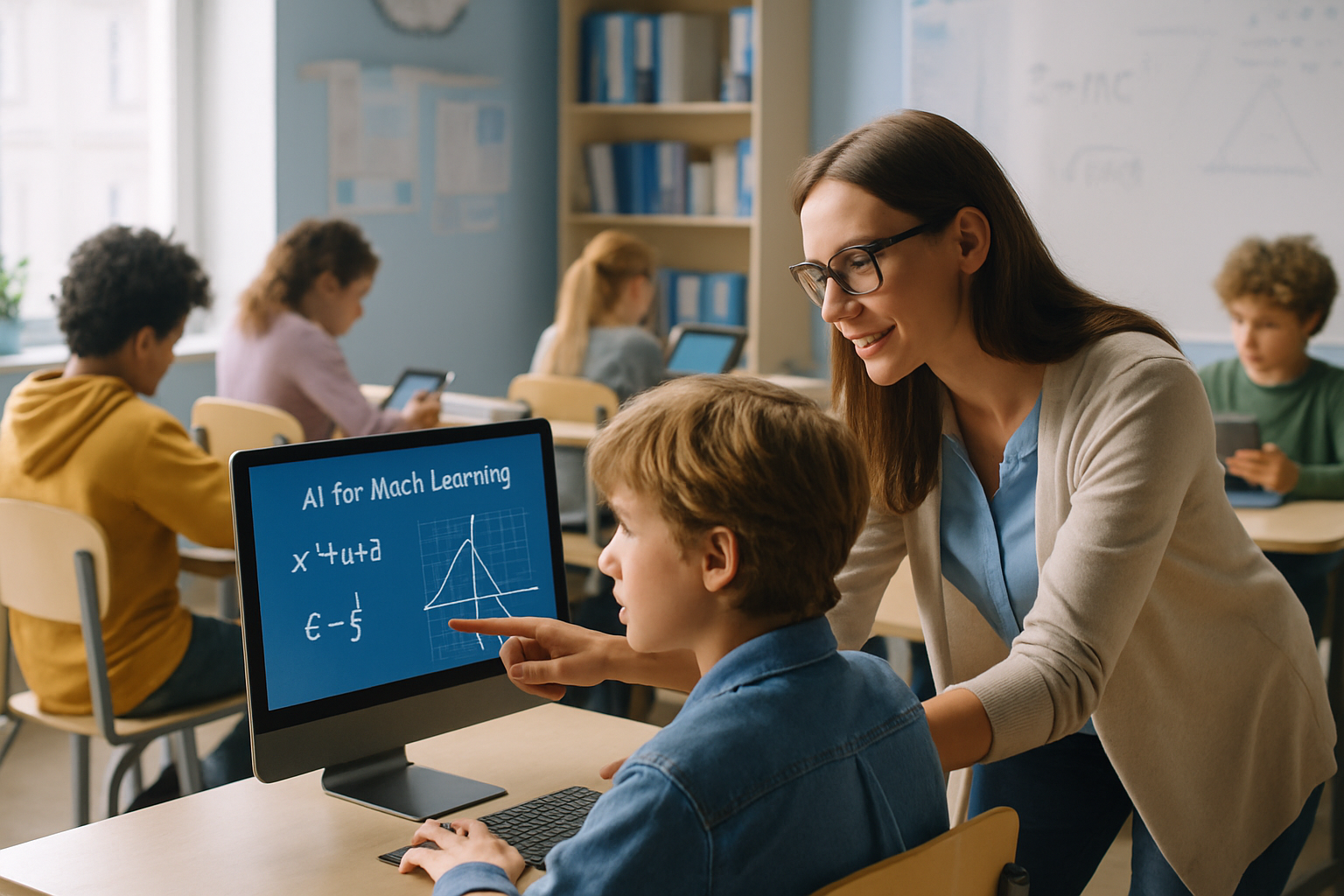
Austrian researchers at FH Vorarlberg have developed a groundbreaking AI-powered mathematics chatbot designed to reduce learning frustration and improve student engagement with mathematical concepts through personalized, step-by-step guidance.
The innovative tutoring system, unveiled in March 2026, represents a significant advancement in educational technology, positioning Austria as a leader in human-centered AI approaches to mathematics education. Unlike traditional automated learning systems, this chatbot is specifically engineered to provide appropriate thought prompts and guidance tailored to individual student needs.
Revolutionary Approach to Mathematics Learning
The FH Vorarlberg development team has created a system that addresses one of education's most persistent challenges: mathematics anxiety and student frustration. According to the research team, the AI tool is designed to guide students through complex mathematical problems step-by-step, offering just the right amount of assistance without providing complete solutions.
"The key innovation lies in the system's ability to provide appropriate thought prompts rather than direct answers," explains the development team's approach. This methodology ensures students actively engage with mathematical concepts while receiving personalized support when they encounter difficulties.
"This represents a fundamental shift from traditional automated tutoring systems that often either provide too much help or leave students struggling alone."
— Educational Technology Researcher, FH Vorarlberg
Addressing the Global Mathematics Education Crisis
The timing of this development is particularly significant given worldwide challenges in mathematics education. Recent international assessments have revealed declining mathematical proficiency among students, with many experiencing heightened anxiety around mathematical subjects.
The Austrian system's focus on reducing frustration addresses a critical barrier to mathematical learning. Research consistently shows that negative emotional associations with mathematics can create lasting impediments to student success in STEM fields, making emotional support as crucial as pedagogical content.
Integration with Global Educational Technology Renaissance
This Austrian innovation emerges within the broader "2026 Educational Technology Renaissance," a coordinated international movement toward thoughtful digital tool integration with traditional educational values. The FH Vorarlberg chatbot exemplifies successful AI implementation that enhances rather than replaces human teaching relationships.
Similar successful models worldwide include Malaysia's AI-integrated Islamic schools, which combine artificial intelligence with traditional learning approaches, and Singapore's WonderBot 2.0, which demonstrates effective conversational AI for heritage education. Canadian universities have also successfully implemented AI teaching assistants while maintaining critical thinking standards.
Technical Innovation and Human-Centered Design
The Austrian system's sophisticated approach involves analyzing student responses and emotional indicators to determine the appropriate level of intervention. Rather than providing immediate answers, the AI identifies specific conceptual gaps and offers targeted prompts to guide students toward understanding.
This methodology aligns with educational research emphasizing the importance of productive struggle in learning. By maintaining student agency in the problem-solving process while providing strategic support, the system aims to build genuine mathematical understanding and confidence.
Addressing Implementation Challenges
The development occurs amid global infrastructure challenges, including the ongoing semiconductor crisis that has driven memory chip prices up sixfold, affecting educational technology implementation worldwide. However, the Austrian team has designed their system to be resource-efficient, making it practical for widespread deployment despite these constraints.
The project also addresses concerns about AI over-dependence in education. Unlike systems that risk creating student reliance on artificial assistance, the FH Vorarlberg chatbot is specifically designed to gradually reduce support as students develop confidence and competency.
Cultural Sensitivity and Local Adaptation
The Austrian approach emphasizes cultural sensitivity in educational technology implementation. The system has been designed to complement existing Austrian educational practices rather than replace traditional teaching methods. This philosophy aligns with successful international models that demonstrate the importance of adapting technological tools to serve specific cultural and educational contexts.
Research from various global implementations shows that the most successful educational AI systems enhance existing relationships between teachers and students rather than substituting for human interaction. The FH Vorarlberg system is designed to free teachers from routine assistance tasks, allowing them to focus on higher-order mathematical thinking and individual student mentorship.
Future Implications and Scaling Potential
Early indicators suggest the Austrian system could serve as a template for broader implementation across Europe and internationally. The emphasis on reducing learning frustration while maintaining educational rigor addresses universal challenges in mathematics education.
The development team anticipates potential applications beyond mathematics, with the underlying approach applicable to other subjects where students commonly experience anxiety and learning barriers. The success of this pilot could influence educational policy discussions throughout the German-speaking world and beyond.
Impact on Teacher Roles and Professional Development
Rather than threatening teacher employment, the Austrian system is positioned to enhance educator effectiveness. By handling routine explanations and basic guidance, the AI system allows teachers to focus on complex problem-solving instruction, creative mathematical applications, and individual student support.
This evolution reflects broader trends in educational transformation, where successful AI integration amplifies human capabilities rather than replacing them. Teachers using the system report increased satisfaction as they can dedicate more time to meaningful educational interactions and less time to repetitive explanations.
Measuring Success and Long-term Outcomes
The FH Vorarlberg team has established comprehensive metrics for evaluating the system's effectiveness, including traditional academic performance measures alongside emotional well-being indicators. Preliminary data suggests improvements in both mathematical competency and student attitudes toward mathematical learning.
Long-term studies will assess whether reduced learning frustration translates into sustained engagement with mathematical concepts and improved performance in advanced coursework. The team is particularly interested in tracking how the system affects students' willingness to pursue STEM fields in higher education.
International Collaboration and Knowledge Sharing
The Austrian development reflects growing international cooperation in educational technology. The FH Vorarlberg team has engaged with researchers worldwide, contributing to global knowledge sharing about effective AI implementation in education.
This collaborative approach aligns with successful international models demonstrating that educational technology advancement requires sustained political commitment, comprehensive stakeholder engagement, and cultural sensitivity. The Austrian system's success could inform similar developments across Europe and provide insights for developing nations seeking to implement educational technology solutions.
As the "2026 Educational Technology Renaissance" continues to evolve, the FH Vorarlberg mathematics chatbot represents a promising model for human-centered AI implementation that prioritizes student well-being alongside academic achievement. The system's emphasis on reducing frustration while maintaining educational rigor offers hope for addressing persistent challenges in mathematics education worldwide.