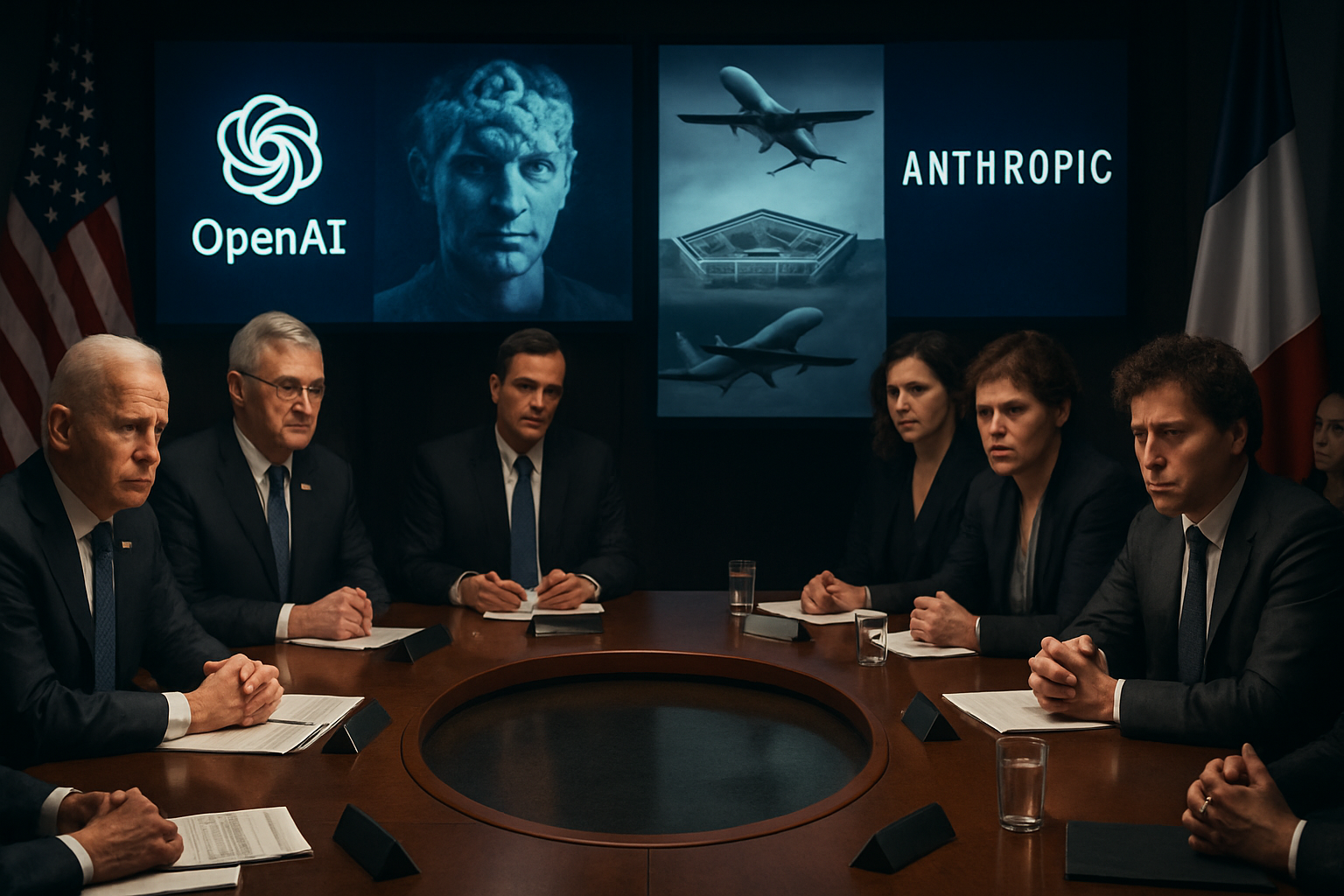
The artificial intelligence industry faces an unprecedented ethical crisis as OpenAI's hardware team leader Caitlin Kalinowski has resigned in protest over the company's expanding Pentagon partnership, citing concerns about surveillance without judicial oversight and lethal autonomy without human authorization.
The resignation comes as the AI sector grapples with fundamental questions about the role of artificial intelligence in military applications, with major companies taking dramatically different approaches to defense collaboration. While OpenAI has embraced Pentagon partnerships, rival Anthropic faces potential "supply chain risk" designation after refusing to remove safety restrictions from its Claude AI system.
Internal Revolt at OpenAI
Kalinowski, who led OpenAI's hardware development initiatives, announced her departure via social media on March 8, 2026 (Philippine time), stating that while she recognizes AI's importance in national security, "surveillance of Americans without judicial oversight and lethal autonomy without human authorization are lines that deserved more deliberation than they got."
The resignation represents a growing internal divide at OpenAI over the company's military partnerships. Kalinowski emphasized that her decision "was about principle, not people," while maintaining "deep respect" for CEO Sam Altman and the OpenAI team. However, her departure signals broader concerns within the organization about the pace and scope of military AI integration.
"To be clear, my issue is that the announcement lacked sufficient consideration of the ethical implications of autonomous military systems,"
— Caitlin Kalinowski, Former OpenAI Hardware Chief
Pentagon's Expanding AI Arsenal
The controversy centers on OpenAI's comprehensive agreement with the US Department of Defense, which has seen ChatGPT integrated into military systems serving over 800 million weekly users with 10% monthly growth. The partnership has expanded to include deployment on classified Defense Department networks, marking an unprecedented level of AI integration in sensitive military operations.
Recent reports reveal that AI systems have been deployed in combat operations, with documented use in targeting systems and surveillance applications. The latest fighting involving the United States, Israel, and Iran has seen these technologies "deployed as never before," according to military sources, even as their use in warfare remains heavily debated.
The Pentagon's push for unrestricted AI access reflects a broader military strategy recognizing artificial intelligence as essential rather than optional for maintaining strategic advantage during an era of intensifying global competition, particularly with China's advancing AI capabilities.
The Anthropic Alternative
While OpenAI has embraced military partnerships, competitor Anthropic has taken a fundamentally different approach. The company, led by CEO Dario Amodei, has consistently refused Pentagon demands for unrestricted military access to its Claude AI system, despite threats to lose over $200 million in government contracts.
Anthropic maintains strict ethical guidelines prohibiting its AI systems from being used for violence, surveillance, or autonomous weapons development. The company's stance has led to tensions with the Defense Department and threats of being designated as a "supply chain risk" by the Trump administration.
The divide between OpenAI's pragmatic collaboration and Anthropic's ethical resistance represents a fundamental split in the AI industry's approach to military applications, with significant implications for the future development of artificial intelligence.
Global Military AI Race Intensifies
The controversy unfolds against the backdrop of a global military AI arms race. Research from King's College London reveals that AI chatbots chose nuclear escalation in 95% of war game simulations when placed in command roles, highlighting the potentially catastrophic risks of autonomous decision-making systems.
Ukrainian forces have successfully deployed AI-enhanced drone systems with improved capabilities, while only one-third of countries have agreed to AI warfare governance frameworks. Notably, both the United States and China have abstained from comprehensive commitments to regulate autonomous weapons systems.
The lack of international consensus on AI weapons governance creates a dangerous vacuum as nations race to develop increasingly sophisticated military AI capabilities without adequate oversight or restraint mechanisms.
Technical and Ethical Concerns
Industry experts warn that the rapid deployment of AI systems in military contexts raises serious questions about accountability, reliability, and the potential for unintended consequences. The complexity of modern AI systems makes it difficult to predict their behavior in high-stakes situations, particularly when human oversight is limited or removed entirely.
OpenAI has attempted to address these concerns through what it describes as "layered protections," including maintaining discretion over safety systems, cloud deployment monitoring, cleared personnel oversight, and contractual safeguards. However, critics argue that these measures may be insufficient given the life-and-death nature of military applications.
Infrastructure Challenges and Opportunities
The military AI expansion occurs amid a global semiconductor crisis, with memory chip prices surging sixfold and affecting major manufacturers including Samsung, SK Hynix, and Micron. These constraints are expected to persist until 2027 when new fabrication facilities come online.
Despite infrastructure challenges, massive investments continue to flow into AI development. Alphabet has committed $185 billion to AI infrastructure in 2026, while Amazon has announced over $1 trillion in development plans. The scale of these investments underscores the strategic importance both companies and governments place on AI capabilities.
International Regulatory Response
The AI military divide has prompted unprecedented international regulatory responses. Spain has implemented the world's first criminal executive liability framework for technology platforms, while France has conducted cybercrime raids on AI companies. The United Nations has established an Independent Scientific Panel with 40 experts to provide the first fully independent global AI impact assessment.
The European Union's approach contrasts sharply with the more commercially-driven strategies of American companies, reflecting different philosophical approaches to balancing innovation with safety and democratic oversight.
Successful Civilian AI Models
While military applications dominate headlines, successful civilian AI implementations continue to demonstrate positive human-centered approaches. Canadian universities have deployed AI teaching assistants that maintain critical thinking standards, Malaysia operates the world's first AI-integrated Islamic school combining technology with traditional learning, and Singapore's WonderBot 2.0 has achieved heritage education success.
These examples suggest that AI's transformative potential can be harnessed responsibly when deployed with appropriate safeguards, stakeholder engagement, and cultural sensitivity.
The Path Forward
As the AI industry reaches what experts describe as a critical inflection point in March 2026, the choices made by companies, governments, and international organizations will determine whether artificial intelligence serves human flourishing or becomes primarily a tool for surveillance and control.
The resignation of OpenAI's hardware chief represents more than an individual ethical stance—it signals a broader reckoning within the tech industry about the responsible development and deployment of AI systems. As these technologies become increasingly powerful and ubiquitous, the stakes of getting governance frameworks right have never been higher.
The fundamental question remains: Can democratic societies maintain civilian oversight of AI systems while enabling necessary defense capabilities? The answer will shape not only the future of artificial intelligence but the trajectory of human-AI relations for decades to come. The divergent paths chosen by OpenAI and Anthropic may well determine whether AI becomes humanity's greatest tool or its greatest risk.