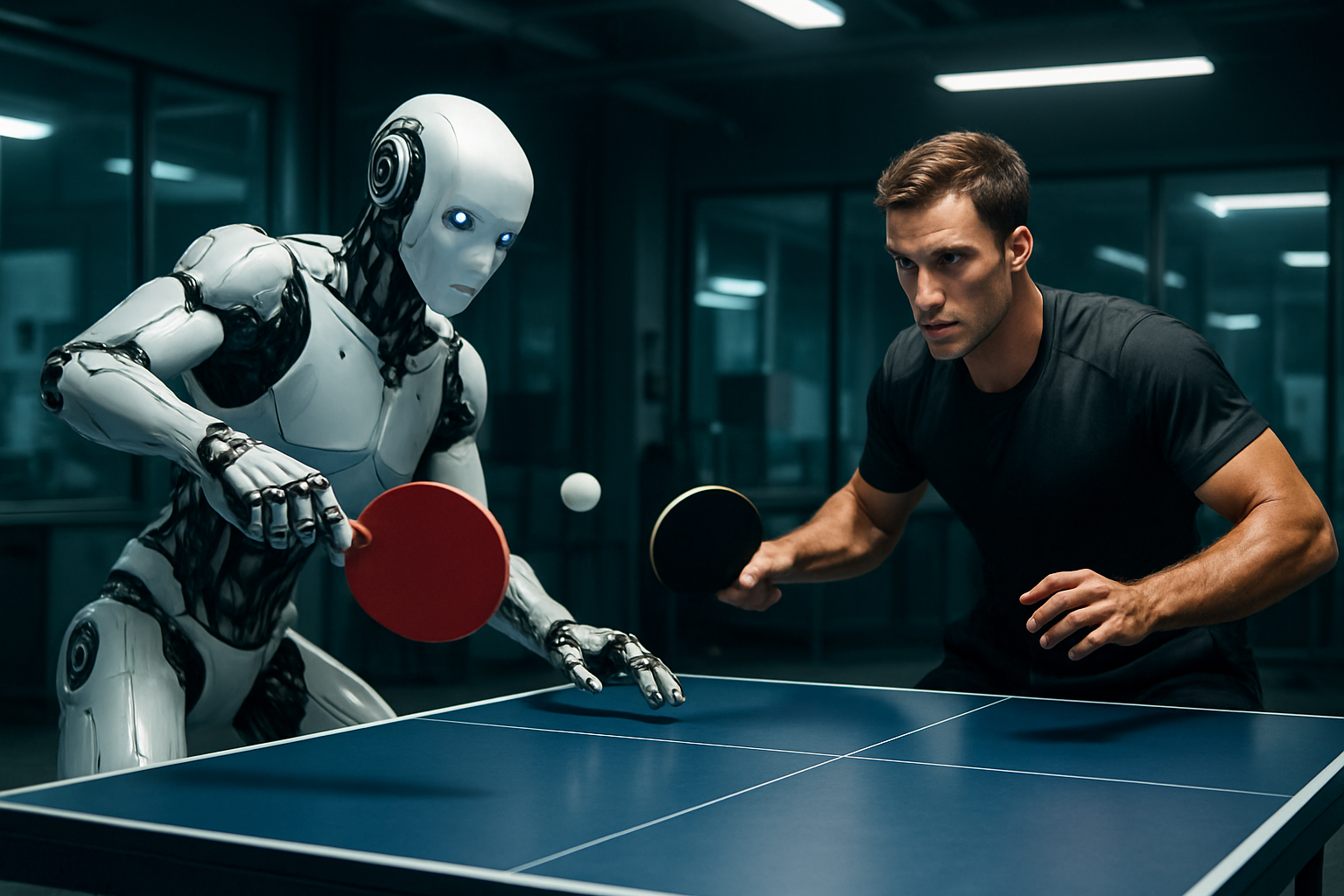
An autonomous artificial intelligence ping-pong robot has made sporting history by becoming the first machine to defeat professional human players in the fast-paced, precision-demanding sport of table tennis, marking a revolutionary breakthrough in AI athletics and robotics capabilities.
The achievement, reported across multiple international sources, represents a significant milestone in the intersection of artificial intelligence, robotics, and competitive sports. Unlike previous robotic achievements in strategic games like chess or Go, this victory demonstrates AI's ability to excel in real-time physical competition requiring split-second reactions, precise motor control, and adaptive strategy.
Technical Breakthrough in Real-Time Competition
Table tennis has long been considered one of the most challenging sports for robotic systems due to the extreme speeds involved, with professional balls reaching velocities exceeding 100 mph, combined with complex spin patterns and the unpredictable nature of human opponents. The sport demands not only lightning-fast reflexes but also sophisticated prediction algorithms to anticipate ball trajectory and opponent behavior.
According to Swiss analysis, table tennis represented a particular "acid test" for robotics research, with machines previously failing due to the combination of high speeds, rotating balls, and unpredictable human adversaries. The breakthrough represents years of advancement in computer vision, machine learning, and precision mechanical engineering.
The robot, developed with Austrian technical support and Sony AI involvement, demonstrates that machines can now compete at elite levels in sports requiring both physical precision and strategic thinking. This achievement builds upon China's broader robotics revolution, where companies like Unitree have scaled humanoid robot production from 5,500 units in 2025 to over 20,000 units in 2026.
Strategic Context of AI in Sports
The victory comes amid a broader transformation in AI capabilities across athletic applications. Recent months have seen Chinese humanoid robots achieve unprecedented athletic milestones, including completing a half-marathon faster than human world records, demonstrating the rapid evolution of AI physical capabilities.
This ping-pong breakthrough is particularly significant because it represents success in a sport that combines the strategic complexity of traditional board games with the physical demands and real-time decision-making required in dynamic athletic competition. Unlike the controlled environment of chess or Go, table tennis requires adaptation to physical variables including air resistance, table surface conditions, and opponent psychology.
The achievement aligns with global trends in sports democratization, where technological advancement is breaking down traditional barriers to elite performance. Advanced AI systems are increasingly able to analyze and execute complex athletic maneuvers previously thought to require uniquely human capabilities like intuition and split-second adaptability.
Implications for Robotics Development
The success in ping-pong represents more than just a sporting achievement—it demonstrates significant advances in several critical robotics technologies. The robot must integrate high-speed computer vision to track the ball's trajectory, sophisticated physics modeling to predict spin and bounce patterns, and precision motor control to execute returns with millimeter accuracy.
These technological capabilities have immediate applications beyond sports, including manufacturing automation, surgical robotics, and autonomous vehicle navigation. The ability to make split-second decisions in unpredictable environments while maintaining precise physical control represents a major step toward more versatile and capable robotic systems.
The breakthrough also highlights the accelerating pace of AI development in physical applications. While previous AI victories in games like chess and Go required enormous computational power but no physical interaction, this achievement demonstrates AI's growing mastery over real-world physical challenges.
Global Competition and Innovation
The ping-pong robot's success fits within a broader pattern of international competition in AI and robotics development. Countries worldwide are investing heavily in AI capabilities, with particular focus on applications that combine artificial intelligence with physical systems.
This achievement comes as nations grapple with how to manage AI's rapid development while ensuring it serves human welfare. Recent months have seen increased international coordination through bodies like the UN Independent Scientific Panel on AI, as policymakers work to balance innovation with responsible development.
The sporting context provides a relatively benign arena for demonstrating advanced AI capabilities, allowing researchers to showcase technological progress while highlighting the potential for human-AI collaboration rather than replacement. Unlike applications in warfare or surveillance, AI athletic achievement celebrates human ingenuity while pushing technological boundaries.
Human-AI Collaboration Model
Notably, the ping-pong robot's victory doesn't necessarily represent a threat to human players but rather opens new possibilities for training and competition. Similar to how chess computers ultimately improved human play by providing new analytical tools and training partners, AI ping-pong systems could enhance human athletic development.
The robot's consistent performance and ability to execute perfect shots repeatedly could serve as an ideal training partner, helping human players develop their skills against an opponent that never tires and can adjust difficulty levels precisely. This represents the type of human-AI collaboration that experts consider most promising for technological development.
Success stories in other domains, including AI teaching assistants in Canadian universities and AI-integrated educational systems in Malaysia, demonstrate that the most effective AI applications often involve augmenting rather than replacing human capabilities.
Technical Specifications and Performance
While specific technical details remain proprietary, the robot's victory required breakthrough advances in multiple engineering domains. High-speed cameras capable of tracking ping-pong balls traveling over 100 mph, combined with machine learning algorithms that can predict trajectories accounting for spin and air resistance, represent significant computational achievements.
The mechanical systems must execute returns with accuracy measured in millimeters while generating appropriate spin and speed to challenge professional human opponents. This level of precision, combined with the speed required for competitive play, pushes the boundaries of current robotics capabilities.
The achievement also demonstrates advances in AI decision-making under time pressure, as the robot must choose optimal shot placement and strategy while operating within the split-second timeframes that define competitive table tennis.
Future Implications and Applications
The ping-pong robot's success signals broader implications for AI development across multiple sectors. The combination of real-time decision-making, precise physical control, and adaptive strategy required for this achievement has applications in autonomous vehicles, medical robotics, manufacturing automation, and space exploration.
As AI systems demonstrate increasing capability in complex physical tasks, questions about integration with human society become more pressing. The sporting context provides a positive framework for considering how advanced AI might complement rather than replace human activities.
Looking ahead, this breakthrough likely represents just the beginning of AI advancement in athletic competition. As robotic systems continue improving, we may see AI competitors in other sports requiring physical precision and real-time decision-making, potentially reshaping our understanding of the relationship between human and artificial intelligence.
The achievement stands as a testament to human ingenuity in creating machines capable of matching our own athletic abilities, while raising important questions about the future of competition, training, and the evolving partnership between humans and artificial intelligence in the years ahead.