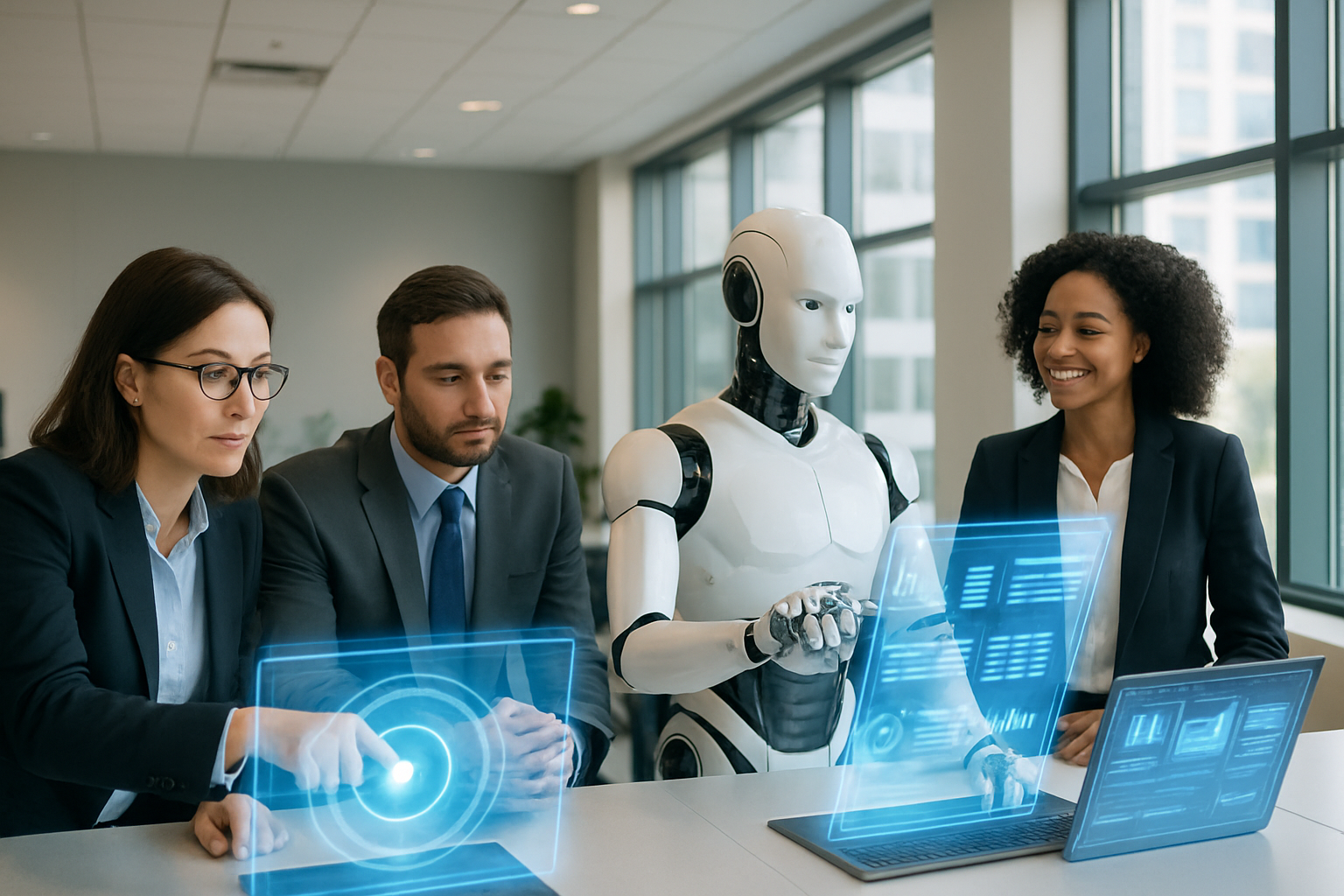
As artificial intelligence rapidly advances toward human-level capacity, tech industry leaders are making unprecedented predictions about which jobs will survive the coming automation wave, with human-centered roles emerging as the last bastion against AI replacement.
Google DeepMind CEO Demis Hassabis delivered a stark timeline at the AI Impact Summit 2026 in New Delhi, predicting that general artificial intelligence will arrive within five to eight years. "We are between 5 and 8 years away from achieving artificial intelligence that can reason in a similar way to humans," Hassabis declared, describing the rapid evolution of this technology that could fundamentally reshape the global workforce.
The "Einstein Test" and Human-Level AI
To measure this advancement, Hassabis proposed a revolutionary evaluation standard called the "Einstein Test," designed to determine when AI systems can match human cognitive abilities across complex reasoning tasks. This ambitious benchmark represents more than academic measurement—it signals when AI could theoretically replace human workers in knowledge-based professions.
The roadmap to achieving this goal requires combining the strategic planning capabilities of systems like AlphaGo with the massive processing scale of modern foundational models. This convergence could create AI systems capable of independent decision-making, complex problem-solving, and creative reasoning previously reserved for human intelligence.
Bill Gates' Prediction: Three Surviving Job Categories
Microsoft co-founder Bill Gates has identified what he believes will be the only three job categories that artificial intelligence cannot fully replace. According to recent reports, Gates estimates that AI will profoundly transform the job market, with most routine and analytical tasks becoming automated as AI systems gain capability.
"The majority of routine and analytical tasks could be automated as AI systems become more sophisticated, but certain professions should remain largely protected from total replacement by machines."
— Bill Gates, Microsoft Co-founder
Gates' three protected categories focus on roles requiring uniquely human qualities: emotional intelligence, interpersonal relationships, and creative problem-solving that involves human understanding and empathy. These predictions align with broader industry analysis showing that jobs requiring human connection, creativity, and complex social interaction will prove most resilient to AI automation.
Current Employment Disruption Trends
The predictions from Gates and Hassabis come as the technology sector already experiences significant workforce transformation. Microsoft's Mustafa Suleyman has warned that AI could replace the majority of office workers within two years, with lawyers and auditors facing automation within 18 months.
The ongoing "SaaSpocalypse" has already eliminated hundreds of billions in market capitalization as AI systems demonstrate capability to directly replace traditional software functions. Indian IT giants including Infosys, Wipro, and HCL Tech have experienced significant stock declines as artificial intelligence threatens core business services previously requiring human expertise.
Infrastructure Challenges and Reality Checks
Despite ambitious predictions, significant infrastructure constraints could slow AI deployment. The global memory crisis has created sixfold semiconductor price increases affecting major manufacturers Samsung, SK Hynix, and Micron, with shortages expected until 2027 when new fabrication facilities come online.
The World Bank projects that AI water demand could reach 4.2-6.6 billion cubic meters by 2027—equivalent to four to six times Denmark's annual water withdrawal—for data center cooling requirements. These physical limitations suggest that while AI capabilities may advance rapidly, widespread deployment faces practical bottlenecks.
Successful AI Integration Models
Educational institutions are pioneering human-AI collaboration models that could provide templates for workplace integration. Canadian universities have successfully implemented AI teaching assistants while maintaining critical thinking standards, demonstrating that technology can enhance rather than replace human capabilities when properly designed.
Malaysia launched the world's first AI-integrated Islamic school, combining artificial intelligence with traditional naqli (religious) and aqli (academic) learning. These success stories emphasize human-centered approaches that use AI to augment rather than eliminate human roles.
Regulatory and Ethical Considerations
As AI capabilities expand, international regulatory frameworks are intensifying. The United Nations has established an Independent International Scientific Panel on Artificial Intelligence with 40 experts—the first fully independent global AI impact assessment body. European authorities have implemented unprecedented measures including Spain's criminal executive liability for AI platforms and France's cybercrime enforcement actions.
These developments suggest that AI deployment will occur within increasingly structured governance frameworks designed to balance innovation with social responsibility, potentially slowing the pace of job displacement while ensuring ethical implementation.
Economic and Social Implications
The transition to an AI-integrated economy presents both opportunities and challenges. Countries positioning themselves as AI leaders—including India's hosting of the first major AI summit in the Global South—recognize that success requires balancing technological advancement with workforce development and social stability.
The employment implications extend beyond individual job categories to fundamental questions about economic structures, social safety nets, and educational systems. As routine tasks become automated, the premium on uniquely human skills—creativity, emotional intelligence, complex relationship management—will likely increase dramatically.
Preparing for the AI Future
The convergence of predictions from tech leaders and current market trends suggests that the job market transformation will occur more rapidly than many anticipated. Workers in analytical and routine positions may need to develop complementary skills that leverage human strengths alongside AI capabilities.
Organizations implementing AI systems most successfully appear to be those that prioritize human-AI collaboration over replacement, creating hybrid models where technology enhances human capabilities rather than eliminating them entirely.
"The stakes extend beyond individual institutions, requiring AI-integrated global economy preparation while maintaining critical thinking, creativity, and interpersonal skills that define human potential."
— Educational Technology Analysis, February 2026
As we approach this critical inflection point in 2026, the decisions made by governments, technology companies, educational institutions, and individual workers will determine whether AI transformation serves human flourishing or creates unprecedented social and economic disruption. The window for proactive adaptation appears to be narrowing as rapidly as AI capabilities are expanding.