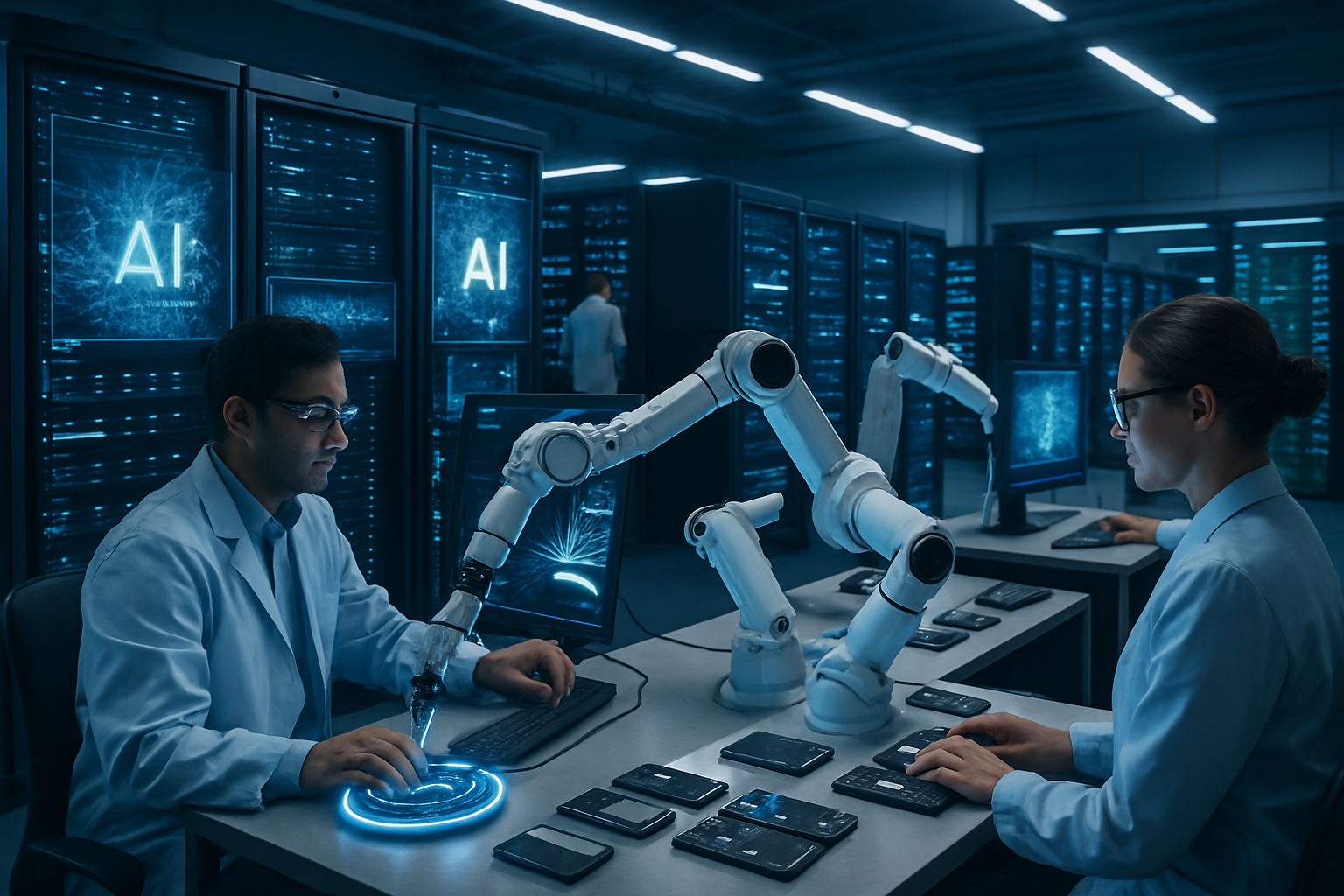
The artificial intelligence revolution reached a critical inflection point in March 2026 as global technology markets witnessed unprecedented developments across AI hardware, smartphone innovation, and workplace automation, fundamentally reshaping industry trajectories amid ongoing infrastructure challenges.
AI Glasses Market Explosion
The AI glasses market experienced explosive growth, with global shipments reaching 8.7 million units in 2025, marking a dramatic 322% increase according to market analysts Omdia. Meta retained its dominant position with an 85.2% market share, shipping 7.4 million units during the year – a 281.3% growth rate driven by strong demand for Oakley and second-generation Ray-Ban-branded AI glasses.
The surge reflects rapidly rising interest in this emerging device category as technology companies accelerate development and market expansion. Meta has actively expanded distribution into countries including India, Mexico and Brazil, fueling further adoption of augmented reality capabilities integrated into everyday eyewear.
Smartphone Industry Faces Challenges
Global smartphone shipments are forecast to decline by around 7% year-on-year in 2026, according to market intelligence firm Omdia. The forecast is based on first-quarter memory price assumptions, indicating that pricing pressure and constrained supply are expected to begin easing during the second half of the year.
Despite the anticipated easing, the global smartphone market faces significant challenges as tightening memory supply and elevated pricing place increasing cost pressures on vendors. Memory costs now account for a significantly larger share of the smartphone bill of materials, eroding vendor profitability, particularly in entry-level devices.
"Since the fourth quarter of 2025, smartphone manufacturers have already begun raising retail prices in an effort to maintain profit margins"
— Omdia Market Analysis Report
Revolutionary Workplace AI Integration
The global adoption of generative artificial intelligence continued to grow in the second half of 2025, rising by 1.2% compared with the first half of the year, with roughly one in six people worldwide now using generative AI tools, according to analysis released by the Microsoft AI Economy Institute in January.
Kazakhstan emerged as a leader in Central Asia for AI adoption, while Latvia's Tilde developed groundbreaking language technology solutions. The leading language technology company adapted its large language model TildeOpen LLM for translation and integrated it into a machine translation platform that provides reliable high-quality translations into 34 European languages.
Manufacturing Innovation and 3D Printing
Apple is analyzing the possibility of using 3D aluminum printing in iPhone production processes, in an attempt to make device manufacturing more efficient and cheaper. The technology could be used for iPhone casings as well as some Apple Watch components, representing a significant shift in manufacturing methodology.
This development comes amid broader industry transformation as companies seek to optimize production costs while maintaining quality standards during challenging supply chain conditions.
Infrastructure Constraints and Solutions
The technology industry continues to grapple with a global memory semiconductor crisis, with prices surging sixfold affecting Samsung, SK Hynix, and Micron operations. Consumer electronics costs have increased 20-30% over the past year, with shortages expected to persist until 2027 when new fabrication facilities come online.
Despite these constraints, massive investments continue across the sector. Alphabet committed $185 billion to AI infrastructure in 2026, while Amazon announced over $1 trillion in AI development plans, demonstrating industry confidence in long-term technological transformation.
Global Regulatory Response
International regulatory frameworks are rapidly evolving to address AI development. Spain implemented the world's first criminal executive liability framework for social media platforms, while France conducted cybercrime raids on AI companies. The UN established an Independent Scientific Panel with 40 experts under António Guterres, representing the first fully independent global AI assessment body.
This coordinated international response represents the most sophisticated global technology governance effort since internet commercialization, as nations grapple with balancing innovation acceleration with responsible development.
Educational Technology Renaissance
The "2026 Educational Technology Renaissance" has emerged as a coordinated international movement toward thoughtful digital tool integration with traditional educational values. Malaysia operates the world's first AI-integrated Islamic school, while Canada implements university AI teaching assistants that maintain critical thinking standards. Singapore's WonderBot 2.0 has achieved heritage education success.
These successful models demonstrate that AI can enhance rather than replace fundamental human relationships in learning when implemented with cultural sensitivity and clear pedagogical objectives.
Employment and Workforce Transformation
The "SaaSpocalypse" has eliminated hundreds of billions in traditional software market cap as AI systems demonstrate direct replacement capabilities for conventional solutions. Microsoft's Mustafa Suleyman predicts AI could replace the majority of office workers within two years, with lawyers and auditors facing automation within 18 months.
However, regional variations exist in response strategies. Indian IT giants like Infosys, Wipro, and HCL are adapting through worker transition programs rather than mass layoffs, demonstrating more measured approaches to workforce transformation.
Looking Ahead: Critical Decisions
March 2026 represents a critical juncture in determining AI's transformative promise versus potential systemic disruption. Success requires unprecedented coordination between governments, technology companies, educational institutions, and civil society to balance innovation acceleration with safety governance, commercial interests with human welfare, and national competitiveness with international cooperation.
The evidence suggests that the most promising path involves AI serving as sophisticated amplification tools for human capabilities, preserving creativity, cultural understanding, and democratic values while addressing pressing global challenges through thoughtful governance frameworks.
"The future lies in sophisticated human-AI collaboration that enhances creativity and cultural understanding while leveraging computational advantages"
— Technology Industry Analysis
Conclusion
The developments of March 2026 underscore a fundamental transformation in how humanity interacts with artificial intelligence across all sectors. From AI glasses revolutionizing personal computing to workplace automation reshaping employment landscapes, these changes demand thoughtful navigation to ensure technology serves human flourishing rather than creating systemic disruption.
As infrastructure constraints drive innovation in efficiency and international cooperation intensifies around governance frameworks, the decisions made in 2026 will likely determine the trajectory of human-AI relationships for decades to come. The challenge lies in harnessing this technological revolution responsibly while preserving the essentially human elements that provide meaning and purpose in our interconnected world.