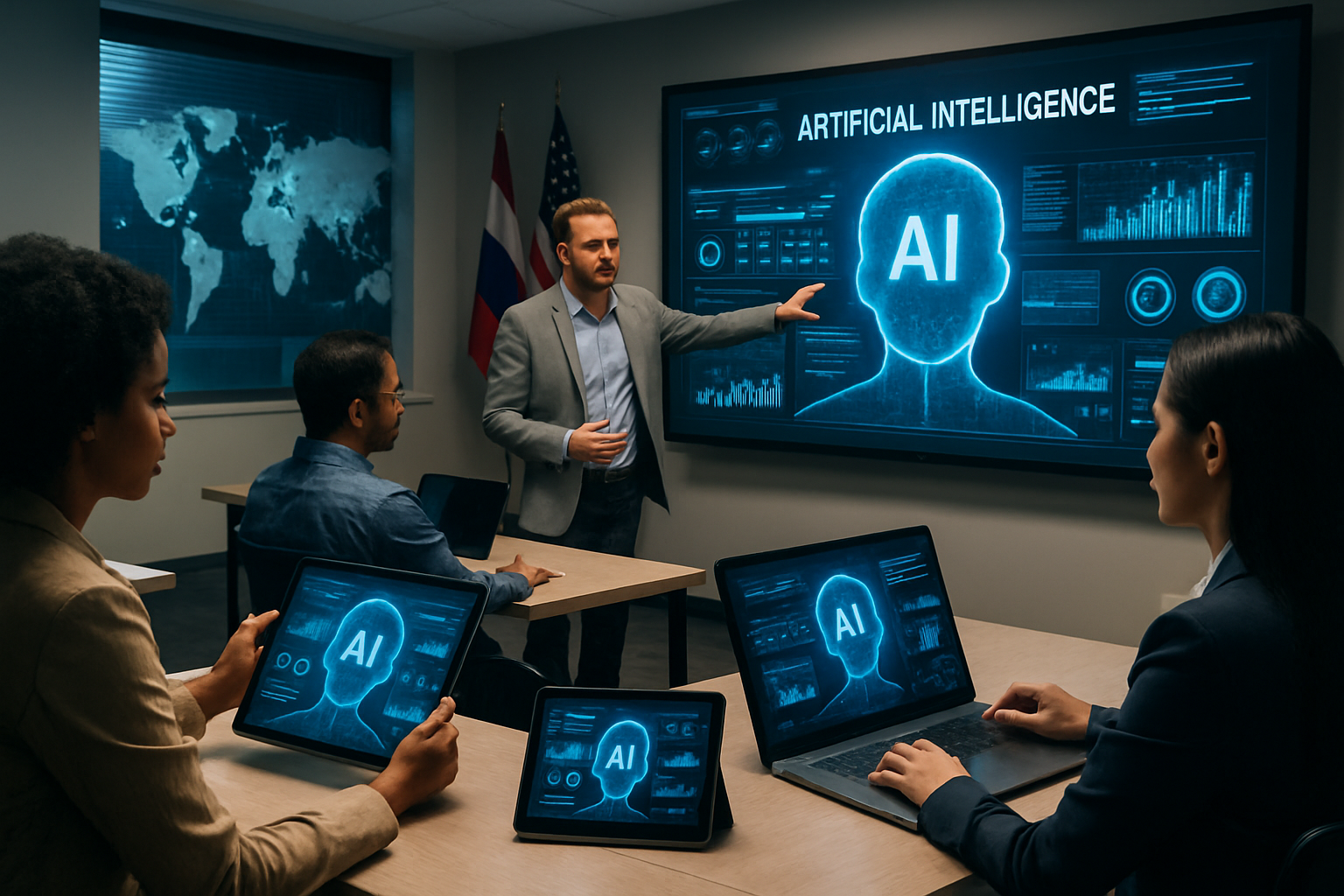
A global transformation is underway as organizations across five continents implement artificial intelligence solutions in education and business operations, marking February 2026 as a pivotal month for AI integration in critical sectors worldwide.
From Argentina's corporate training partnerships to China's logistics automation breakthroughs, new evidence reveals how AI is fundamentally reshaping both educational institutions and business operations. The developments span multiple countries and represent billions in investment as organizations race to harness AI's transformative potential while addressing implementation challenges.
Argentina Leads Corporate-Education AI Partnerships
Argentina has emerged as a leader in bridging AI education gaps through innovative corporate partnerships. Ford Argentina, in collaboration with Fundación Forge, launched a comprehensive free virtual training program in Data Analytics and Automation with AI, specifically targeting young people aged 18-24. The initiative, with registration open until March 12, 2026, represents a strategic investment in developing the next generation of AI-capable professionals.
The program addresses critical skills gaps identified by AI analysis, which recommends three specific career paths showing strong growth potential: roles in data analytics, automation engineering, and AI systems management. These positions offer significant advantages including remote work capabilities, international project opportunities, and compensation often paid in foreign currencies, making them particularly attractive in Argentina's current economic environment.
"The demand for AI-skilled professionals is creating unprecedented opportunities for young people willing to invest in technical education,"
— Ford Argentina Training Initiative
Kuwait's Educational System Embraces Google AI Tools
Kuwait's Ministry of Education launched a groundbreaking project implementing Google for Education AI tools in partnership with Google, targeting approximately 40,000 secondary school teachers and department heads. The initiative represents a major national strategic commitment to integrating AI technologies into educational processes according to international standards.
Assistant Undersecretary for Educational Affairs Hamad Al-Hamad emphasized that the project constitutes a significant national strategic initiative aimed at enabling educators to utilize AI technologies safely and ethically. The program focuses on enhancing digital competency and developing teaching practices through structured AI implementation.
The Kuwait initiative demonstrates how governments are taking proactive approaches to AI education integration, ensuring teachers receive comprehensive training before technology deployment to students. This measured approach contrasts with ad-hoc AI adoption seen in some other educational systems.
China Achieves AI-Driven Logistics Efficiency Breakthrough
China reported record-breaking logistics efficiency improvements for 2025, with the total social logistics costs to GDP ratio falling to 13.9 percent—the lowest level on record. This improvement, down from 14.1 percent in 2024, was directly attributed to rapid adoption of AI technologies and delivery drones according to the National Development and Reform Commission.
The achievement means that for every 100 yuan of economic output, only 13.9 yuan was spent on logistics costs, representing significant productivity gains through AI automation. The improvement was driven by expanding infrastructure investment combined with systematic deployment of AI-powered logistics optimization, autonomous delivery systems, and predictive analytics for supply chain management.
This breakthrough demonstrates AI's potential for massive efficiency gains in business operations, with implications extending far beyond China's borders as global supply chains adopt similar technologies.
Slovakia Reports AI Healthcare Integration Success
Slovakia's healthcare system has successfully integrated AI tools into medical practice, with artificial intelligence becoming a standard component of European healthcare delivery. New AI-powered diagnostic tools can predict disease risks with up to 10 years advance notice, representing a paradigm shift from reactive to predictive medicine.
Healthcare professionals report that AI assistance is particularly valuable in five key areas: diagnostic imaging analysis, patient monitoring systems, treatment protocol optimization, administrative efficiency, and early disease detection. The technology enables medical professionals to focus more time on patient care while AI handles routine analytical tasks.
The Slovak experience illustrates how AI integration in professional services requires careful implementation that enhances rather than replaces human expertise, providing a model for other healthcare systems worldwide.
Global Memory Crisis Challenges AI Expansion
Despite rapid AI adoption, organizations face significant infrastructure challenges due to the ongoing global memory crisis. Semiconductor prices have increased sixfold, affecting major manufacturers including Samsung, SK Hynix, and Micron, who are operating at full capacity to meet explosive AI demand.
The shortage is expected to persist until 2027 when new fabrication facilities come online, creating bottlenecks for AI implementations worldwide. Consumer electronics costs have increased 20-30% over the past year due to supply constraints, while data center operators report significant challenges in scaling AI infrastructure.
Organizations are responding by developing memory-efficient AI algorithms, implementing cloud-based solutions to share resources, and prioritizing AI applications with the highest return on investment during the supply shortage period.
Educational AI Integration Models Emerge
Beyond the specific national programs, broader patterns of AI educational integration are emerging globally. Canadian universities have successfully implemented AI teaching assistants while maintaining critical thinking standards, demonstrating that technology can enhance rather than replace traditional pedagogical approaches.
Malaysia operates the world's first AI-integrated Islamic school, combining technology with traditional religious learning in a model being studied internationally. Singapore's WonderBot 2.0 provides conversational AI for heritage education, while European institutions focus on AI literacy as essential as traditional digital skills.
These diverse approaches suggest that successful AI educational integration requires cultural adaptation and clear pedagogical objectives rather than one-size-fits-all technology deployment.
Business Sector AI Adoption Accelerates
Beyond education, business adoption of AI technologies is accelerating across sectors. Corporate implementations range from customer service automation and predictive analytics to supply chain optimization and human resources management.
Organizations report that successful AI business integration requires comprehensive staff training, clear governance frameworks, and gradual implementation strategies that allow for adjustment and optimization. Companies focusing on employee upskilling alongside technology deployment show higher success rates than those attempting wholesale replacement of human capabilities.
The business AI revolution is creating new job categories while transforming existing roles, requiring workforce development strategies that balance technological advancement with human capital development.
International Cooperation and Knowledge Sharing
The global nature of AI development is fostering increased international cooperation in both educational and business contexts. Countries are sharing best practices, developing joint training programs, and creating frameworks for cross-border AI skill recognition.
International organizations are establishing standards for AI education and business implementation, while bilateral partnerships enable knowledge transfer between nations at different stages of AI adoption. This cooperation is essential as AI capabilities develop rapidly and require coordinated responses to maximize benefits while minimizing risks.
The February 2026 developments demonstrate that AI integration success depends not just on technological capabilities but on thoughtful implementation strategies, comprehensive training programs, and international collaboration to address shared challenges and opportunities.
Looking Forward: Sustainable AI Integration
As AI continues transforming education and business sectors, organizations must balance innovation with sustainability, human development with technological advancement, and global cooperation with local adaptation. The initiatives launched in February 2026 provide templates for successful AI integration that other organizations worldwide can adapt to their specific contexts and needs.
Success in the AI revolution will ultimately depend on how well organizations can harness technological capabilities while preserving human creativity, critical thinking, and cultural values that remain essential for thriving societies and economies.