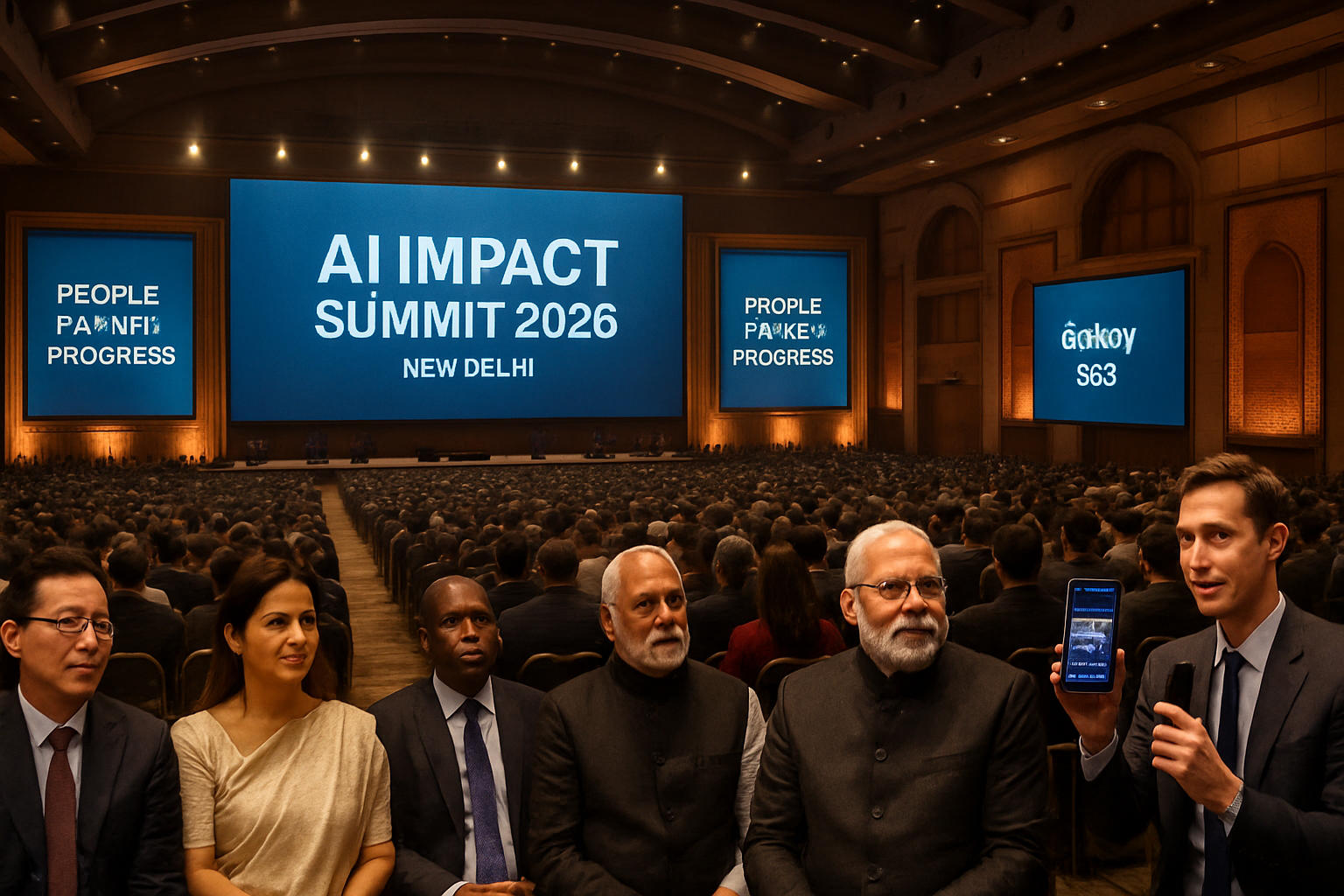
February 2026 has emerged as the most critical inflection point in artificial intelligence history, as global leaders gathered for the unprecedented AI Impact Summit 2026 in New Delhi while Samsung unveiled its groundbreaking Galaxy S26 lineup featuring industry-first Privacy Display technology, marking a decisive moment in the transition from experimental to essential AI infrastructure worldwide.
Historic AI Summit Positions Global South as Technology Leader
The AI Impact Summit 2026, held February 16-20 in New Delhi, represented a watershed moment for international AI governance. As the first major AI conference hosted in the Global South, the summit welcomed over 250,000 delegates from more than 100 countries, including technology leaders Google's Sundar Pichai, OpenAI's Sam Altman, Nvidia's Jensen Huang, and Anthropic's Dario Amodei.
Prime Minister Narendra Modi positioned India as a bridge between advanced and developing economies through his "People, Planet, Progress" framework, emphasizing that AI must remain "deeply human-centric, aligned with global development goals" at this "civilizational inflection point." The summit's Delhi Declaration, signed by 88 countries, established the largest AI diplomatic agreement in history, positioning developing nations as equal partners rather than passive technology recipients.
"India brings scale and energy to everything it does, and this summit was no exception," Modi declared during the opening ceremony. Representatives from over 100 nations witnessed thousands of young people exploring AI exhibitions, their curiosity transforming the event into what organizers called "the most democratized AI summit in world history."
Samsung's Privacy Revolution in Mobile Technology
Coinciding with the global AI governance discussions, Samsung Electronics unveiled its Galaxy S26 series at Galaxy Unpacked in San Francisco, featuring the industry's first Privacy Display technology. This revolutionary hardware-level privacy feature controls pixel light dispersion to prevent side-angle viewing, effectively eliminating "shoulder surfing" without permanent screen protectors.
The comprehensive Galaxy S26 lineup—including the S26, S26+, and S26 Ultra—integrates a multi-agent Galaxy AI ecosystem spanning Notes, Clock, Gallery, Reminders, and Calendar applications, plus third-party integrations through confirmed partnerships including Perplexity AI. The system combines on-device neural processing with secure cloud capabilities via encrypted channels.
"This represents Samsung's evolution from a hardware manufacturer to an AI-powered technology platform," industry analysts noted. The Privacy Display technology can be activated on-demand while maintaining full display quality when privacy isn't necessary, addressing growing workplace and public transportation security concerns.
Global Infrastructure Crisis Constrains AI Development
Despite ambitious AI plans worldwide, the industry faces unprecedented infrastructure challenges. The global memory crisis has driven semiconductor prices up sixfold, affecting Samsung, SK Hynix, and Micron operations with shortages expected until 2027 when new fabrication facilities come online. Consumer electronics costs have increased 20-30%, creating severe AI development bottlenecks.
The World Bank projects AI water demand could reach 4.2-6.6 billion cubic meters by 2027 for data center cooling—equivalent to four to six times Denmark's annual water withdrawal. This environmental challenge adds urgency to calls for sustainable AI development approaches.
"The infrastructure constraints are forcing us to prioritize efficiency and sustainability in ways we never imagined,"
— Technology Industry Executive
Despite these constraints, massive investments continue. Alphabet committed $185 billion to AI infrastructure in 2026, while Amazon's development plans exceed $1 trillion, representing fundamental bets on AI as essential infrastructure rather than experimental technology.
Urgent Calls for International AI Regulation
The New Delhi summit witnessed dramatic calls for immediate AI governance action. OpenAI CEO Sam Altman demanded "nuclear-style international regulation," citing AI-made pathogens and technological centralization risks. He proposed an International Atomic Energy Agency-similar coordination body specifically for AI oversight.
Google DeepMind CEO Sir Demis Hassabis warned that urgent research on AI threats "needs to be done," predicting general artificial intelligence could arrive within 5-8 years through his proposed "Einstein Test" evaluation standard. Geoffrey Hinton reinforced extinction warnings, suggesting AI should develop "maternal instincts" to prevent humanity's destruction.
Microsoft's Mustafa Suleyman delivered stark employment predictions, warning AI could replace the majority of office workers within two years and lawyers and auditors within 18 months. These warnings coincided with the ongoing "SaaSpocalypse"—a market phenomenon that has eliminated hundreds of billions in traditional software market capitalization as AI demonstrates direct replacement capabilities.
Multipolar AI Competition Reshapes Global Landscape
The summit revealed a rapidly evolving multipolar AI landscape challenging traditional Silicon Valley dominance. Chinese breakthroughs, particularly with DeepSeek's advanced capabilities, have triggered market volatility and forced reassessment of Western technological supremacy assumptions.
European efforts toward digital sovereignty gained momentum with Germany's Deutsche Telekom opening an "Industrial AI Cloud" in Munich through NVIDIA partnerships. Switzerland advocates open-source solutions for AI and cloud independence, viewing open-source technology as particularly attractive for achieving technological autonomy.
South Korean retail investors have poured $507 million into Hong Kong-listed Chinese AI stocks and $154 million into mainland-listed shares between January 2 and February, demonstrating global capital flow toward diverse AI capabilities regardless of geographic origin.
Regulatory Revolution Intensifies Worldwide
The month witnessed unprecedented regulatory intensification across multiple jurisdictions. Spain implemented the world's first criminal executive liability framework for social media platforms, creating personal legal risks for technology executives beyond traditional corporate penalties. France conducted cybercrime raids on AI companies, while the European Union found TikTok violated Digital Services Act provisions with potential penalties reaching billions.
The United Nations established an Independent International Scientific Panel on Artificial Intelligence with 40 global experts led by Secretary-General António Guterres—described as the first fully independent global AI impact assessment body. This represents the most sophisticated attempt at global technology governance since internet commercialization began.
Military AI Applications Create Complex Tensions
The summit occurred amid escalating military-civilian AI tensions. The Pentagon has integrated ChatGPT into military systems while pressuring companies to deploy AI in classified networks without civilian safety restrictions. Ukrainian forces have deployed AI-enhanced drone systems with improved low-light vision capabilities, while only one-third of countries agreed to AI warfare governance declarations as the US and China abstained from comprehensive commitments.
Anthropic faces Department of Defense pressure over safety restrictions, with the Pentagon threatening to designate the company as a "supply chain risk" over its refusal to allow military use of Claude AI for "all lawful purposes." The unauthorized use of Claude in the Nicolás Maduro capture operation, despite terms prohibiting violence and surveillance applications, highlighted fundamental conflicts between AI safety protocols and national security imperatives.
Human-Centered Integration Models Show Promise
Despite technological tensions, successful AI integration models demonstrate the potential for human-centered approaches. Canadian universities have implemented AI teaching assistants while maintaining critical thinking standards, providing templates for educational enhancement rather than replacement.
Malaysia launched the world's first AI-integrated Islamic school, combining artificial intelligence with naqli (religious) and aqli (academic) learning approaches. The initiative successfully demonstrates how technology can enhance cultural and traditional education without compromising foundational values.
Singapore's WonderBot 2.0 conversational AI system has achieved remarkable success in heritage education applications, showing how AI can amplify rather than replace human creativity and cultural understanding.
Investment Surge Amid Market Disruption
The "SaaSpocalypse" market phenomenon has fundamentally altered technology investment patterns as AI systems demonstrate capabilities to replace conventional software solutions directly. Indian IT giants including Infosys, Wipro, and HCL Technologies have experienced stock declines as core services face AI disruption, though companies are adapting through worker transition programs rather than mass layoffs.
China's strategic investments continue reshaping global competition. Unitree Robotics announced production scaling to 10,000-20,000 humanoid robots in 2026, up from 5,500 in 2025, following successful Spring Festival Gala demonstrations. Four Chinese robotics companies showcased advanced capabilities including kung fu and somersaults, marking the transition from laboratory research to mass production.
Environmental and Social Challenges Mount
The AI revolution faces growing environmental and social resistance. Malaysia experienced its first major community protests against data center development, with over 50 residents in Johor state demanding compensation for health impacts and expressing concerns about future water consumption.
French creative industry professionals mounted significant resistance, with 4,000 actors and filmmakers condemning "systematic plundering" by AI tools that reproduce voices and images. This represents widespread anxiety about AI-generated content sophistication threatening traditional livelihoods and artistic integrity.
Critical Decision Point for Humanity
February 2026 represents what experts universally recognize as the most critical AI juncture since the technology boom began. The decisions made during this period will determine whether AI fulfills its transformative promise or creates systemic societal disruption requiring dramatic corrections.
Success requires unprecedented coordination between governments, technology companies, educational institutions, and civil society organizations. The challenge involves balancing innovation acceleration with safety governance, commercial interests with human welfare, and national competitiveness with international cooperation.
"We are at a civilizational choice point. The world must decide whether AI serves democratic values and human flourishing or becomes a tool for exploitation and control,"
— Summit Technology Policy Expert
The Global South's leadership through the Delhi summit represents a fundamental shift in technology governance, positioning developing nations as active participants rather than passive recipients of technological change. This democratization of AI governance may prove as significant as the technology itself.
Looking Forward: Sustainable AI Development
The path forward requires resolving infrastructure constraints while maintaining focus on human welfare and democratic governance. Samsung's Privacy Display technology exemplifies how companies can innovate responsibly, addressing consumer concerns while advancing technological capabilities.
The success of educational integration models in Canada, Malaysia, and Singapore provides blueprints for thoughtful AI adoption that enhances rather than replaces human capabilities. These examples demonstrate that the future lies in sophisticated human-AI collaboration rather than wholesale replacement of human functions.
As the world transitions AI from experimental technology to essential infrastructure, the decisions of February 2026 will echo through decades of human development. The unprecedented coordination witnessed at the Delhi summit, combined with innovative approaches like Samsung's privacy-first technology, suggests that humanity may yet chart a course toward AI that serves human flourishing while preserving the creativity, empathy, and wisdom that define human potential.