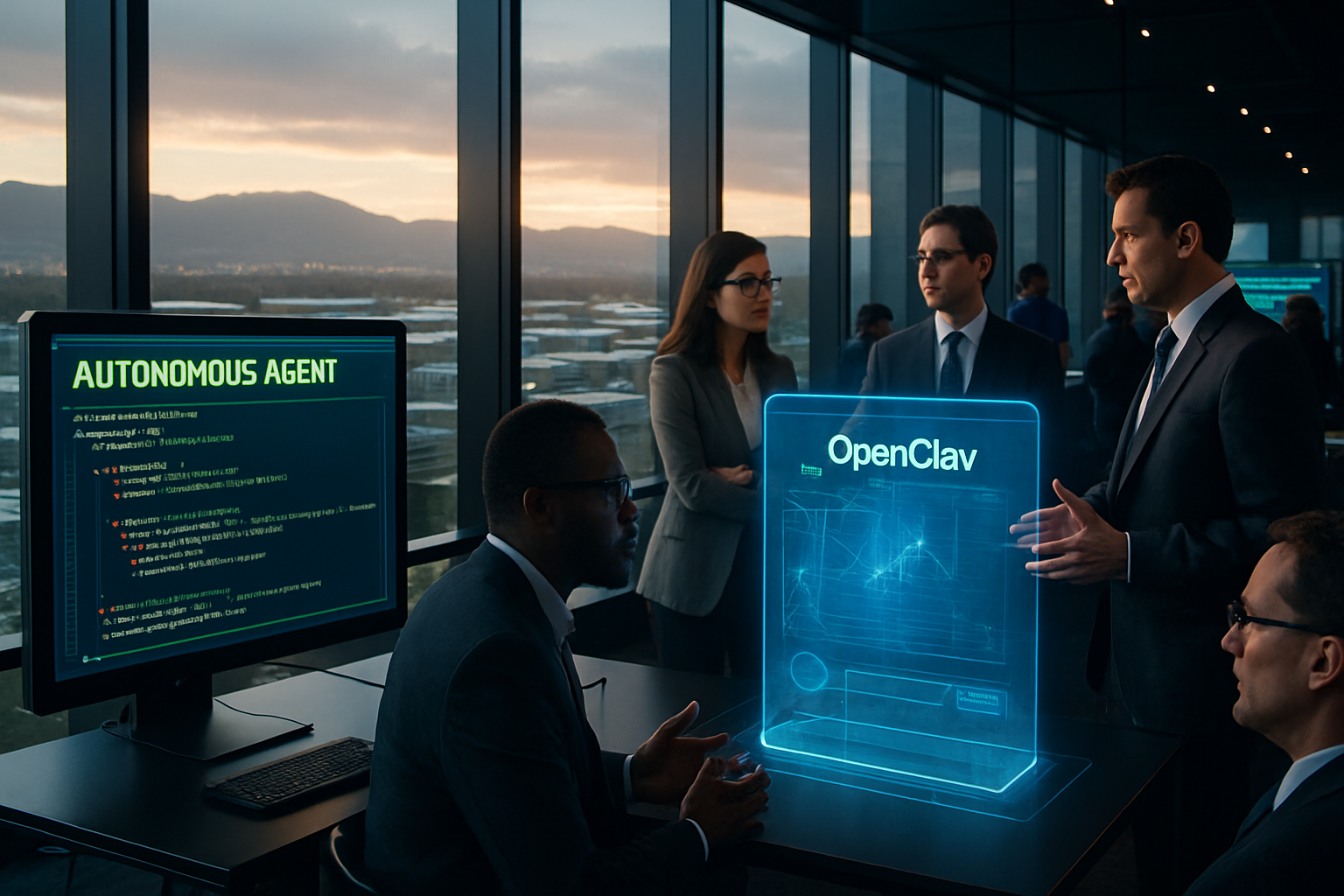
Silicon Valley is experiencing unprecedented excitement over Austrian-developed OpenClaw autonomous AI agent technology while Anthropic's revolutionary Mythos AI system remains restricted due to security concerns, highlighting the critical balance between innovation and safety as artificial intelligence transitions from experimental technology to essential business infrastructure.
The convergence of breakthrough AI developments across multiple continents represents what industry experts are calling the "April 2026 Civilizational Choice Point" – a decisive moment that will determine whether artificial intelligence serves human flourishing or becomes a tool of exploitation and surveillance.
OpenClaw: Austria's Breakthrough Captures Global Attention
The Austrian-developed OpenClaw AI toolkit has generated extraordinary enthusiasm in technology circles, with early users describing its capabilities as "magical." According to German-language technology reports, the system represents "the AI toolkit of the hour that promises the future," offering comprehensive autonomous agent capabilities rather than single-purpose applications.
OpenClaw's impact extends far beyond Silicon Valley boardrooms. In China, the technology has driven unprecedented demand for Apple Mac Mini computers, with Beijing electronics dealers charging 500 yuan ($73) markups amid a nationwide "raise a lobster" craze – local slang referring to OpenClaw's capabilities. Hong Kong users embrace the technology despite security warnings from the Digital Policy Office about unauthorized data access risks.
"This represents a fundamental shift in how we think about AI agents," explains tech industry analyst Dr. Sarah Chen. "OpenClaw isn't just another chatbot – it's a comprehensive ecosystem that can take near-complete control of computer systems."
— Dr. Sarah Chen, Silicon Valley Technology Analyst
The technology's success has attracted OpenAI's attention, with reports indicating at least one Austrian "genius" AI researcher behind OpenClaw has been hired by the American AI giant. This acquisition highlights the global competition for advanced AI talent as companies race to develop next-generation autonomous systems.
Mythos AI: Too Powerful for Public Release
While OpenClaw generates excitement, Anthropic's Mythos AI system tells a different story about the current state of artificial intelligence development. The system, described as "revolutionary" but "too risky for release," demonstrates capabilities so advanced that the company has restricted access to select enterprises only.
Mythos represents a breakthrough in AI security vulnerability discovery, capable of identifying system weaknesses with unprecedented effectiveness. However, this same capability raises profound concerns about potential misuse, particularly as AI-enhanced criminal networks increasingly use artificial intelligence as "elite hackers" for automated vulnerability detection.
The decision to restrict Mythos access reflects broader industry tensions between rapid innovation and responsible development. Former Anthropic safety researchers have warned that "the world is in peril" due to AI development outpacing safety measures, highlighting internal tensions between commercial pressures and ethical considerations.
Global AI Infrastructure Crisis Creates Urgency
These developments occur against the backdrop of a global semiconductor crisis that has driven memory chip prices sixfold higher, affecting major manufacturers including Samsung, SK Hynix, and Micron. The shortages are expected to persist until 2027 when new fabrication facilities come online, creating what experts term a "critical vulnerability window" that may favor entities willing to compromise safety for computational access.
Despite infrastructure constraints, massive corporate investments continue unabated. Alphabet has committed $185 billion to AI infrastructure in 2026 – the largest single-year corporate technology investment in history – while Amazon plans to exceed $1 trillion in AI development over the coming decade. These investments demonstrate unwavering confidence in AI as essential business infrastructure, even amid supply chain disruptions.
The World Bank projects that AI systems will demand 4.2-6.6 billion cubic meters of water in 2027 for data center cooling alone – equivalent to four to six times Denmark's annual water consumption. This environmental challenge is driving renewable energy investments and the development of more efficient computing architectures.
Regulatory Response Intensifies Globally
The rapid advancement of AI capabilities has triggered unprecedented regulatory coordination across multiple jurisdictions. Spain has implemented the world's first criminal executive liability framework for technology platforms, creating personal imprisonment risks for executives whose companies fail to meet safety standards. France has conducted AI company cybercrime raids, while the European Union investigates Digital Services Act violations with potential penalties reaching billions of dollars.
At the international level, the United Nations has established an Independent Scientific Panel comprising 40 global experts under Secretary-General António Guterres – the first fully independent international AI assessment body. This represents the most sophisticated global technology governance framework since the commercialization of the internet.
The regulatory intensification reflects growing recognition that AI governance requires unprecedented international cooperation to prevent "jurisdictional shopping" by companies seeking the most permissive regulatory environments.
Chinese Gaming Company Sparks AI Labor Ethics Debate
Adding complexity to the global AI discourse, a Chinese gaming company in Shandong province has attracted controversy by reportedly using a former employee's personal data to create an AI-powered "digital worker" that continued performing human resources tasks after the individual's resignation. The incident highlights emerging ethical questions about AI systems replacing human workers and the boundaries of acceptable data use in creating digital employees.
This development occurs as companies worldwide grapple with what Microsoft's Mustafa Suleyman predicts will be the replacement of the majority of office workers within two years, with lawyers and auditors following within 18 months. The phenomenon, dubbed the "SaaSpocalypse," has already eliminated hundreds of billions in traditional software market capitalization as AI demonstrates direct replacement capabilities for conventional solutions.
Japan's Strategic AI Partnership Formation
Meanwhile, Japan's business landscape shows signs of strategic adaptation with reports that engineers from SoftBank and Tokyo-based AI developer Preferred Networks Inc. are participating in the development of high-performance AI systems. While details remain limited, this collaboration represents Japan's continued commitment to maintaining competitiveness in the global AI race through strategic partnerships and domestic innovation.
The Japanese approach contrasts with more aggressive strategies observed in other markets, suggesting a measured response to AI development that prioritizes stability and long-term planning over rapid deployment.
Successful Human-AI Collaboration Models Emerge
Amid concerns about AI replacement of human workers, successful integration models are emerging worldwide that demonstrate the potential for human-AI collaboration. Canadian universities have implemented AI teaching assistants that maintain critical thinking standards, while Malaysia operates the world's first AI-integrated Islamic school, combining advanced technology with traditional learning approaches.
Singapore's WonderBot 2.0 heritage education system has achieved remarkable success by using AI to enhance cultural understanding and preserve historical knowledge. These examples demonstrate that the most promising path forward involves treating AI as amplification tools that serve human goals while preserving creativity, cultural understanding, and ethical reasoning.
"The future lies in sophisticated human-AI collaboration that amplifies our capabilities while preserving the qualities that make us uniquely human," notes educational technology researcher Dr. Maria Rodriguez.
— Dr. Maria Rodriguez, Global Education Technology Institute
The Civilizational Choice Point
Industry experts characterize April 2026 as a "civilizational choice point" that will determine whether AI serves democratic values and human flourishing or becomes a tool for surveillance and control. The decisions made during this critical period will establish patterns for human-AI relationships that could persist for decades.
The OpenClaw phenomenon and Mythos restrictions illustrate the fundamental tension at the heart of AI development: the balance between innovation acceleration and safety governance. Success requires unprecedented coordination between governments, technology companies, educational institutions, and civil society to ensure that commercial interests align with human welfare.
The multipolar AI landscape emerging from these developments – with Austrian innovation, Chinese market dynamics, American corporate investment, and European regulatory frameworks – suggests that no single entity will dominate artificial intelligence development. This distributed capability structure may prevent concentration of AI power while enabling culturally sensitive development approaches.
Looking Forward: Infrastructure and Innovation
The current infrastructure constraints, while challenging, are paradoxically spurring innovation in memory-efficient algorithms and sustainable deployment strategies. These developments may ultimately democratize AI access by reducing hardware requirements, potentially benefiting smaller organizations and developing nations that lack extensive computational resources.
As the window for coordinated international action narrows rapidly, the challenge becomes ensuring that AI serves humanity's highest aspirations through democratic governance and human-centered values during this experimental-to-essential infrastructure transition.
The convergence of breakthrough technologies like OpenClaw with safety-conscious approaches exemplified by Mythos restrictions suggests that the AI industry is maturing in its understanding of both technological possibilities and societal responsibilities. The decisions made in the coming months will determine whether this technological revolution fulfills its transformative promise or creates systemic challenges requiring dramatic course corrections.
The stakes extend far beyond individual companies or national competitiveness to fundamental questions about human agency, democratic governance, and the kind of technological future humanity chooses to create. As these powerful AI systems transition from laboratory experiments to essential infrastructure, the choices made today will shape the relationship between humans and artificial intelligence for generations to come.