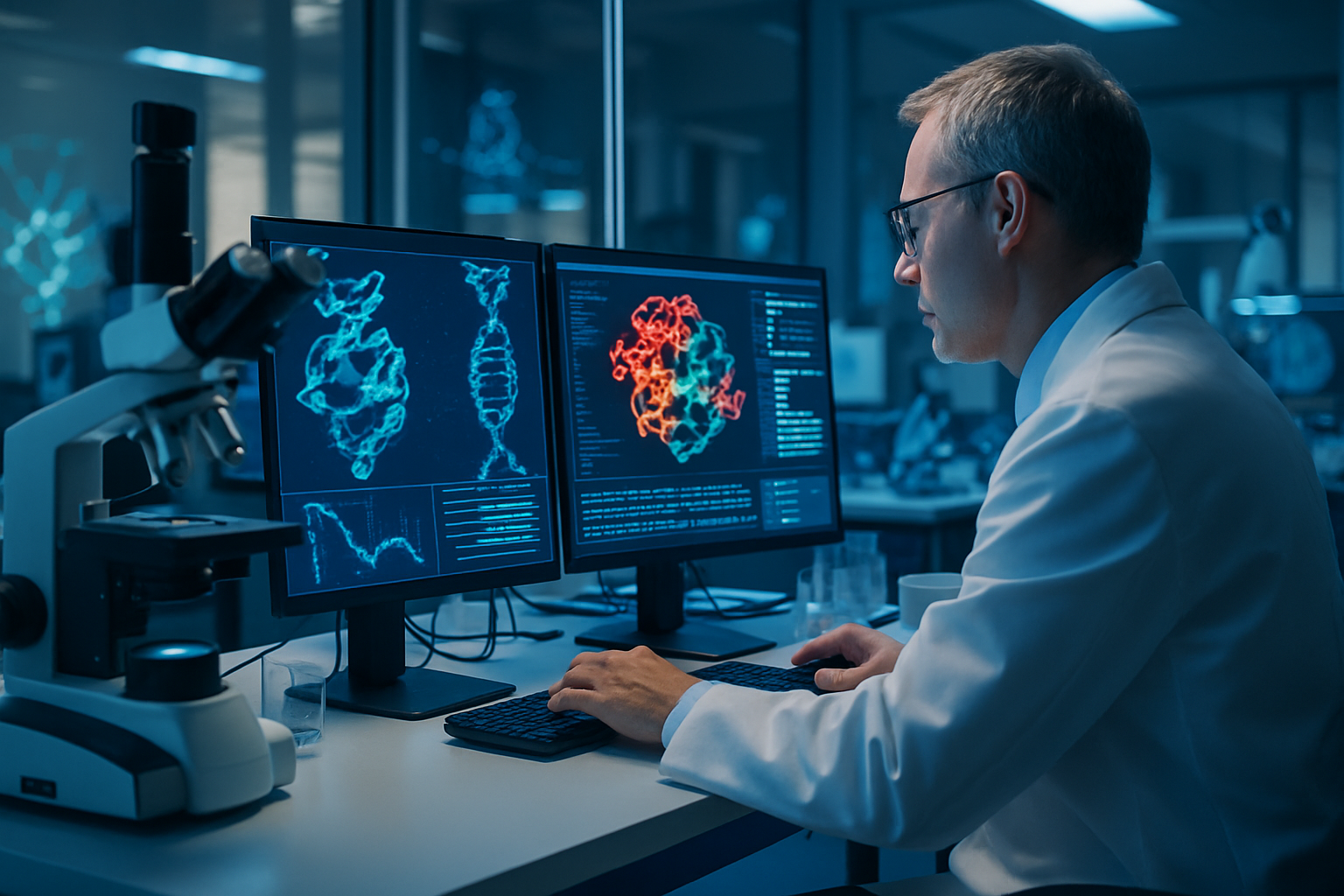
Artificial intelligence has emerged as the most powerful microscope humanity has ever invented, fundamentally transforming our approach to disease research and treatment from reactive care to predictive medicine.
The journey began with what scientists called an "impossible" problem that had puzzled biology for 50 years: predicting the shape of proteins. These molecular machines control everything in our bodies, yet their complex three-dimensional structures remained largely mysterious until DeepMind's AlphaFold breakthrough.
The AlphaFold Revolution: Solving Biology's 50-Year Mystery
For decades, researchers struggled to understand how proteins fold into their functional shapes. This knowledge gap severely limited drug development, as pharmaceutical companies couldn't design effective medications without knowing exactly what they were targeting. AlphaFold changed everything by accurately predicting protein structures from their genetic sequences, unlocking a treasure trove of potential therapeutic targets.
The breakthrough has accelerated drug discovery timelines from decades to years in some cases. Pharmaceutical giants like Novo Nordisk have partnered with OpenAI to deploy artificial intelligence across entire business operations, from analyzing complex datasets to identifying promising drug candidates. These collaborations represent a new paradigm where AI enhances human expertise rather than replacing it.
"AI is not a 'cure' in itself; rather, it is the most powerful microscope humanity has ever invented."
— Medical AI Research Team
From Drug Discovery to Personalized Treatment
Chinese biomedicine companies now lead global personalized medicine development, with MGI Tech unveiling the world's fastest gene sequencing machines and BGI Genomics becoming the largest generator of human genetic data. This technological supremacy enables real-time medical decision-making and identification of genetic predispositions to diseases years before symptoms appear.
The integration of AI in healthcare has produced remarkable results across multiple domains:
- Swedish institutions achieve unprecedented accuracy in AI-powered breast cancer detection
- South Korean medical centers develop AI systems identifying hormonal diseases from hand photographs
- Estonian hospitals use AI for stroke and radiation therapy, improving patient outcomes while reducing physician workload
- New Zealand deploys "Heidi" AI medical scribes, saving emergency doctors 10 minutes per patient
The AI Healthcare Paradox
Despite these successes, a troubling paradox has emerged in the "Therapeutic Revolution of 2026." While AI excels at complex pharmaceutical research and specialized diagnostics, it struggles with basic medical advice for consumers. Oxford University's Nature Medicine study revealed that AI chatbots perform no better than internet searches across medical scenarios, yet 50% of Canadians now consult AI systems for health information.
More concerningly, Canadian Medical Association research shows that AI healthcare tool users are five times more likely to report health harms compared to non-users. This disparity highlights the critical distinction between AI enhancement of professional medical judgment versus direct consumer applications.
Breakthrough Applications in Disease Research
AI's impact extends far beyond drug discovery into innovative diagnostic and treatment applications:
Revolutionary Detection Methods
Greek researchers are pioneering AI voice analysis for laryngeal cancer detection, identifying "hidden" patterns in human speech that indicate early disease stages. Lithuanian scientists at Kaunas University of Technology achieved breakthroughs demonstrating AI can recognize depression through voice analysis even when individuals attempt to mask symptoms.
Personalized Medicine Revolution
French cancer research has solved longstanding mysteries about why promising cancer medications repeatedly failed in clinical trials. Scientists discovered that BRD2 and BRD4 proteins, previously considered interchangeable targets, actually play fundamentally different roles in cancer therapy success. This represents a paradigm shift from broad-spectrum targeting to precision medicine approaches.
Global Healthcare Infrastructure
El Salvador has become the world's first country to implement a comprehensive AI-integrated platform for chronic disease detection and treatment nationwide through its Doctor SV program. The system serves approximately 3 million Salvadorans, demonstrating how AI can democratize access to advanced medical care across entire populations.
Critical Safety and Implementation Challenges
The rapid deployment of AI in healthcare has revealed significant challenges requiring immediate attention:
- Romanian studies documented AI chatbots incorporating information about completely fictitious diseases
- Cyprus reports increased surgical AI errors in operating rooms
- Only one-third of healthcare workers understand their employer's AI policies despite widespread usage
- Global semiconductor shortages are constraining AI healthcare development with memory chip prices surging sixfold
Dr. Giuseppe Carabetta from the University of Technology Sydney warns of potential job termination consequences for healthcare workers breaching AI policies they don't fully understand, adding complexity to the rapidly evolving landscape.
International Cooperation and Regulatory Response
Governments worldwide are implementing coordinated approaches to AI healthcare governance:
Spain has established the world's first criminal executive liability framework for technology platforms, creating imprisonment risks for executives. France has conducted AI cybercrime raids, while the UN has established an Independent Scientific Panel of 40 experts representing the most sophisticated global AI assessment since internet commercialization.
Despite WHO funding challenges, bilateral partnerships and peer-to-peer knowledge sharing networks continue driving medical innovation. The distributed cooperation model allows culturally responsive approaches while maintaining evidence-based medical standards.
Economic Impact and Prevention-First Healthcare
Countries implementing prevention-first healthcare strategies through AI report substantial economic benefits. Montana's mobile crisis teams achieved an 80% reduction in police mental health calls through AI-enhanced proactive intervention, generating significant resource savings while improving community outcomes.
The economic implications extend beyond healthcare savings to broader societal advantages. Medical tourism, improved workforce productivity, and enhanced international competitiveness create substantial opportunities for nations developing breakthrough AI technologies.
Looking Forward: Human-AI Collaboration
Successful AI healthcare implementations share common characteristics: they enhance rather than replace human medical judgment, maintain comprehensive safety protocols with regular audits, and include mandatory professional training emphasizing AI limitations.
The key to avoiding the "wellness paradox" – where technological solutions create healthcare inequality – lies in ensuring AI serves as an amplification tool for human capabilities while preserving creativity, empathy, and cultural understanding that define effective patient care.
"The challenge is ensuring AI enhances versus replaces professional medical judgment during this experimental-to-essential infrastructure transition."
— Healthcare Technology Expert
Critical Implementation Requirements
For AI to fulfill its revolutionary potential in disease research while ensuring patient safety, several requirements must be met:
- Mandatory AI safety protocols with criminal liability for violations
- Enhanced professional training emphasizing limitations and capabilities
- Regular clinical performance audits with public reporting
- Patient education campaigns about AI capabilities and risks
- International cooperation standards and best practices
April 2026 represents a critical juncture in healthcare evolution, where the contrasting realities of AI pharmaceutical innovation success and consumer healthcare advice failures underscore technology's complex role in medicine. The resolution of this paradox will determine whether AI fulfills its revolutionary medical advancement promise or becomes a source of widespread healthcare misinformation and patient harm.
As artificial intelligence transitions from experimental applications to essential healthcare infrastructure globally, the decisions made regarding safety protocols, professional training, and regulatory frameworks will establish patterns that persist for decades. Success depends on unprecedented coordination between governments, technology companies, healthcare institutions, and civil society to ensure AI serves healthcare advancement while preserving the human-centered care that remains fundamental to healing.