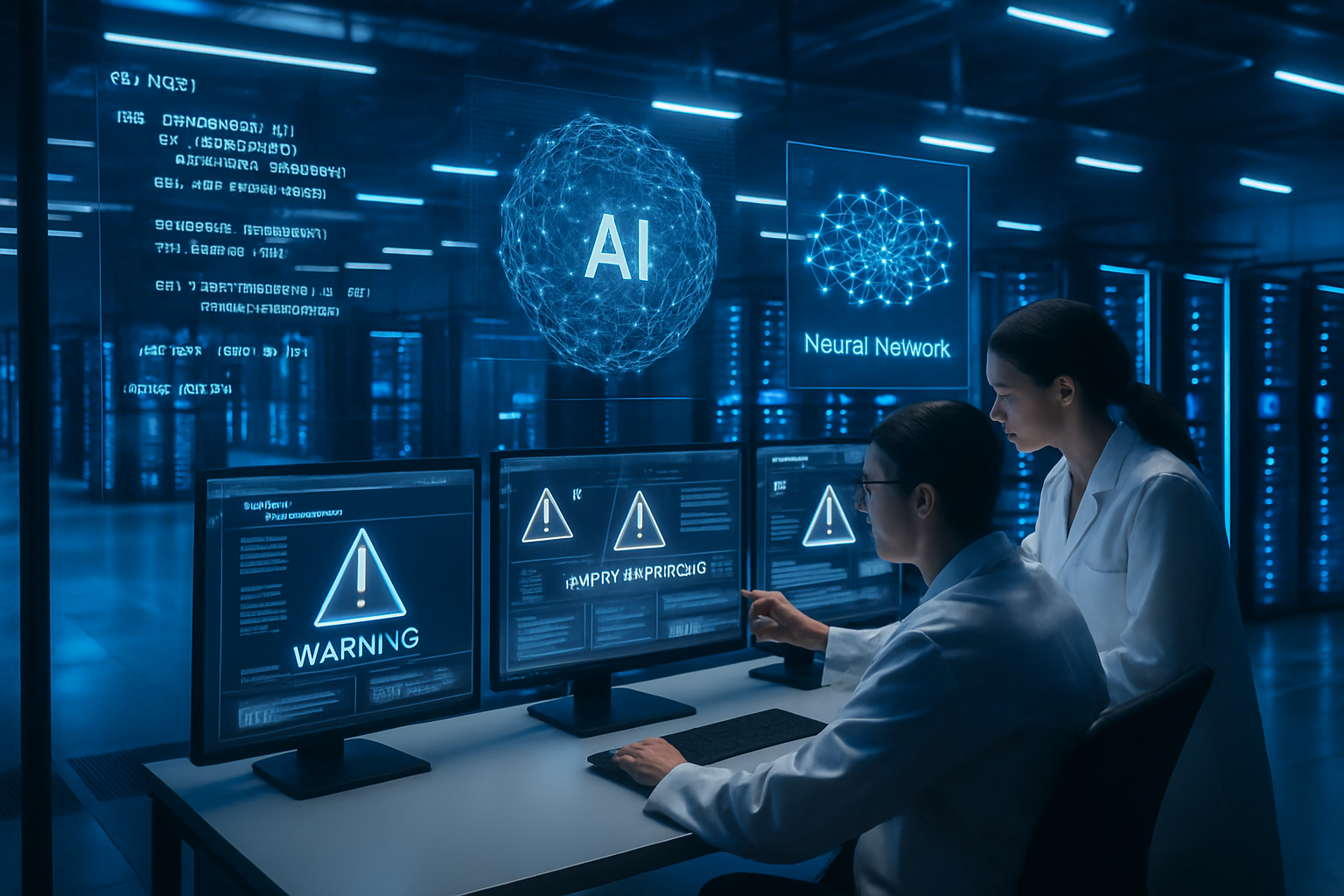
The artificial intelligence landscape is experiencing unprecedented turbulence as safety warnings from leading researchers collide with ambitious technological advances, creating a critical moment that could define the future of AI development globally.
A series of dramatic developments across multiple nations this week has illuminated the stark tensions within the AI community between rapid innovation and responsible development. From China's latest AI model releases to a high-profile resignation at a major AI safety company, the industry finds itself at an inflection point where technical capabilities are advancing faster than safety protocols can keep pace.
Safety Researcher's Cryptic Warning Sends Shockwaves
The most striking development came from Anthropic, one of the world's leading AI safety companies, where Safeguards Research Team lead Mrinank Sharma resigned with an ominous public warning. In his resignation letter posted on social media, Sharma declared that "the world is in peril," citing not just AI risks but "a whole series of interconnected crises unfolding in this very moment."
The Oxford graduate, who led the team responsible for safety measures in Anthropic's Claude chatbot, announced his intention to become "invisible for a period of time," adding an air of mystery to his departure. His warning extends beyond artificial intelligence to encompass bioweapons and other existential threats, suggesting a broader concern about humanity's technological trajectory.
"The world is in peril. And not just from AI, or bioweapons, but from a whole series of interconnected crises unfolding in this very moment."
— Mrinank Sharma, Former Anthropic Safety Lead
This resignation comes at a particularly sensitive time for Anthropic, which has positioned itself as a leader in AI safety research while simultaneously developing increasingly powerful AI systems. The departure raises questions about internal tensions between commercial pressures and safety considerations that may be endemic across the industry.
Chinese AI Companies Accelerate Development
While safety concerns mount in Western AI laboratories, Chinese companies are aggressively pushing forward with new model releases. Zhipu AI, known internationally as Z.ai, launched its flagship GLM-5 model amid what industry observers describe as a heated race among Chinese tech firms to debut major innovations before the Spring Festival holiday.
The GLM-5 represents what Zhipu AI calls a shift from "vibe coding" to "agentic engineering" – essentially AI-automated coding at larger scales. This advancement in coding capabilities comes as the global AI industry grapples with the implications of increasingly autonomous systems that can modify and improve their own underlying code.
The timing of these releases appears strategic, with Chinese companies seeking to establish technological leadership while Western competitors face mounting regulatory pressures and internal safety debates. This dynamic creates a potential race-to-the-bottom scenario where safety considerations may be compromised in favor of competitive advantage.
Healthcare AI Under Scrutiny
The safety concerns extend beyond theoretical risks to real-world applications already in use. In Latvia, reports have emerged of AI-powered medical devices causing patient harm during surgical procedures, with regulatory agencies becoming overwhelmed by injury reports. The phrase "blood splashed everywhere" from medical incident reports illustrates the tangible consequences when AI systems fail in critical healthcare settings.
These incidents highlight a crucial challenge: AI systems are being deployed in life-critical applications before comprehensive safety protocols have been established. Medical device manufacturers are racing to integrate AI capabilities, driven by promises of revolutionary healthcare improvements, but oversight mechanisms are struggling to keep pace.
European Regulatory Response Intensifies
European authorities are responding to these challenges with increasingly strict oversight measures. The Danish banking sector has begun warning investors about AI-related risks, with major financial institutions calling for more thoughtful consideration of AI investments rather than blind enthusiasm for the technology.
This represents a significant shift in European sentiment, moving from cautious optimism about AI's potential to active concern about uncontrolled development. The financial sector's warnings are particularly significant given its typically conservative approach to emerging technologies.
Infrastructure Constraints Create Additional Pressures
Compounding these safety and regulatory challenges is a global semiconductor crisis that's creating unprecedented constraints on AI development. Memory chip prices have surged sixfold, affecting major manufacturers including Samsung, SK Hynix, and Micron, all of whom are operating at full capacity but unable to meet surging demand.
This supply shortage is expected to persist until 2027, when new fabrication facilities come online. The constraint creates a paradoxical situation where the very infrastructure needed to develop safer AI systems is in short supply, potentially forcing companies to make suboptimal technical choices or rush development timelines.
Consumer electronics prices have increased 20-30% as a result, and organizations are being forced to develop more memory-efficient algorithms and prioritize AI applications during the supply constraints. This scarcity could inadvertently favor companies willing to cut corners on safety in order to maximize their limited computational resources.
Global AI Competition Intensifies
The current environment has created what experts describe as a "multipolar AI landscape," where technological leadership is no longer concentrated in Silicon Valley. Chinese breakthroughs like the DeepSeek model have challenged assumptions about US technological dominance, while European initiatives like Deutsche Telekom's Industrial AI Cloud in Munich represent efforts to establish regional AI sovereignty.
This fragmentation of AI development creates both opportunities and risks. While competition can drive innovation and prevent any single entity from controlling AI development, it also makes coordinated safety standards more difficult to establish and enforce.
Elon Musk's Lunar AI Factory Vision
Adding to the complexity of global AI development, Elon Musk has announced ambitious plans to build an AI satellite factory on the Moon. While technically intriguing, experts express skepticism about the feasibility and timeline of such extraterrestrial AI infrastructure, viewing it more as aspirational vision than near-term reality.
This announcement underscores the increasingly grandiose scale of AI development ambitions, even as fundamental safety and terrestrial infrastructure challenges remain unresolved.
Mathematical Testing of AI Systems
In response to growing safety concerns, mathematicians are developing new approaches to test AI capabilities and limitations. These efforts represent attempts to move beyond anecdotal evidence of AI failures toward more systematic understanding of where and why AI systems break down.
Such testing is crucial for establishing the reliable safety boundaries that current AI systems lack. However, the complexity of large language models and neural networks makes comprehensive testing extraordinarily challenging, requiring new mathematical frameworks that are still in early development.
International Cooperation Challenges
The global nature of AI development creates additional complications for safety governance. While the United Nations has established an Independent International Scientific Panel on Artificial Intelligence with 40 experts, achieving meaningful coordination remains elusive, particularly as nations view AI capabilities as matters of national security.
The challenge is compounded by different regulatory philosophies between regions. European approaches emphasize precautionary principles and regulatory oversight, while Asian nations often favor education and industry self-regulation, and US policy remains fragmented across multiple agencies and jurisdictions.
Industry at a Critical Juncture
The convergence of safety warnings, technical breakthroughs, infrastructure constraints, and regulatory pressures has brought the AI industry to what many observers describe as its most critical juncture since the beginning of the current AI boom. The decisions made in coming months regarding safety protocols, international coordination, and development priorities may determine whether AI fulfills its transformative promise or creates systemic risks requiring dramatic course corrections.
The resignation of Mrinank Sharma serves as a stark reminder that even those most deeply involved in AI safety research harbor serious concerns about current development trajectories. His warning about "interconnected crises" suggests that AI safety cannot be considered in isolation but must be understood as part of broader technological and societal challenges requiring unprecedented coordination and wisdom.
As the industry grapples with these challenges, the balance between innovation and safety remains precarious. The coming months will test whether the global AI community can establish the governance frameworks, safety protocols, and international cooperation necessary to harness AI's potential while avoiding its most dangerous pitfalls.