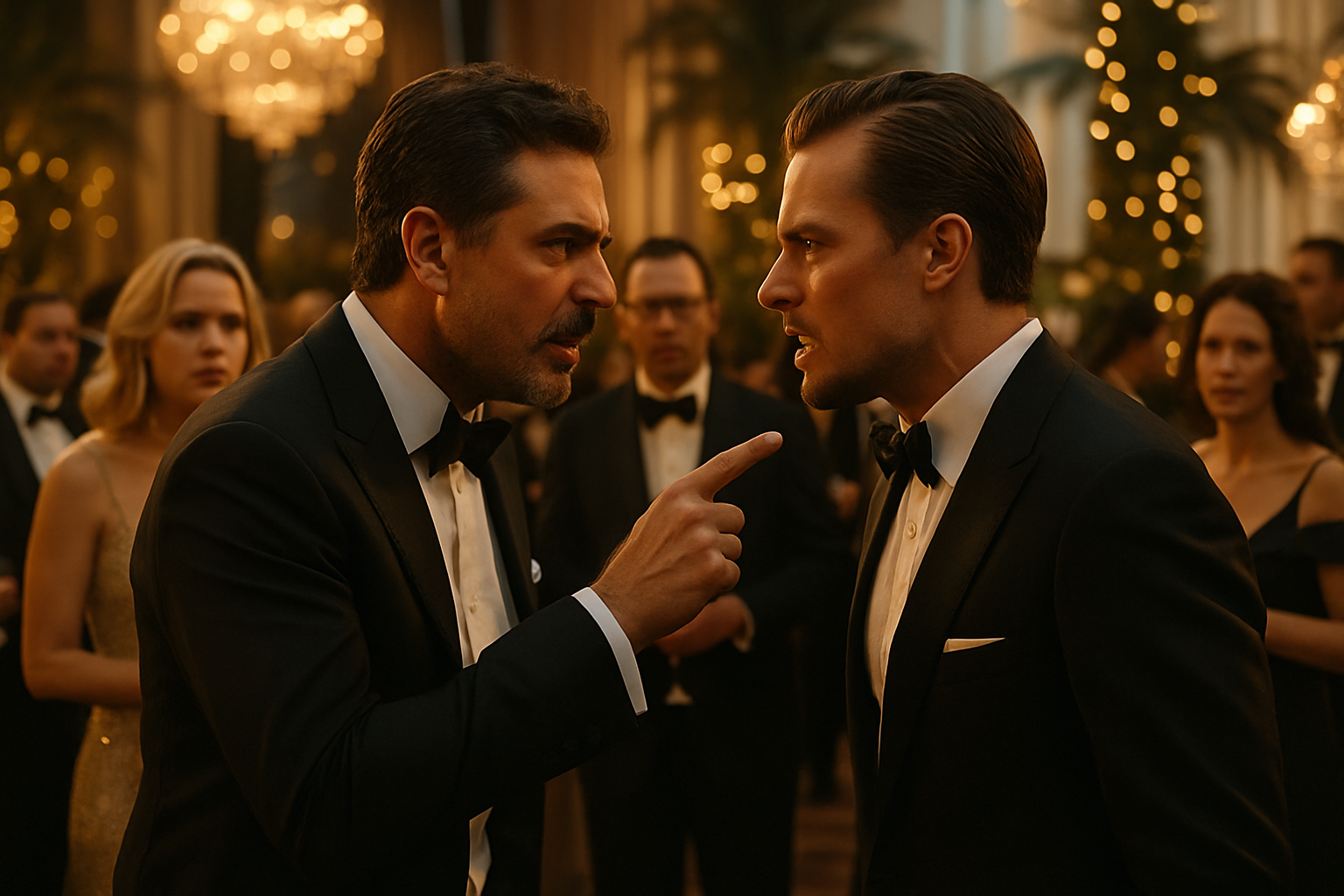
A dramatic confrontation at the prestigious Vanity Fair Oscars after-party has exposed the deepening tensions between Hollywood's entertainment industry and the artificial intelligence sector, with a successful playwright directly confronting OpenAI CEO Sam Altman over what they termed AI's role in "global violences."
The high-profile clash occurred at one of Hollywood's most exclusive post-ceremony gatherings, where industry luminaries traditionally celebrate cinema's biggest night. Instead, the evening became a flashpoint for mounting frustrations over AI's impact on creative industries, marking what many observers are calling a watershed moment in the relationship between technology and entertainment.
The Confrontation Heard Around Hollywood
According to the Sydney Morning Herald, the unnamed playwright chose the high-profile venue to publicly accuse Altman of "wilfully allowing his technology to be an agent in global violences." The dramatic scene unfolded against the backdrop of Hollywood's most prestigious after-party, where the collision of old-school entertainment values and Silicon Valley innovation created an unprecedented moment of public discord.
The confrontation reflects broader industry anxieties that have been simmering throughout 2026, as AI technology has advanced from experimental tools to essential infrastructure across the entertainment sector. What began as whispered concerns in studio boardrooms has now erupted into public accusations at the industry's most visible gathering.
A Year of Growing Tensions
The March 2026 incident represents the culmination of mounting tensions that have defined the entertainment industry's relationship with AI throughout the year. In February, over 4,000 French actors and filmmakers condemned what they called the "systematic plundering" by AI tools that reproduce voices and images without consent, ahead of the César Awards.
The Academy of Motion Picture Arts and Sciences made headlines earlier this year by allowing AI-assisted films to compete for Oscars for the first time in history, marking mainstream acceptance of the technology. However, this decision has been accompanied by fierce resistance from creative professionals who fear their livelihoods are under threat.
"The challenge involves harnessing technology responsibly while preserving essentially human storytelling aspects that provide emotional resonance and cultural significance."
— Industry Analysis Report, March 2026
Hollywood studios have issued repeated warnings about AI-generated content using unauthorized intellectual property. Disney and Paramount notably condemned ByteDance's Seedance 2.0 system, which creates cinema-quality videos from text prompts, including a viral video featuring Tom Cruise and Brad Pitt that demonstrated sophisticated AI capabilities.
The AI Revolution Reshapes Hollywood
The entertainment industry transformation has been nothing short of revolutionary. AI-generated background performers are replacing human extras in large-scale productions, while digital crowds have become indistinguishable from human performers. The technology enables customization and modification during post-production without the logistical challenges of traditional filming.
Educational institutions have adapted rapidly to this change. The Curious Refuge AI film academy, launched in May 2023, has become essential for Hollywood workers during production slowdowns. Visual effects veterans like Michael Eng represent thousands acquiring machine learning skills for career survival, as AI literacy transitions from optional to essential in the entertainment industry.
However, this technological advancement has come at a cost. The emergence of "Tilly Norwood," the first AI-generated actress who released a debut single titled "Take the Lead," marked a historic moment in synthetic media entertainment. Yet Austrian analysis revealed "how unfinished the dream of the artificial artist still is," exposing significant technological limitations despite impressive advances.
Global Infrastructure Constraints Fuel Innovation
The confrontation occurs against the backdrop of unprecedented technological challenges. A global memory semiconductor crisis has driven prices up sixfold, affecting Samsung, SK Hynix, and Micron operations until 2027. Paradoxically, these constraints have driven innovation toward memory-efficient algorithms and hybrid processing approaches, potentially democratizing advanced filmmaking tools.
Despite infrastructure limitations, massive investments continue. Alphabet committed $185 billion to AI infrastructure in 2026—the largest single-year corporate technology investment in history—while Amazon announced over $1 trillion in AI development plans. The World Bank projects that AI will demand 4.2-6.6 billion cubic meters of water by 2027 for data center cooling, equivalent to four to six times Denmark's annual water consumption.
Regulatory Responses and International Frameworks
The entertainment industry's AI reckoning coincides with unprecedented regulatory intensification globally. Spain implemented the world's first criminal executive liability framework for social media platforms, while France conducted cybercrime raids on AI companies. The United Nations established an Independent International Scientific Panel with 40 experts as the first fully independent global AI assessment body.
European film festivals report AI as a "looming presence" throughout the industry, though traditional storytelling continues to dominate competitive categories. This suggests a maturation toward tool-within-framework integration rather than wholesale replacement of human creativity.
The Delhi Declaration, signed by 88 countries following February's AI Impact Summit, represents the largest AI diplomatic agreement in history. The voluntary framework calls for "safe, reliable, and robust" AI development, though tensions persist between innovation advocates and safety-focused experts.
Success Stories Amid the Turmoil
Not all AI integration in entertainment has been contentious. Several successful models demonstrate sophisticated human-AI collaboration rather than replacement. Canadian universities have implemented AI teaching assistants while maintaining critical thinking standards, and Malaysia launched the world's first AI-integrated Islamic school, combining technology with traditional learning approaches.
Belgium's Atomium celebrated its 20th renovation anniversary with AI-enhanced digital art programming, demonstrating technology-tradition synthesis that preserves cultural heritage while embracing innovation. These examples suggest that the most promising path involves AI serving as sophisticated amplification tools while preserving human creativity, cultural understanding, and emotional depth.
The Economic Reality of the "SaaSocalypse"
The entertainment industry's AI transformation occurs within the broader context of what economists have termed the "SaaSocalypse"—the elimination of hundreds of billions in traditional software market capitalization as AI demonstrates direct replacement capabilities. This market disruption affects not just software providers but the entire ecosystem of companies that support creative industries.
Employment predictions have grown increasingly stark. Microsoft's Mustafa Suleyman forecasts that AI will replace the majority of office workers within two years, with lawyers and auditors following within 18 months. However, regional approaches vary significantly: while Western companies pursue traditional layoffs followed by AI hiring, Asian corporations implement comprehensive worker transition programs emphasizing retraining over displacement.
The Human Cost of Technological Progress
Behind the technological marvel and economic disruption lies a very human story of displacement and adaptation. The Prague designer Vašek Krejčí's "Postapo Praha" project creates hyper-realistic apocalyptic videos that viewers mistake for reality despite repeated emphasis on their fictional nature. This authenticity crisis extends to journalism, where German broadcaster ZDF recalled a correspondent over AI-generated immigration images, highlighting the urgent need for editorial controls.
The copycat behavior phenomenon has become particularly pronounced in cosmetic surgery, where AI-enhanced photos create unrealistic expectations. This reflects broader concerns about AI's impact on human perception and decision-making, with Slovak researchers warning about AI's capability to distort reality and influence human thinking.
Military Applications Add Complexity
The entertainment industry's AI debate has gained additional complexity from parallel developments in military applications. OpenAI has expanded its Pentagon partnership, deploying AI models on classified Defense Department networks serving over 800 million weekly military users. This military integration contrasts sharply with Anthropic's ethical resistance, creating a fundamental industry divide over AI's appropriate applications.
The unauthorized use of Anthropic's Claude AI in the Nicolás Maduro capture operation, despite terms of service violations, highlights how AI technologies developed for civilian applications can be repurposed for controversial military use. This dual-use concern adds another layer of complexity to entertainment industry debates about AI ethics and responsibility.
A Civilizational Choice Point
Industry experts characterize March 2026 as a "critical inflection point" in humanity's relationship with artificial intelligence. The Oscars after-party confrontation symbolizes a broader civilizational choice between AI serving human creativity and democratic values versus becoming tools for surveillance and control.
The success of AI integration in entertainment will likely serve as a template for other creative sectors facing similar technological disruption. The fundamental question remains whether AI enhances human creativity or diminishes authentic expression in the pursuit of efficiency and cost reduction.
"The most promising path involves sophisticated human-AI collaboration amplifying capabilities while preserving creativity, empathy, and wisdom that define human potential."
— Technology Industry Analysis, March 2026
Looking Forward: The Path to Coexistence
As Hollywood grapples with its AI future, several principles have emerged from successful integration models. Organizations that prioritize human welfare, maintain stakeholder engagement, and demonstrate cultural sensitivity achieve superior outcomes compared to wholesale automation approaches. The technology must serve specific human goals rather than replacing human judgment entirely.
The window for coordinated action is narrowing rapidly as AI development accelerates. The decisions made in 2026 will likely determine the trajectory of human-AI relationships for the remainder of the century. The entertainment industry, as society's storyteller, bears particular responsibility for modeling how technology can enhance rather than diminish human creativity and cultural expression.
The Oscars after-party confrontation, while dramatic, represents just one moment in this ongoing negotiation between human creativity and artificial intelligence. The ultimate resolution will determine not just the future of entertainment, but the broader relationship between technology and human expression in the 21st century.