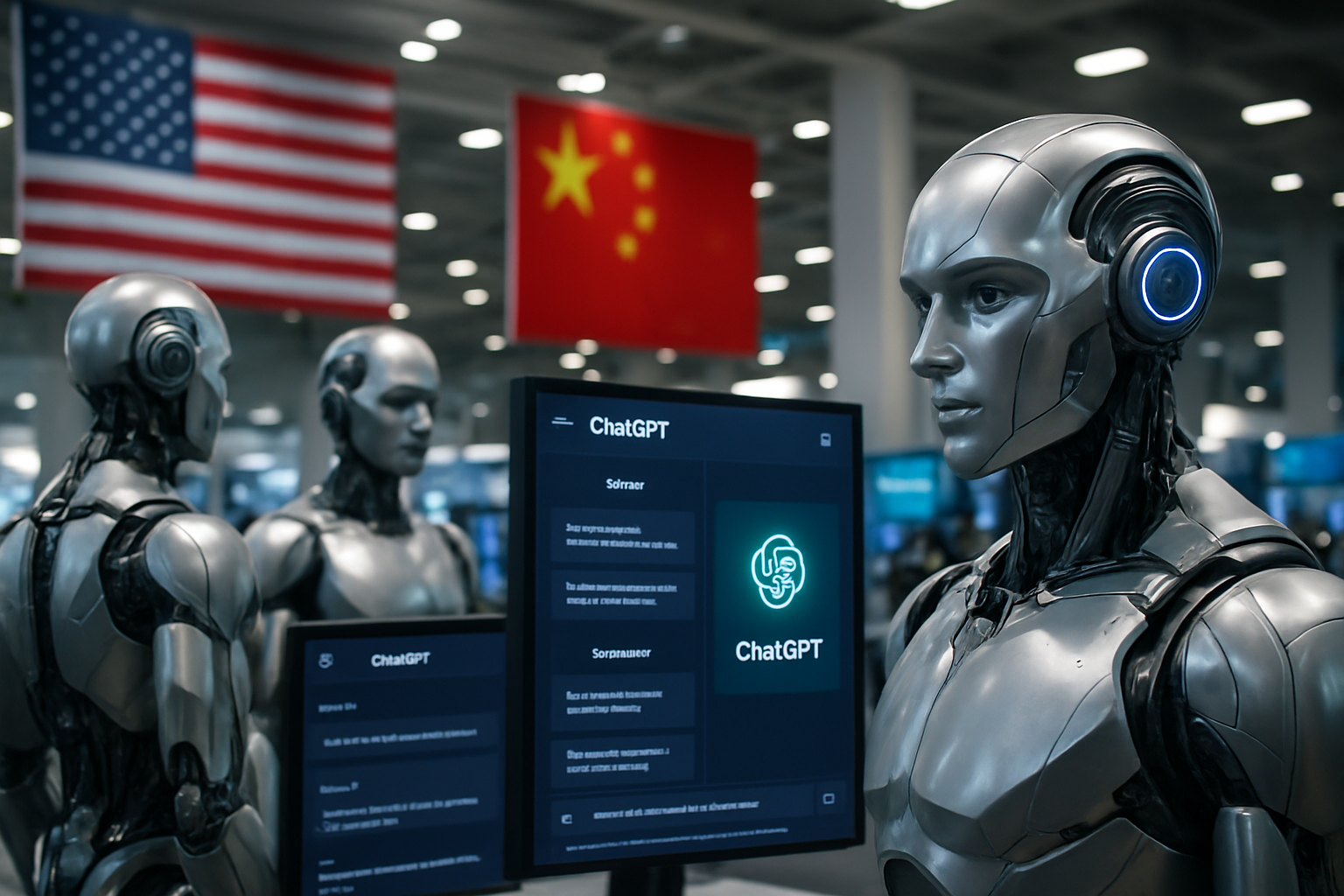
Artificial intelligence has reached a pivotal moment as US robotics companies warn of an escalating "robot race" with China, while workplace AI applications face mounting legal and adoption challenges that could reshape the global technology landscape.
The convergence of geopolitical competition, workplace transformation, and corporate governance crises marks March 2026 as what experts are calling a "civilizational choice point" for artificial intelligence development. From Silicon Valley boardrooms to manufacturing floors in Shenzhen, the decisions made in coming weeks will determine whether AI serves human flourishing or becomes a tool for surveillance and control.
US Sounds Alarm Over China's Humanoid Robotics Surge
American artificial intelligence and robotics companies are issuing urgent warnings to lawmakers about China's rapid advancement in humanoid robotics technology. The alarm centers on companies like Unitree Robotics, which has dramatically scaled production from 5,500 units in 2025 to over 20,000 humanoid robots in 2026, demonstrating a successful transition from laboratory concepts to mass commercialization.
The Chinese Spring Festival 2026 showcased this technological prowess to a global audience of 600 million viewers, as four major Chinese robotics companies—Unitree, Galbot, Noetix, and MagicLab—demonstrated sophisticated humanoid robots performing kung fu and lion dances. This public display represented what analysts describe as a strategic shift from experimental development to confident market deployment.
"We're witnessing the laboratory-to-production transition happening at unprecedented speed," notes a senior industry analyst who requested anonymity due to the sensitive nature of US-China technology competition. "What took Western companies years to achieve, Chinese firms are accomplishing in months."
China's approach appears driven by demographic necessity. The country faces a "4-2-1 problem" where single children must support four aging parents and grandparents—a consequence of decades-old population control policies that created an inverted population pyramid. Bank of America analysis reveals that AI and robotics development has become a strategic response to the world's most rapidly aging population, accelerating investment to offset labor shortages and sustain productivity despite demographic pressures.
Corporate Governance Crisis in AI Workplace Integration
The workplace AI revolution faces a significant setback following revelations that a major gaming publisher made critical personnel decisions based on ChatGPT recommendations, only to face legal consequences when those decisions proved discriminatory. The incident has sparked widespread concern among corporate leaders about the reliability and legal implications of AI-assisted management decisions.
According to court documents, Krafton CEO Changhan Kim attempted to avoid paying a $250 million bonus by dismissing senior executives at Unknown Worlds Entertainment, the developers behind the popular "Subnautica" game series. The dismissals were reportedly influenced by AI-generated advice about cost-cutting measures. However, the courts ruled against Krafton, forcing the company to reinstate the terminated executives and highlighting the legal risks of relying on artificial intelligence for sensitive corporate decisions.
This case exemplifies what German researcher Dr. Frank Bäumer describes as the "productivity paradox" in AI workplace integration. His research documents a "double workload effect" where AI implementation creates more work rather than the promised efficiency gains, as workers must perform their original responsibilities while also supervising and correcting AI systems.
Global CEO Anxiety About AI Transformation Speed
The workplace AI crisis reflects broader concerns among global business leaders about the pace of technological change. A comprehensive survey by PwC Cyprus reveals that 43% of CEOs worry their companies are not transforming "fast enough" to keep pace with artificial intelligence and broader technological disruption.
The survey of 77 Cypriot business leaders points to "mounting unease over the speed of business transformation" in an increasingly volatile technological environment. This anxiety is not limited to smaller economies—similar concerns are being expressed across the Eurozone and globally as executives grapple with the challenge of integrating AI while maintaining operational stability and regulatory compliance.
"The paradox is that companies feel pressure to adopt AI quickly, but those who rush into implementation without proper governance frameworks are discovering significant legal and operational risks."
— Dr. Maria Stavros, Technology Policy Expert
The regulatory landscape is intensifying these concerns. Spain has implemented the world's first criminal executive liability framework for tech platforms, creating imprisonment risks for executives whose companies violate AI governance standards. France has conducted cybercrime raids on AI companies, while the European Union investigates Digital Services Act violations with potential penalties reaching billions of euros.
Infrastructure Constraints Reshape Development Strategies
Despite rapid advancement, the AI revolution faces significant infrastructure constraints that are reshaping development strategies worldwide. A global memory semiconductor crisis has driven chip prices sixfold higher, affecting major manufacturers Samsung, SK Hynix, and Micron, with shortages expected to persist until 2027 when new fabrication facilities come online.
Consumer electronics costs have increased 20-30% as a result, while the World Bank projects that AI water demand will reach 4.2-6.6 billion cubic meters by 2027 for data center cooling—equivalent to four to six times Denmark's annual water consumption. These constraints are paradoxically spurring innovation in memory-efficient algorithms and sustainable deployment strategies.
Major technology companies continue massive investments despite these challenges. Alphabet has committed $185 billion to AI infrastructure in 2026—the largest single-year corporate technology investment in history—while Amazon has announced over $1 trillion in AI development plans. These investments signal the transition of AI from experimental technology to essential business infrastructure.
Military Applications Intensify Civilian Oversight Concerns
The civilian AI crisis is compounded by escalating military applications that challenge traditional oversight mechanisms. The Pentagon has integrated ChatGPT into military systems serving over 800 million weekly users, while Ukrainian forces deploy AI-enhanced drone systems with improved battlefield capabilities.
However, only one-third of countries have agreed to AI warfare governance frameworks, with major powers including the US and China abstaining from comprehensive commitments. This governance gap was highlighted when Anthropic's Claude AI was used in unauthorized military operations despite the company's terms of service prohibiting violence and surveillance applications.
The Trump administration has designated Anthropic as a "supply chain risk" after the company refused to remove safety restrictions on its Claude AI system for military use. With over $200 million in federal contracts at stake, this confrontation represents a landmark test of corporate autonomy versus national security imperatives in the AI age.
Successful Integration Models Offer Hope
Despite the challenges, several successful human-AI collaboration models demonstrate the technology's potential when implemented thoughtfully. Canada has deployed AI teaching assistants in universities while maintaining critical thinking standards. Malaysia operates the world's first AI-integrated Islamic school, combining artificial intelligence with traditional religious and academic learning. Singapore's WonderBot 2.0 has achieved success in heritage education applications.
These success stories share common elements: treating AI as amplification tools rather than replacement technology, maintaining sustained commitment to human development, ensuring comprehensive stakeholder engagement, and preserving cultural sensitivity in implementation approaches.
The Stakes of the March 2026 Inflection Point
Industry experts increasingly describe March 2026 as a critical inflection point—a moment when decisions made today will determine the trajectory of human-AI relationships for the remainder of the century. The convergence of geopolitical competition, workplace transformation challenges, infrastructure constraints, and governance gaps creates what some analysts call a "civilizational choice point."
Success requires unprecedented coordination among governments, technology companies, educational institutions, and civil society. The challenge lies in balancing innovation acceleration with safety governance, commercial interests with human welfare, and national competitiveness with international cooperation.
The emerging multipolar AI landscape—with Chinese advancement through companies like Unitree, European digital sovereignty efforts such as Deutsche Telekom's Munich AI Cloud, and continued US technological leadership—suggests that no single entity will control AI development. This distribution of capabilities may ultimately serve humanity's interests by preventing concentration of power while encouraging diverse approaches to AI governance.
As the robot race intensifies and workplace AI faces growing scrutiny, the decisions made in the coming months will determine whether artificial intelligence fulfills its transformative promise or creates systemic challenges requiring dramatic corrections. The window for coordinated, proactive responses is narrowing, making international cooperation and democratic oversight more critical than ever in shaping the AI revolution's trajectory.