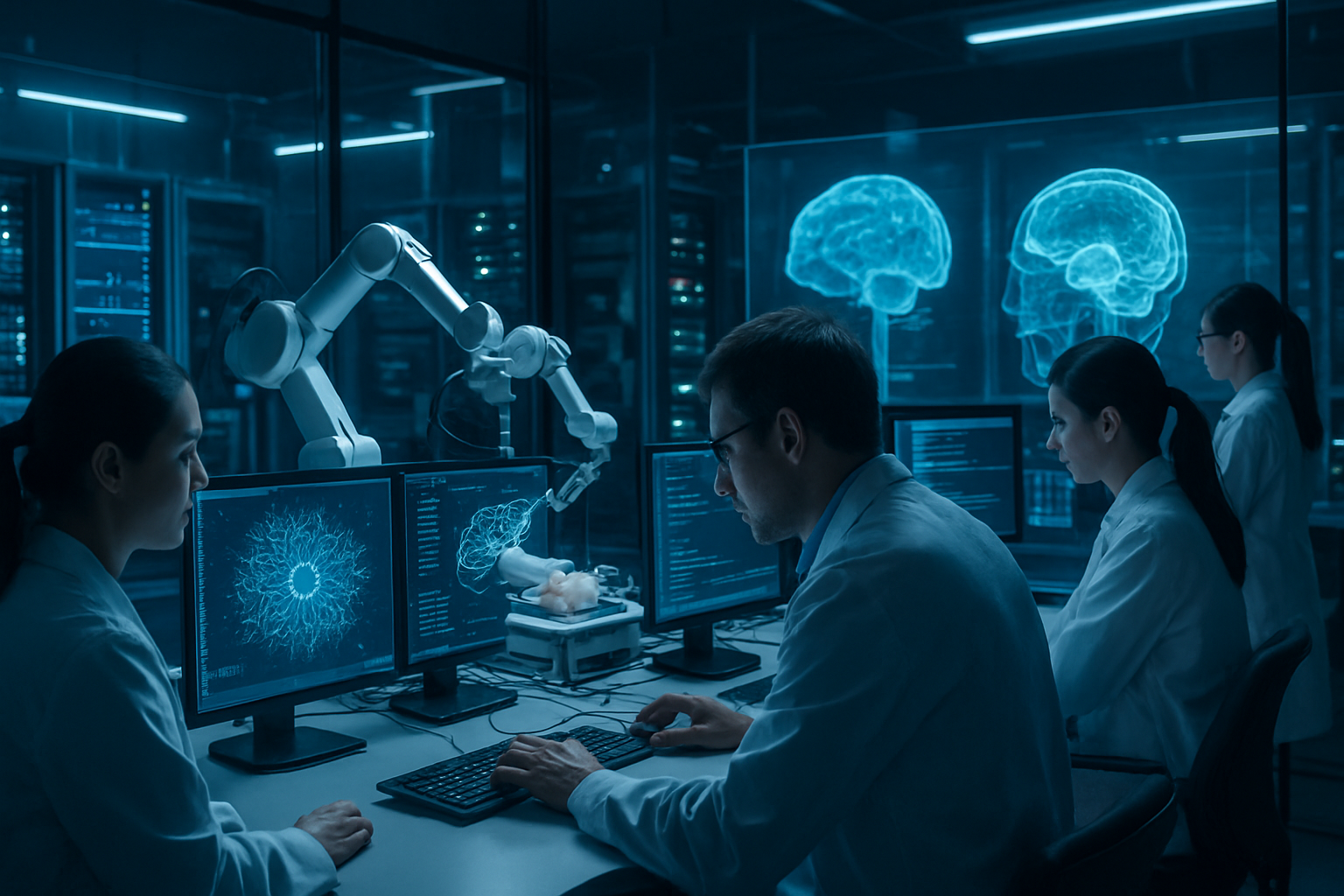
Artificial intelligence is experiencing unprecedented breakthroughs across multiple sectors in February 2026, with revolutionary applications emerging in medical research, creative technology platforms, and international partnerships that signal a fundamental shift in how AI integrates with human society.
The most significant development comes from Galaxy Brain Scientific Inc., whose technology has enabled a landmark Parkinson's disease study published in Nature. The research, led by Prof. Hesheng Liu, founder and Chief Scientific Officer of the company, has successfully pinpointed the core functional circuit underlying Parkinson's disease, fundamentally redefining our understanding of the biological mechanisms behind this debilitating condition.
Medical AI Breakthroughs Transform Disease Understanding
The Parkinson's research represents a quantum leap in neuroscience, providing a scientific basis for developing precision treatments that could benefit millions of patients worldwide. This breakthrough builds upon a growing body of AI-powered medical research, including recent Swedish trials demonstrating AI's superior capability in breast cancer detection through mammography screenings.
The Galaxy Brain Scientific study exemplifies how AI is moving from experimental applications to core medical research infrastructure. The company's technology has enabled researchers to map complex neural circuits with unprecedented precision, opening new avenues for understanding neurodegenerative diseases that have long puzzled medical professionals.
Creative Industries Revolutionized by Natural Language AI
Meanwhile, Roblox has launched its groundbreaking "4D creation" technology, now available in beta, which represents a revolutionary advancement in content creation. This AI system builds upon the company's earlier three-dimensional object generation model but extends far beyond static creation—it can now generate functioning models with natural language commands.
The implications for the gaming and creative industries are staggering. Content creators can now describe complex interactive elements in plain language, and the AI system translates these descriptions into fully functional 3D models. This democratization of content creation removes traditional technical barriers that have limited creative expression in digital environments.
"The technology enables users to create sophisticated 3D environments and interactive elements without requiring advanced programming knowledge."
— Industry Analysis, The Hindu
International AI Cooperation Accelerates
On the diplomatic front, Azerbaijan's partnership with Israel represents a strategic approach to AI development that could serve as a model for international cooperation. The collaboration focuses on civilian AI applications and human capital development, offering Azerbaijan an opportunity to leapfrog common integration challenges by leveraging Israel's advanced AI ecosystem.
This partnership aligns with both nations' priorities for economic growth and quality of life improvements through AI technology. The cooperation emphasizes practical applications that can create tangible benefits for citizens while building sustainable AI ecosystems that can evolve and scale over time.
Infrastructure Challenges Test AI Expansion
However, the AI boom faces significant infrastructure headwinds. The global semiconductor industry is experiencing a critical shortage, with memory chip prices surging sixfold as demand from AI companies outstrips manufacturing capacity. Major manufacturers including Samsung, SK Hynix, and Micron are operating at full capacity but cannot meet the exponential demand from AI development projects.
This crisis particularly affects China's AI ambitions, as the country's domestic memory chip capabilities lag significantly behind Western alternatives. The Chinese government is hoping that potential changes in U.S. export policies under President Trump might ease restrictions on memory chip exports, highlighting how AI development has become intertwined with global trade and geopolitical relationships.
Electric Vehicle Innovation Demonstrates AI Integration
While not directly AI-focused, China's Contemporary Amperex Technology (CATL) deployment of the world's first sodium-ion batteries in passenger cars illustrates how breakthrough technologies support AI development infrastructure. The Naxtra battery system, undergoing winter testing in Inner Mongolia, represents the kind of advanced materials innovation that enables more efficient AI computing systems.
Educational Applications Show Promise
The human element of AI development remains crucial, as highlighted by Francisco Soler's insights on effective AI interaction. Rather than requiring engineering expertise, successful AI utilization depends on understanding how to communicate effectively with AI systems—a skill that bridges technical capability with human intuition.
This perspective underscores a critical point: as AI becomes more sophisticated, the ability to craft effective prompts and provide proper context becomes increasingly valuable. The most successful AI implementations will likely combine advanced technology with enhanced human-AI collaboration skills.
Looking Forward: Integration Challenges and Opportunities
The current wave of AI breakthroughs demonstrates that 2026 marks a transition from experimental AI applications to essential infrastructure across industries. Medical research, creative platforms, international partnerships, and infrastructure development all show AI moving from supporting role to central function.
However, success will depend on addressing fundamental challenges including memory supply constraints, international cooperation frameworks, and educational programs that prepare human workers for AI-integrated workflows. The organizations and nations that successfully navigate these challenges while maximizing AI's beneficial applications will likely define the competitive landscape for years to come.
As these developments unfold, the integration of AI technology appears less like a gradual adoption and more like a fundamental restructuring of how industries operate, research is conducted, and international cooperation is structured around shared technological capabilities.