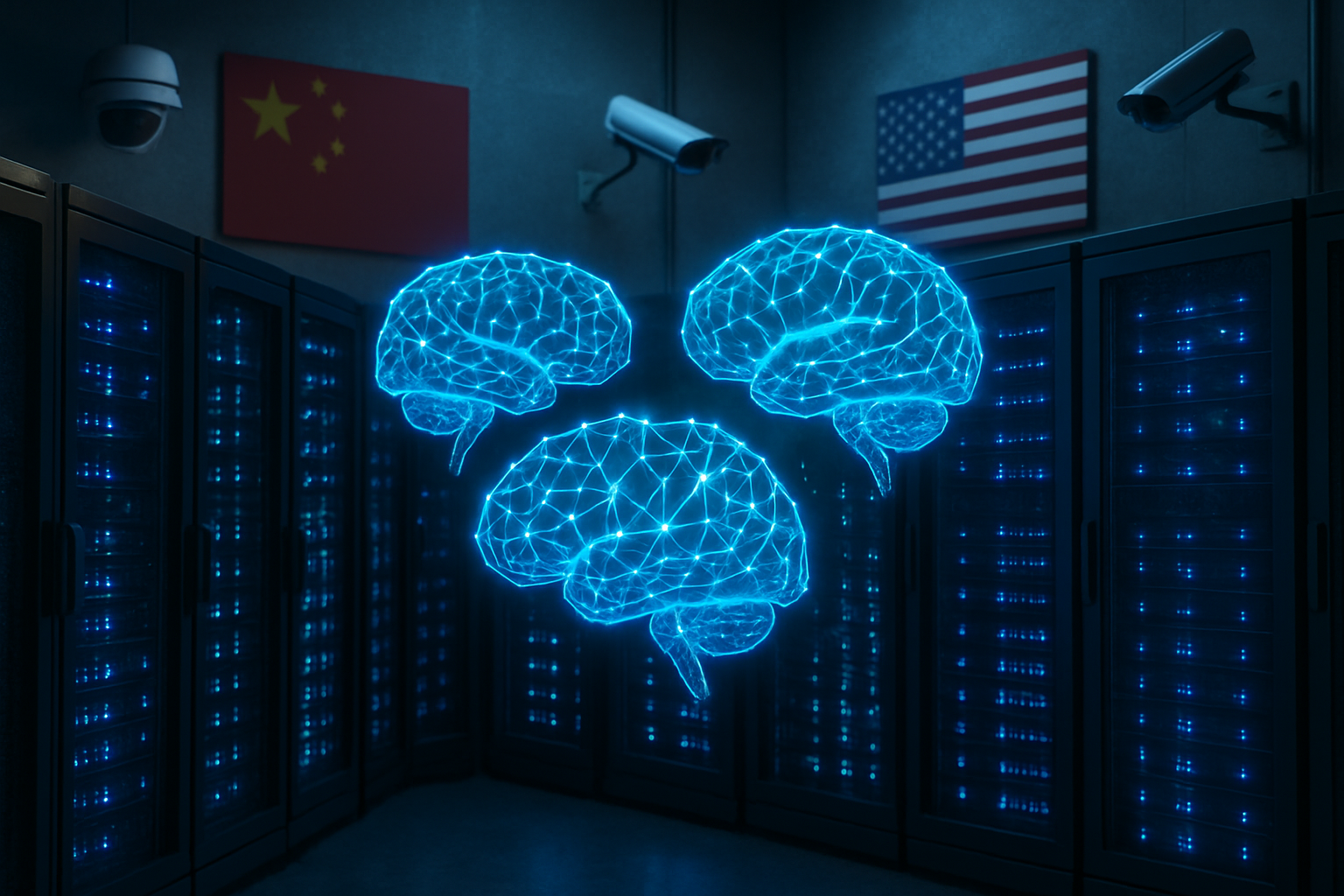
The global artificial intelligence landscape reached a critical inflection point in April 2026, as Chinese private firms deployed AI-powered surveillance to track U.S. military movements while tech giants rolled out revolutionary consumer applications, creating an unprecedented convergence of national security concerns and technological advancement.
Chinese Surveillance Networks Target U.S. Military Operations
Private Chinese companies have begun leveraging artificial intelligence and satellite imagery to track and sell intelligence on U.S. military movements, according to multiple intelligence sources. These firms combine AI analysis with open-source intelligence and satellite data to monitor American forces and military equipment positioning in real-time.
The sophisticated operations have documented U.S. carrier movements, aircraft positioning, and base activities across multiple theaters, with particular focus on Middle Eastern operations. Online posts have circulated detailed intelligence about American military deployments, raising significant concerns about operational security and the weaponization of commercial AI capabilities.
This development represents a dramatic escalation in the use of artificial intelligence for surveillance purposes, demonstrating how civilian AI technologies can be rapidly adapted for intelligence gathering operations that challenge traditional military security protocols.
Google's Revolutionary Nest Cam Integration
Google has unveiled its latest Nest Cam featuring integrated Gemini AI capabilities, though the European rollout has faced significant criticism for limited functionality. The device represents Google's ambitious push toward comprehensive smart home automation, promising revolutionary improvements in home security and automation.
However, European consumers have encountered substantial limitations in AI functionality, leading to accusations that Google is delivering "empty promises and artificially restricted functions" in European markets. The disparity highlights growing tensions between American tech innovation and European regulatory constraints that increasingly limit advanced AI deployment.
The Nest Cam's Gemini integration demonstrates the rapid progression of consumer AI applications, with the system capable of sophisticated pattern recognition, automated threat assessment, and seamless integration with broader smart home ecosystems.
Healthcare AI Breakthroughs and Controversies
Greek researchers have developed groundbreaking AI software that analyzes heart function using standard two-dimensional ultrasound data, revolutionizing cardiac assessment capabilities. The innovative system leverages artificial intelligence to evaluate right ventricle performance, providing critical diagnostic insights previously requiring more complex and expensive imaging techniques.
This medical breakthrough exemplifies the "Therapeutic Revolution of 2026," with AI systems increasingly demonstrating superior diagnostic capabilities across multiple medical specialties. The technology promises to democratize advanced cardiac care, making sophisticated diagnostic tools available in resource-constrained environments.
"This AI system represents a fundamental advancement in cardiac care accessibility, enabling precise heart function assessment using widely available ultrasound equipment."
— Greek Research Team, Medical AI Development
However, healthcare AI deployment has also generated significant controversy. The CEO of America's largest hospital chain announced plans to replace radiologists with AI systems, sparking fierce opposition from medical professionals who accuse the healthcare industry of prioritizing profit over patient care.
Space Computing and Infrastructure Innovation
China has accelerated development of space-based computing capabilities, with officials describing a systematic approach to deploying computing power in orbital environments. The initiative represents a strategic response to growing demands for AI processing capacity and the limitations of terrestrial data centers.
Space computing offers distinct advantages including real-time global coverage and freedom from terrestrial energy and space constraints. The technology is driven by explosive AI computing demand, breakthroughs in reusable rocket technology, and the physical limitations facing ground-based data centers worldwide.
Chinese advances in space computing coincide with the ongoing global semiconductor crisis, which has driven memory chip prices to unprecedented levels. The shortage has created a "critical vulnerability window" that is spurring innovation in alternative computing architectures and deployment strategies.
AI Talent Wars and Geopolitical Tensions
Beijing faces mounting pressure to develop new strategies for attracting and retaining Chinese AI professionals as America's integration of artificial intelligence into military and national security systems creates difficult choices for researchers. Many highly skilled Chinese scientists working at U.S. technology and research institutions confront increasingly painful dilemmas about their career paths and national loyalties.
The brain drain concerns reflect broader geopolitical tensions surrounding AI development, with both superpowers recognizing artificial intelligence as critical to national competitiveness and security. The acceleration of AI integration into military systems has created an environment where technical expertise carries significant geopolitical implications.
Meanwhile, educational institutions worldwide are grappling with AI integration challenges. Portuguese educators report widespread uncertainty about classroom chatbot usage, with national data on the phenomenon remaining elusive despite the technology's apparent inevitability in educational settings.
Swedish Perspectives on AI and Human Experience
Sweden has emerged as a fascinating laboratory for AI-human interaction studies. A colorful art exhibition at Kalmar Castle explores the intersection of digital art and artificial intelligence, examining whether AI can contribute to human happiness and fulfillment.
Swedish religious historian David Thurfjell has posed provocative questions about AI's impact on traditional religious and spiritual practices. His research examines how AI companions and conversational systems might affect humanity's relationship with faith, solitude, and imagination.
"In loneliness, doubt, and uncertainty, we have turned to religion for comfort and guidance. But with AI, we can now have conversations where someone is always with us, responds immediately, and offers closeness. How does this affect our faith and ability to imagine?"
— David Thurfjell, Religious Historian
These philosophical explorations highlight the profound questions surrounding AI's role in human experience beyond mere technological utility, suggesting that artificial intelligence may fundamentally alter how humans understand consciousness, spirituality, and authentic relationship.
Critical Infrastructure and Security Concerns
The convergence of AI advancement with critical infrastructure vulnerabilities has created unprecedented security challenges. The global semiconductor crisis continues to constrain AI development, with memory chip prices experiencing sixfold increases affecting major manufacturers including Samsung, SK Hynix, and Micron.
Despite these constraints, major technology companies continue massive AI infrastructure investments. Alphabet has committed $185 billion to AI development in 2026, while Amazon has announced over $1 trillion in AI-related investments, demonstrating unwavering confidence in artificial intelligence as essential 21st-century infrastructure.
The infrastructure challenges have paradoxically spurred innovation in memory-efficient algorithms and sustainable deployment strategies, potentially democratizing access to advanced AI capabilities. However, the constraints have also created vulnerabilities that malicious actors can exploit, particularly in critical infrastructure sectors.
International Governance and Regulatory Response
The European Union has intensified AI regulatory efforts, with Spain implementing the world's first criminal executive liability framework for technology platforms, creating personal legal risks for tech executives. France has conducted cybercrime raids targeting AI companies, while the United Nations has established an Independent Scientific Panel with 40 global experts to assess AI's societal impacts.
These regulatory developments represent the most sophisticated global technology governance efforts since the internet's commercialization. However, the effectiveness of international coordination remains challenged by competing national interests, technological sovereignty concerns, and the rapid pace of AI development.
The regulatory landscape reflects a fundamental tension between innovation acceleration and safety governance, with democratic institutions struggling to maintain oversight of technologies that evolve faster than policy frameworks can adapt.
Future Implications and Strategic Choices
April 2026 represents what experts characterize as a "civilizational choice point" for artificial intelligence development. The decisions made regarding AI governance, international cooperation, and human-centered implementation will establish patterns affecting humanity's relationship with technology for decades to come.
Successful AI integration models from Canada, Malaysia, and Singapore demonstrate that human-centered approaches emphasizing enhancement rather than replacement consistently produce superior outcomes. These models prioritize sustained human development, comprehensive stakeholder engagement, and cultural sensitivity in technology deployment.
The window for coordinated international action continues to narrow as AI capabilities advance rapidly. Success requires unprecedented cooperation between governments, technology companies, educational institutions, and civil society to ensure that artificial intelligence serves human flourishing while preserving creativity, empathy, and wisdom that define human potential.
As Chinese surveillance capabilities expand, healthcare AI reshapes medical practice, and consumer applications become increasingly sophisticated, humanity faces fundamental questions about the role of artificial intelligence in democratic society, national security, and human experience itself.