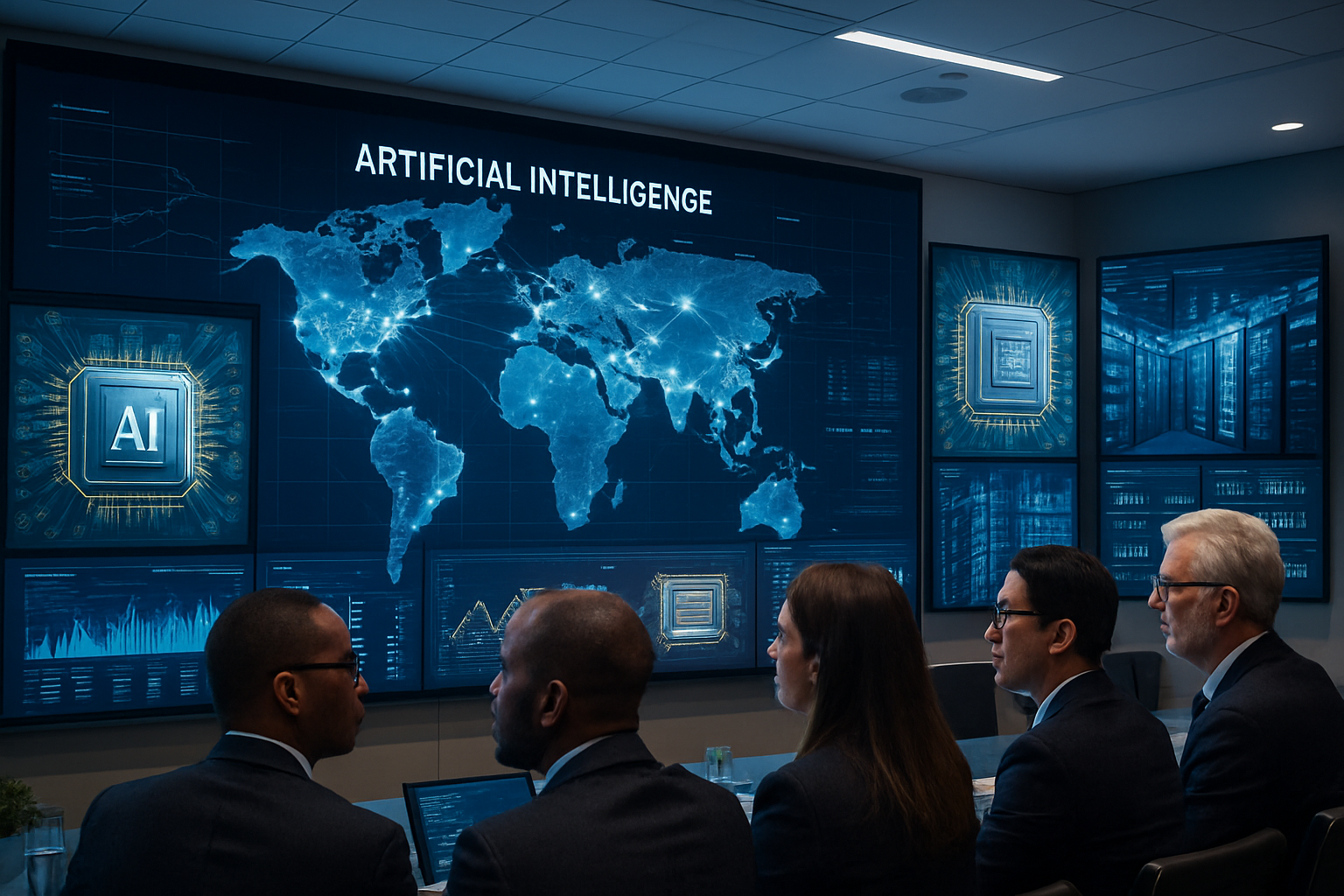
A sweeping transformation is reshaping the global technology landscape as artificial intelligence development accelerates across multiple continents, with major corporations and emerging companies driving unprecedented investment levels despite ongoing infrastructure challenges.
March 2026 has emerged as what industry experts are calling a "critical inflection point" for artificial intelligence, marking the transition from experimental applications to essential business infrastructure. The convergence of breakthrough innovations, massive corporate investments, and regulatory developments signals a fundamental shift in how AI technology will integrate into the global economy.
Amazon's Automation Revolution
Amazon founder Jeff Bezos is reportedly establishing a groundbreaking investment fund designed to acquire companies and systematically automate their operations using artificial intelligence. According to sources familiar with the initiative, the fund represents a strategic evolution of Bezos's vision to transform traditional manufacturing and service industries through comprehensive AI integration.
The ambitious project builds on Amazon's extensive experience in warehouse automation and logistics optimization, but extends far beyond the company's traditional e-commerce operations. Industry analysts suggest this could fundamentally alter how businesses approach operational efficiency and workforce management across multiple sectors.
"This represents a fundamental shift from technology as a tool to technology as a comprehensive transformation strategy,"
— Industry analyst familiar with the project
Samsung's Record AI Investment
Samsung Electronics has announced plans to invest 110 trillion won (approximately $73.2 billion) in facilities and research and development this year, with artificial intelligence semiconductors as a primary focus. The South Korean technology giant aims to establish itself as "the world's only semiconductor firm capable of delivering a one-stop solution spanning memory, foundry, and advanced packaging."
This massive investment comes as the global semiconductor industry faces unprecedented challenges, with memory chip prices surging sixfold due to overwhelming AI demand. Samsung's strategic positioning represents a bet on AI infrastructure becoming the backbone of 21st-century technology, despite current supply constraints that are expected to persist until 2027.
The investment timeline aligns with Samsung's broader strategy to capture the emerging AI chip market, which analysts project could exceed $1 trillion in value by 2030. The company's integrated approach to AI hardware development positions it to compete directly with specialized firms like Nvidia while leveraging its manufacturing scale advantages.
European Innovation and Chinese Advancement
European companies are making significant strides in AI development, with several breakthrough applications gaining international attention. Austria has seen the emergence of innovative translation tools that are capturing internet attention for their unconventional approaches, while maintaining the sophisticated technical capabilities that European firms are known for.
Meanwhile, China continues to demonstrate remarkable progress in AI demographics and strategic applications. The nation's approach to artificial intelligence is increasingly driven by demographic pressures, with the "4-2-1 problem" – where single children support four aging parents and grandparents – creating urgent demand for AI-powered solutions in healthcare, logistics, and manufacturing.
Chinese companies have achieved notable success in humanoid robotics, with Unitree Robotics scaling production from 5,500 to over 20,000 units, marking a critical transition from laboratory development to mass production capabilities.
Healthcare and Entertainment Disruption
The entertainment industry is experiencing dramatic upheaval as AI-generated content reaches unprecedented sophistication levels. The emergence of AI-powered creative tools is forcing a fundamental reconsideration of intellectual property, authenticity, and the role of human creativity in media production.
In healthcare, artificial intelligence applications are demonstrating both remarkable potential and important limitations. While AI medical scribes are saving emergency doctors significant time per patient encounter, comprehensive studies reveal that current AI systems often perform no better than traditional internet searches for complex medical scenarios, highlighting the continued importance of human medical judgment.
Infrastructure Crisis Drives Innovation
The global semiconductor shortage continues to create both challenges and opportunities for AI development. Memory chip prices have increased sixfold, affecting major manufacturers Samsung, SK Hynix, and Micron, with shortages expected to persist until new fabrication facilities come online in 2027.
Paradoxically, these constraints are spurring innovation in memory-efficient algorithms and sustainable deployment strategies. Companies are developing creative solutions that maximize AI capabilities while minimizing hardware requirements, potentially democratizing access to advanced AI technologies.
The World Bank projects that AI infrastructure will require 4.2-6.6 billion cubic meters of water annually by 2027 for data center cooling alone – equivalent to four to six times Denmark's total annual water consumption. This environmental challenge is driving significant investment in renewable energy and efficient computing architectures.
Regulatory Framework Evolution
International regulatory responses to rapid AI development are intensifying significantly. Spain has implemented the world's first criminal executive liability framework for technology platforms, creating potential imprisonment risks for executives beyond traditional corporate penalties. France has conducted cybercrime raids on AI companies, while the European Union investigates potential billion-dollar penalties for Digital Services Act violations.
The United Nations has established an Independent International Scientific Panel with 40 global experts, representing the first fully independent international AI impact assessment body. This coordinated approach prevents regulatory arbitrage and represents the most sophisticated global technology governance effort since internet commercialization.
Employment Transformation Patterns
The impact of AI on employment varies significantly by region and implementation approach. Western companies have generally pursued traditional layoff strategies, while Asian corporations, particularly in India, have implemented comprehensive worker transition programs that emphasize reskilling rather than displacement.
Microsoft's Mustafa Suleyman's prediction that AI will replace the majority of office workers within two years is gaining credibility as major corporations eliminate positions explicitly due to AI advancement. However, successful integration models demonstrate that human-AI collaboration approaches consistently outperform wholesale replacement strategies.
Success Models Emerge
Several institutions have demonstrated effective human-AI collaboration approaches. Canadian universities have successfully implemented AI teaching assistants while maintaining critical thinking standards. Malaysia operates the world's first AI-integrated Islamic school, combining artificial intelligence with traditional religious and academic learning approaches. Singapore's WonderBot 2.0 has achieved notable success in heritage education applications.
These success models share common characteristics: they treat AI as sophisticated amplification tools rather than replacement mechanisms, maintain sustained commitment to human development, ensure comprehensive stakeholder engagement, and demonstrate cultural sensitivity in implementation approaches.
Market Disruption and Investment Surge
The "SaaSpocalypse" phenomenon continues to eliminate hundreds of billions in traditional software market capitalization as AI systems demonstrate direct replacement capabilities for conventional solutions. This fundamental shift from software-as-a-service to AI-based alternatives is reshaping entire business ecosystems.
Despite infrastructure constraints, massive corporate investments continue at unprecedented levels. Alphabet has committed $185 billion to AI infrastructure in 2026 – the largest single-year corporate technology investment in history. Amazon has announced development plans exceeding $1 trillion, demonstrating continued confidence in AI's transformative potential.
Critical Inflection Point
Industry experts increasingly characterize March 2026 as a "civilizational choice point" that will determine whether artificial intelligence serves human flourishing or becomes primarily an exploitation tool. The decisions being made now regarding infrastructure development, international cooperation frameworks, and sustainable business models will establish decades-long patterns for human-AI relationships.
Success in navigating this transformation requires unprecedented coordination between governments, technology companies, educational institutions, and civil society organizations. The challenge involves balancing innovation acceleration with responsible governance, commercial interests with human welfare, and national competitiveness with international cooperation.
The multipolar landscape emerging in AI development – with Chinese technological advancement, European regulatory frameworks, and American corporate investments – creates distributed capabilities that potentially prevent single-entity control while enabling culturally sensitive development approaches.
The window for effective coordinated action appears to be narrowing rapidly as AI development accelerates. The choices made in 2026 will likely determine the human-AI relationship trajectory for the remainder of the century, making this period historically significant for technological and social development worldwide.