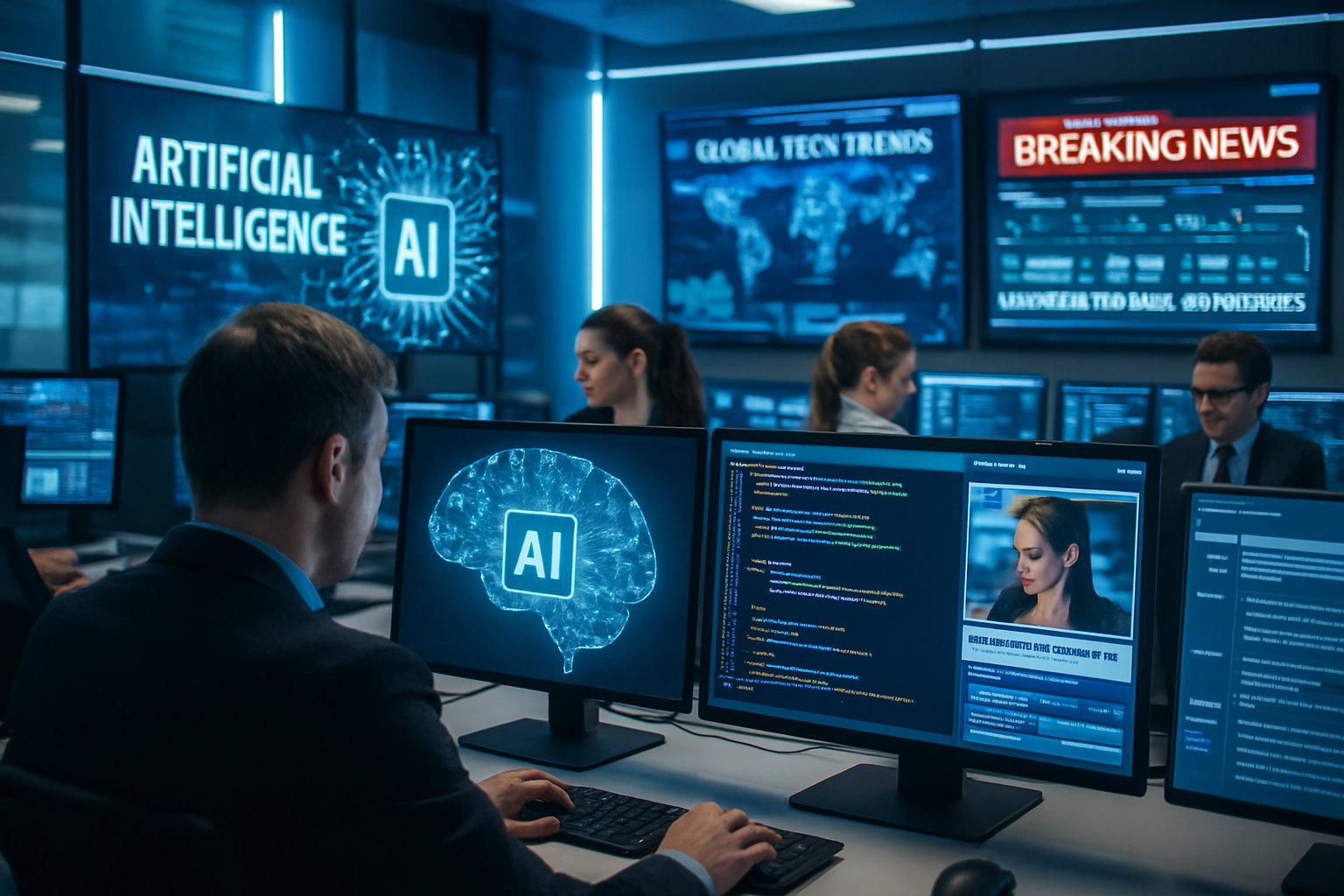
March 2026 has emerged as a critical inflection point in global artificial intelligence and technology development, with major regulatory frameworks, infrastructure challenges, and breakthrough innovations converging to reshape the digital landscape across multiple nations.
The month's developments span from the United States announcing sweeping AI policy reforms to address the intensifying technology race with China, to space agencies grappling with an unprecedented orbital debris crisis that threatens the very infrastructure supporting our digital civilization. Meanwhile, entertainment industry pioneers are pushing the boundaries of AI-generated content, and major technology companies are responding to mounting user pressures for more responsive software experiences.
US-China AI Competition Intensifies
The Trump administration unveiled a comprehensive artificial intelligence policy framework aimed at curbing state-level restrictions on innovation while reinforcing America's technological edge in an escalating competition with China. The new legislative recommendation, dubbed the National AI framework, seeks to establish unified federal standards instead of what officials describe as "fifty discordant" state-level regulations.
"Congress should pre-empt state AI laws that impose undue burdens, to ensure a national standard instead of fifty discordant ones."
— Donald Trump, US President
This strategic move comes as the global AI landscape has reached what experts characterize as a "civilizational choice point," where decisions made in 2026 will determine the trajectory of human-AI relationships for decades to come. The policy framework represents the culmination of months of analysis regarding how artificial intelligence transitions from experimental applications to essential business infrastructure.
Space Infrastructure Crisis Threatens Digital Economy
While terrestrial AI development accelerates, a growing crisis in low Earth orbit poses an existential threat to the satellite infrastructure that underpins our connected world. Thousands of new satellites are being launched at unprecedented rates, joining hundreds of thousands of pieces of high-velocity space debris that are making orbital regions increasingly hazardous.
The space junk problem has evolved from a distant concern to an immediate threat to the global digital economy. With over 34,000 tracked objects larger than 10 centimeters already orbiting Earth at speeds exceeding 17,500 mph, the risk of catastrophic collisions that could trigger cascade effects—where one collision creates debris causing additional collisions—is becoming critically high.
This orbital congestion crisis coincides with ambitious plans for space-based data centers designed to address the global semiconductor shortage. Companies like Blue Origin are proposing massive satellite constellations to support orbital computing infrastructure, potentially adding up to 51,600 additional satellites to an already crowded environment.
Entertainment Industry AI Breakthrough
The entertainment sector witnessed a remarkable milestone with the emergence of "Tilly Norwood," the first AI-generated actress to release a debut single. Her song "Take the Lead" represents a historic moment in artificial intelligence entertainment, though industry analysis reveals significant technological limitations that expose "how unfinished the dream of the artificial artist still is."
The development coincides with broader entertainment industry transformation, as AI-generated content reaches unprecedented sophistication levels. Hollywood studios have issued intellectual property violation warnings regarding unauthorized use of copyrighted material in AI training systems, highlighting the complex legal and creative challenges posed by synthetic media.
Global Infrastructure Constraints Drive Innovation
A persistent global semiconductor crisis continues to reshape the technology landscape, with memory chip prices surging sixfold due to unprecedented AI development demands. Companies including Samsung, SK Hynix, and Micron are operating at full capacity but remain unable to meet the explosive demand from AI infrastructure development.
Despite these constraints, massive investments continue flowing into AI development. Major technology companies are committing unprecedented resources to artificial intelligence infrastructure, with some allocations reaching hundreds of billions of dollars. This investment surge occurs against the backdrop of what industry observers term the "SaaSpocalypse"—the elimination of hundreds of billions in traditional software market capitalization as AI systems demonstrate direct replacement capabilities for conventional solutions.
Microsoft Responds to User Criticism
Microsoft announced significant improvements to its Windows 11 operating system following mounting user criticism. The company acknowledged ongoing technical issues through a comprehensive series of modifications, though it stopped short of issuing explicit apologies for the problems users have reported.
The Windows improvements come as Microsoft faces broader challenges in maintaining user satisfaction while transitioning its software ecosystem toward AI-integrated experiences. Industry experts predict that majority office worker replacement could occur within two years, with legal professionals and auditors facing similar timelines.
International Cooperation and Governance
The month's developments underscore the critical need for unprecedented international cooperation in managing AI development and space infrastructure. The United Nations has established an Independent Scientific Panel with 40 global experts to provide the first fully independent international AI assessment, representing the most sophisticated global technology governance framework since internet commercialization.
European nations are implementing increasingly sophisticated regulatory approaches, with Spain introducing the world's first criminal executive liability framework for technology platforms and France conducting cybercrime raids on AI companies. These coordinated regulatory efforts aim to prevent jurisdictional shopping while ensuring responsible AI development.
Success Models for Human-AI Collaboration
Despite challenges, several successful models for human-AI collaboration have emerged globally. Malaysia operates the world's first AI-integrated Islamic school, combining artificial intelligence with traditional learning approaches. Canadian universities have implemented AI teaching assistants that maintain critical thinking standards, while Singapore's WonderBot 2.0 has achieved success in heritage education.
These success stories demonstrate that the most promising path forward involves treating AI as sophisticated amplification tools for human capabilities rather than wholesale replacement mechanisms. The common thread among successful implementations is their emphasis on enhancing human creativity, cultural understanding, and ethical reasoning while leveraging computational advantages.
Looking Forward: Critical Decisions Ahead
March 2026 represents what experts characterize as the most critical AI juncture since the technology boom began. The convergence of infrastructure constraints, regulatory intensification, massive investments, and international cooperation requirements creates unprecedented coordination challenges that will determine whether AI achieves its transformative promise or creates systemic societal disruptions.
Success will require resolving infrastructure constraints while maintaining innovation momentum, developing sustainable business models that prioritize human welfare, and fostering international cooperation frameworks that balance national competitiveness with global stability. The decisions made in this pivotal period will establish the template for human-AI relationships throughout the remainder of the century.
As artificial intelligence transitions from experimental curiosity to essential infrastructure, the world faces fundamental choices about how this powerful technology will serve humanity's highest aspirations while preserving the creativity, empathy, and wisdom that define human potential.