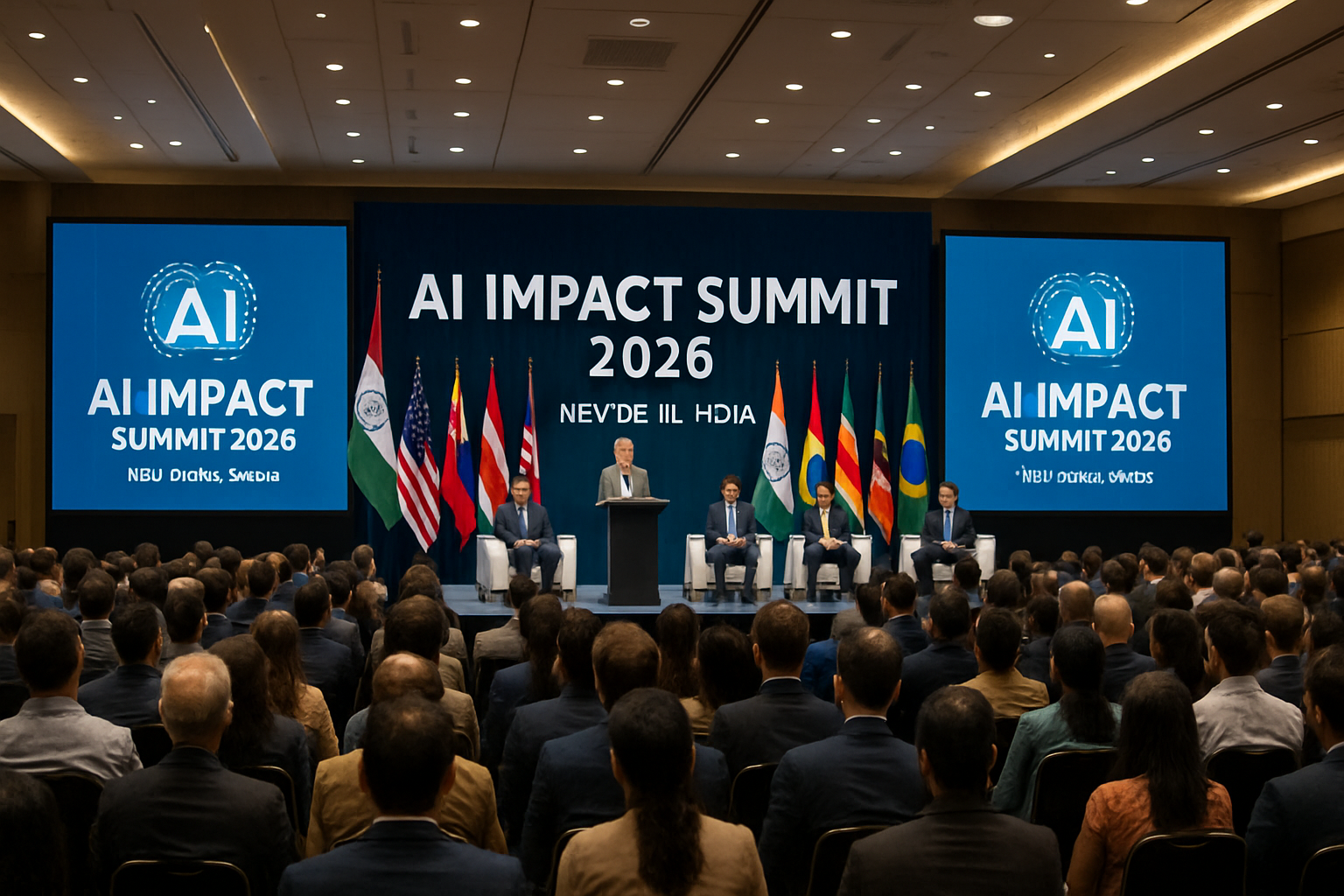
February 2026 represents the most critical inflection point in artificial intelligence development since the technology's inception, as world leaders, tech giants, and regulators converge in New Delhi for the first major AI summit hosted in the Global South while infrastructure crises and regulatory battles reshape the industry landscape.
Historic Delhi Summit Positions Global South as AI Governance Hub
The AI Impact Summit 2026, running February 16-20 in New Delhi, has attracted over 250,000 delegates including Google's Sundar Pichai, OpenAI's Sam Altman, Nvidia's Jensen Huang, and Anthropic's Dario Amodei. Prime Minister Narendra Modi positioned India as a bridge between advanced and developing economies, emphasizing that AI must remain "deeply human-centric, aligned with global development goals" at this "civilizational inflection point."
The summit's "People, Planet, Progress" framework establishes seven working groups covering AI safety, skills development, economic inclusion, and sustainable growth. This marks the first comprehensive AI governance conference held outside traditional Western technology centers, signaling a shift toward multipolar AI leadership.
However, the summit faced unexpected disruption when Bill Gates withdrew from his keynote address just hours before his scheduled presentation, citing ongoing fallout from the Jeffrey Epstein document scandal. The Gates Foundation confirmed the decision was made after "careful consideration," with Ankur Vora, president of Africa and India offices, stepping in as replacement.
Urgent Calls for Nuclear-Style AI Regulation
Industry leaders delivered stark warnings about AI's existential risks during the summit. OpenAI's Sam Altman called for nuclear-style international regulation, citing dangers from AI-made pathogens and technological centralization. "This doesn't mean we don't need any regulation or safety measures. Obviously we need them, urgently, just as we've needed them for other powerful technologies," Altman declared from the New Delhi stage.
"The world urgently needs global regulation of fast-evolving AI. We need something similar to the International Atomic Energy Agency (IAEA) to coordinate these efforts."
— Sam Altman, CEO of OpenAI
Google DeepMind CEO Demis Hassabis predicted general artificial intelligence would arrive within 5-8 years, proposing an "Einstein Test" evaluation standard to measure human-level AI reasoning. Geoffrey Hinton warned AI could lead to human extinction without proper guardrails, suggesting AI systems should develop "maternal instincts" toward humanity.
Microsoft's Mustafa Suleyman provided specific employment predictions, warning AI could replace the majority of office workers within two years, with lawyers and auditors facing automation within 18 months. These forecasts align with the ongoing "SaaSpocalypse" that has eliminated hundreds of billions in market capitalization as AI systems directly replace traditional software functions.
Revolutionary Technology Breakthroughs Amid Infrastructure Crisis
The summit coincided with several major technological announcements that demonstrate AI's rapid advancement across multiple domains. Google unveiled its Lyria 3 model, enabling users to create 30-second musical compositions using text descriptions, images, and videos. The system now supports Arabic language generation, allowing users to request compositions like "an upbeat, modern Arabic fusion track for Ramadan."
Pakistan's Higher Education Commission made AI education mandatory, requiring a three-credit-hour artificial intelligence course for all undergraduate and postgraduate degree programs starting in the 2026 academic session. This directive applies to all public and private higher education institutions across the country, reflecting AI's integration into core educational curricula globally.
Meanwhile, a severe global memory crisis threatens AI development momentum. Semiconductor prices have surged sixfold, affecting major manufacturers Samsung, SK Hynix, and Micron. Consumer electronics costs have increased 20-30% over the past year, with supply shortages expected to persist until 2027 when new fabrication facilities come online.
The World Bank projects AI water demand could reach 4.2-6.6 billion cubic meters by 2027 for data center cooling—equivalent to four to six times Denmark's annual water withdrawal—highlighting the environmental challenges accompanying AI expansion.
Multipolar Competition Challenges Western AI Dominance
The summit occurs against a backdrop of intensifying global AI competition. Chinese developments are challenging traditional assumptions about US technological dominance, with companies like DeepSeek achieving breakthrough performance using domestic semiconductors. This has triggered market volatility as investors reassess the sustainability of current AI investment levels.
European initiatives represent a third pillar of AI development, with Germany's Deutsche Telekom opening an "Industrial AI Cloud" in Munich as part of broader digital sovereignty efforts. These developments suggest a multipolar AI landscape emerging, with geographic distribution of capabilities challenging Silicon Valley's concentration of resources and talent.
China's Unitree Robotics announced scaling production to 10,000-20,000 humanoid robots in 2026, up from 5,500 in 2025, following successful demonstrations at the Spring Festival Gala. Four Chinese robotics companies showcased kung fu and somersault capabilities, marking the transition from laboratory concepts to mass production.
Regulatory Revolution and Military-Civilian Tensions
The regulatory landscape is experiencing unprecedented transformation. Spain has implemented the world's first criminal executive liability framework for social media platforms, creating imprisonment risks for technology executives. France has escalated enforcement through cybercrime raids on AI companies, while the European Commission found TikTok violated the Digital Services Act with potentially billions in penalties.
Military applications of AI are creating particular tensions. The Pentagon has integrated ChatGPT into military systems and is pressuring AI companies to deploy tools on classified networks without standard safety restrictions. This has created a fundamental conflict with companies like Anthropic, which opposes autonomous weapons development and maintains restrictions on violence and surveillance applications.
The unauthorized use of Anthropic's Claude AI chatbot in the military operation to capture former Venezuelan President Nicolás Maduro has intensified this dispute, highlighting the challenge of maintaining civilian oversight of military AI applications.
Successful Integration Models Emerge
Despite the challenges, several successful AI integration models are demonstrating responsible development approaches. Canadian universities have implemented AI teaching assistants while maintaining critical thinking standards, providing a template for educational enhancement rather than replacement of human instruction.
Malaysia has launched the world's first AI-integrated Islamic school, combining artificial intelligence with both naqli (religious) and aqli (academic) learning approaches. Singapore's WonderBot 2.0 demonstrates successful heritage education applications, showing how AI can preserve and transmit cultural knowledge.
These examples illustrate that effective AI integration requires human-centered approaches, cultural sensitivity, and comprehensive stakeholder engagement rather than technology-first implementations.
UN Establishes Independent AI Assessment Body
The United Nations has responded to mounting concerns by establishing an Independent International Scientific Panel on Artificial Intelligence, comprising 40 experts led by Secretary-General António Guterres. This represents the first fully independent global AI impact assessment body, designed to provide objective analysis of AI's societal implications.
The panel includes Nobel laureate Maria Ressa, Canadian AI pioneer Yoshua Bengio, and Google DeepMind's Joelle Barral, among other leading researchers. Their mandate encompasses comprehensive evaluation of AI's benefits and risks across economic, social, and security dimensions.
Infrastructure Investment Race Despite Constraints
Technology companies continue massive infrastructure investments despite supply chain constraints. Google's parent company Alphabet has committed $185 billion to AI infrastructure in 2026—the largest single-year technology investment in corporate history. Amazon has announced development plans exceeding $1 trillion, while India has committed to creating massive AI "data cities" in Visakhapatnam, Andhra Pradesh.
These investments occur as the industry faces the "SaaSpocalypse"—a market correction that has eliminated hundreds of billions in market capitalization as investors question traditional software business models in an AI-dominated landscape. Indian IT giants including Infosys, Wipro, and HCL Tech have experienced stock declines as AI threatens their core service offerings.
Looking Forward: Critical Decision Point
The convergence of breakthrough technologies, infrastructure crises, regulatory intensification, and geopolitical competition positions February 2026 as the most critical juncture in AI development history. Success in navigating these challenges requires unprecedented coordination between governments, technology companies, educational institutions, and civil society organizations.
The path forward demands resolving infrastructure constraints, establishing international cooperation frameworks, and developing sustainable business models that prioritize human welfare alongside technological advancement. The decisions made in 2026 will determine whether AI fulfills its transformative promise or creates systemic societal disruption.
As Prime Minister Modi noted in his opening address, this represents a "civilizational inflection point" where humanity must choose between AI development that serves democratic values and human flourishing, or technology that concentrates power and undermines social cohesion.
The Delhi Declaration emerging from this summit is expected to establish new frameworks for international AI cooperation, positioning developing nations as equal partners in AI governance rather than passive recipients of technology developed elsewhere. This could fundamentally reshape global technology governance for the remainder of the decade and beyond.