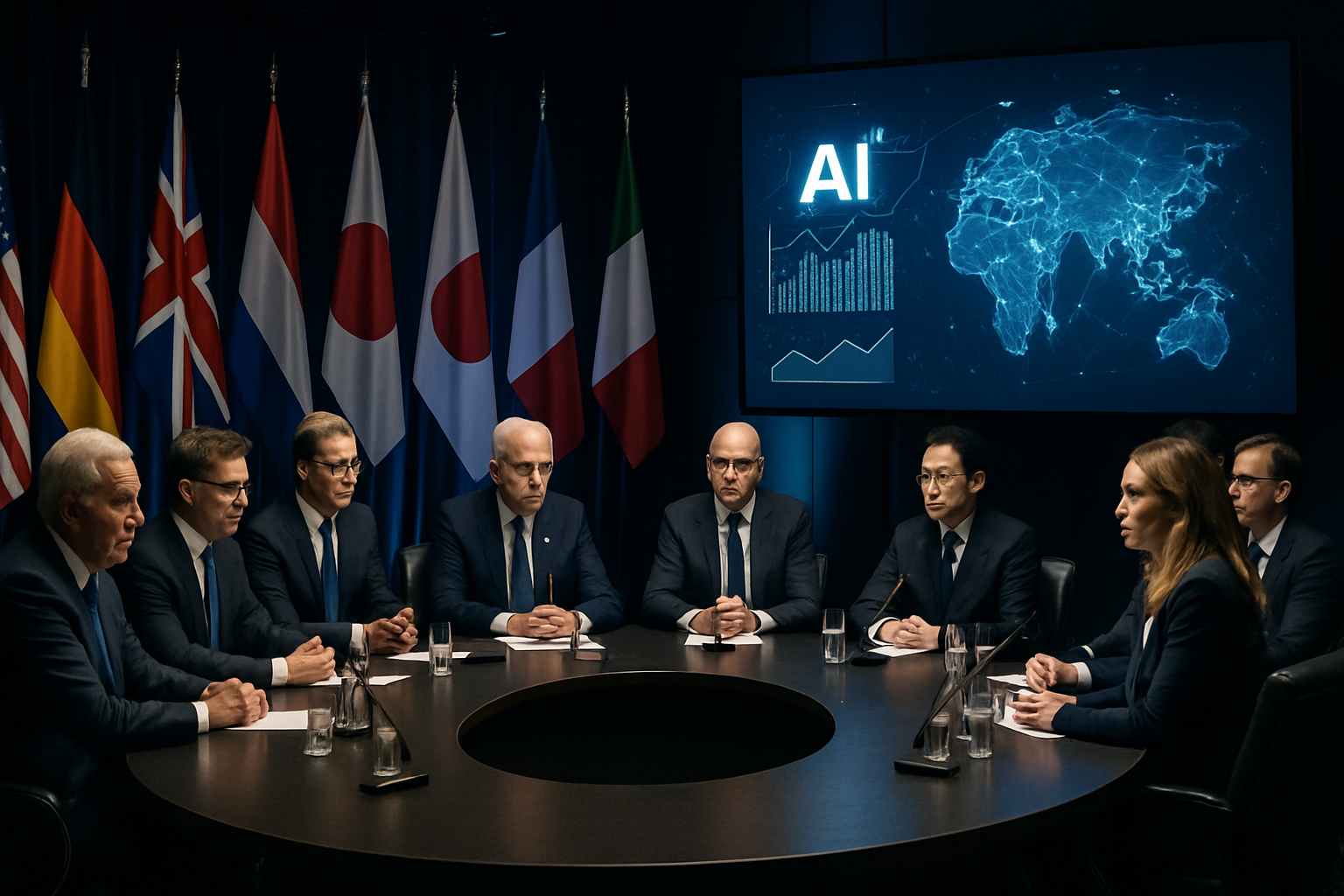
February 2026 has emerged as a watershed moment in the global artificial intelligence revolution, with China's unique economic structure potentially offering greater resilience against AI-driven employment disruption while OpenAI expands its strategic defense partnerships with the Pentagon. This convergence of economic, technological, and military factors is reshaping the international balance of power in the AI era.
China's "Iron Rice Bowl" Advantage in the AI Age
As humanoid robots performed elaborate break-dancing routines and sword combat demonstrations during China's Spring Festival Gala—the world's most-watched television program—Chinese economists are arguing that the nation's traditional employment structure may provide unexpected advantages in weathering artificial intelligence disruption. The concept of the "iron rice bowl," China's historical guarantee of job security, could prove remarkably prescient as AI threatens to eliminate millions of positions globally.
During the televised celebration, domestic AI brands took center stage alongside the robotic performers, showcasing China's rapid advancement in artificial intelligence development. This public demonstration of technological capability came as analysts increasingly recognize that China's state-controlled economy and extensive public sector employment may create natural buffers against the mass unemployment that AI adoption could trigger in market-driven economies.
"The iron rice bowl system that Western economists once criticized as inefficient may become China's greatest asset in the AI transition period."
— Economic Analyst, South China Morning Post
The implications extend far beyond employment policy. China's approach to AI development emphasizes gradual integration within existing social structures, contrasting sharply with Silicon Valley's disruptive innovation model. This methodical approach, combined with significant state control over key economic sectors, could position China to maintain social stability while Western nations grapple with AI-induced labor market upheaval.
Pentagon-OpenAI Partnership Deepens Military AI Integration
Simultaneously, the United States is accelerating its own AI strategy through unprecedented military partnerships. OpenAI has detailed comprehensive "layered protections" in its expanding collaboration with the US Department of Defense, marking a significant evolution in how artificial intelligence is being integrated into national security infrastructure.
The partnership represents a fundamental shift from experimental AI applications to essential military infrastructure. ChatGPT, which now serves over 800 million weekly users with 10% monthly growth, has been successfully integrated into Pentagon systems, demonstrating the technology's maturation from consumer novelty to strategic necessity.
This military AI integration occurs against the backdrop of intensifying global competition. Chinese advances in AI technology, including breakthrough developments by companies like DeepSeek that challenge US technological assumptions, have prompted Washington to treat AI capability as a matter of national security rather than merely commercial advantage.
Infrastructure Crisis Constrains Global Development
Despite ambitious AI initiatives on multiple continents, the global technology industry faces severe infrastructure constraints that threaten to limit rapid expansion. Memory semiconductor prices have surged sixfold, affecting major manufacturers including Samsung, SK Hynix, and Micron Technology. Consumer electronics costs have increased 20-30% over the past year, with shortages expected to persist until 2027 when new fabrication facilities come online.
The crisis extends beyond semiconductors to water resources. The World Bank projects that AI operations could require 4.2 to 6.6 billion cubic meters of water by 2027 for data center cooling—equivalent to four to six times Denmark's annual water withdrawal. This environmental demand adds urgency to finding sustainable solutions for AI infrastructure.
Companies are responding with massive investments despite these constraints. Alphabet has committed $185 billion to AI infrastructure development in 2026, while Amazon's AI development plans exceed $1 trillion. These investments signal corporate confidence that current bottlenecks represent temporary challenges rather than fundamental limitations on AI expansion.
Successful Human-Centered AI Implementation
Amid the geopolitical tensions and infrastructure challenges, several nations have demonstrated successful models for human-centered AI integration. Malaysia has launched the world's first AI-integrated Islamic school, combining artificial intelligence capabilities with traditional religious and academic learning frameworks. This approach shows how AI can enhance rather than replace cultural and educational traditions.
Canada has implemented AI teaching assistants in universities while maintaining critical thinking standards, proving that artificial intelligence can augment human capabilities without diminishing intellectual rigor. Singapore's WonderBot 2.0 has achieved notable success in heritage education, using conversational AI to make cultural learning more engaging for students.
These examples contrast sharply with concerns about AI replacing human judgment and creativity. They demonstrate that thoughtful implementation can preserve human agency while leveraging AI's computational advantages.
Regulatory Frameworks Struggle to Keep Pace
As AI capabilities rapidly advance, regulatory frameworks worldwide are struggling to establish appropriate governance structures. Spain has implemented the world's first criminal executive liability framework for social media platforms, creating personal legal risks for technology executives. France has conducted cybercrime raids on AI companies, while the European Union has found TikTok in violation of Digital Services Act provisions with potential penalties in the billions.
The United Nations has established an Independent International Scientific Panel on Artificial Intelligence with 40 global experts led by Secretary-General António Guterres. This represents the first fully independent global AI assessment body, though its effectiveness will depend on international cooperation from major AI-developing nations.
"We are at the most critical AI governance moment since the technology boom began. Decisions made in 2026 will echo through decades."
— UN AI Policy Expert
Economic Disruption Accelerates Market Transformation
The economic implications of rapid AI advancement are becoming increasingly apparent through what analysts term the "SaaSpocalypse"—the elimination of hundreds of billions in market capitalization from traditional software companies as AI systems demonstrate their ability to replace conventional solutions.
Employment predictions have become increasingly stark. Microsoft's Mustafa Suleyman forecasts that AI will replace the majority of office workers within two years, with lawyers and auditors facing displacement within 18 months. Indian information technology giants including Infosys, Wipro, and HCL Technologies are adapting through worker transition programs rather than mass layoffs, showing proactive approaches to managing technological displacement.
However, this disruption is creating opportunities alongside challenges. The transition from experimental AI to essential infrastructure is generating new categories of employment while eliminating others. Success in this transformation will likely depend on how quickly societies can retrain workers and adapt educational systems to the new technological landscape.
Global South Emerges as AI Governance Leader
A significant development in 2026 has been the emergence of Global South nations as active participants in AI governance rather than passive recipients of Western or Chinese technology. India's AI Impact Summit in New Delhi, featuring 250,000+ delegates from over 100 countries, positioned developing nations as equal partners in determining AI's global trajectory.
Prime Minister Narendra Modi's "People, Planet, Progress" framework offers an alternative to both Silicon Valley's market-driven approach and China's state-controlled model. This third path emphasizes human welfare alongside technological advancement, potentially providing a template for smaller nations seeking to benefit from AI without sacrificing sovereignty or social stability.
Looking Ahead: Critical Decisions Shape Decades
February 2026 represents what many experts consider the most critical inflection point in artificial intelligence development since the technology boom began. The decisions made by governments, technology companies, and educational institutions in this period will likely determine whether AI serves transformative human purposes or creates systemic disruption requiring dramatic corrections.
Success will require unprecedented coordination between innovation acceleration and safety governance, commercial interests and human welfare, national competitiveness and international cooperation. The multipolar AI landscape emerging through Chinese breakthroughs, American military integration, European regulatory frameworks, and Global South governance initiatives suggests that no single entity will control AI's development trajectory.
The stakes extend beyond technological advancement to fundamental questions about human agency in an AI-integrated world. Whether artificial intelligence enhances human creativity, empathy, and wisdom while preserving democratic governance and social cohesion may depend on decisions made in the coming months rather than years.
As China's Spring Festival robots danced before billions of viewers and Pentagon systems integrated advanced AI capabilities, February 2026 demonstrated that the artificial intelligence revolution has moved beyond experimental phases to become essential infrastructure for economic, military, and social systems worldwide. The challenge now lies in ensuring this transformation serves human flourishing rather than diminishing it.