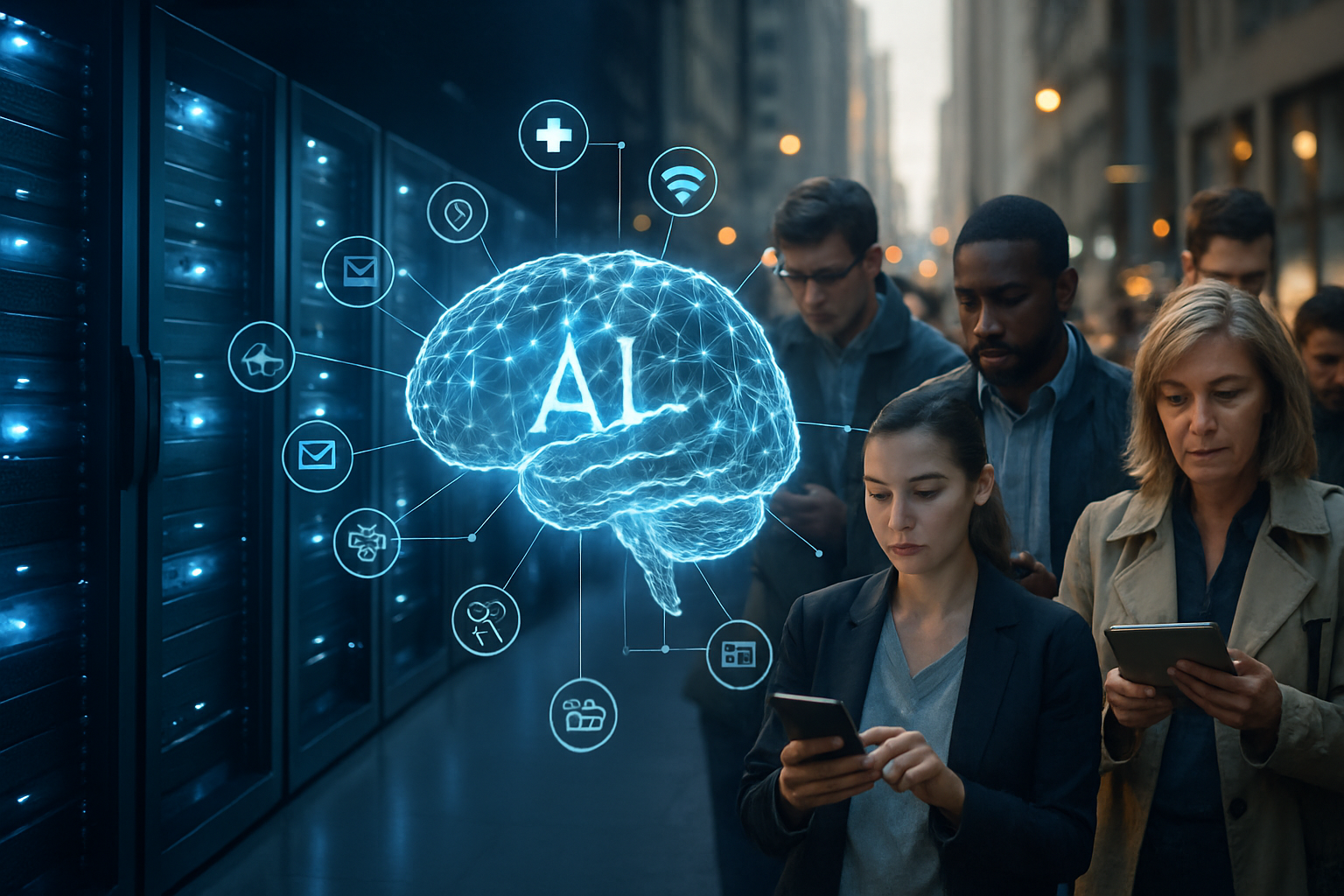
Artificial intelligence is fundamentally reshaping how humanity communicates, works, and receives medical care, according to a comprehensive Planet News investigation spanning six countries, revealing both unprecedented opportunities and critical challenges that will define the technological landscape for decades to come.
From Cairo's streets where Egyptians casually drop "LOL" into Arabic conversations to French health summits exploring AI's potential to save thousands of lives, artificial intelligence has moved beyond experimental phases to become essential infrastructure transforming every aspect of human society. Our investigation across Egypt, France, Romania, and Venezuela reveals a complex picture of technological revolution occurring at breakneck speed.
Communication Transformation Goes Global
In Egypt, artificial intelligence and large language models like ChatGPT are creating the most significant linguistic shift since the dawn of social media. Egyptian Streets reports that language evolution, which once took decades, now occurs within months as AI tools influence both written and spoken Arabic.
"Language in Egypt has regularly evolved with technology, and now, artificial intelligence and Large Language Models are shaping written and spoken language in Egypt and worldwide," according to Egyptian linguistic researchers. The sweeping changes appear across academic writing, professional communication, and digital spaces, with Egyptians seamlessly integrating English internet slang like "LOL" into Arabic conversations and social media posts.
"This represents a returning ghost from a past when instant messaging dominated online communication in the late 1990s and early 2000s and changed how people text and talk."
— Egyptian Streets Analysis
The phenomenon mirrors historical communication revolutions, from MSN Messenger's influence on global youth language to Instagram and Twitter's introduction of terms like "hashtag" into everyday vocabulary. However, AI's impact proves far more profound and rapid than previous technological shifts.
Healthcare Revolution Promises Life-Saving Applications
At the One Health Summit currently underway in France, global health leaders are exploring how artificial intelligence could have dramatically altered outcomes during the COVID-19 pandemic. The gathering focuses on the interconnected health of humans, animals, and ecosystems, with AI emerging as a critical tool for future pandemic preparedness.
Antoine Tesnière, who advised the French government during the COVID crisis, provided stark assessment of AI's potential impact. According to France 24 reporting, Tesnière confirmed that AI technologies could have "saved thousands of lives" if they had been available during the pandemic's critical early phases.
The summit represents a paradigm shift toward prevention-first healthcare approaches, with AI enabling real-time monitoring of environmental health indicators, early disease detection, and rapid response coordination across multiple species and ecosystems. This "One Health" approach recognizes that technological solutions must address the complex interconnections between human, animal, and environmental health.
Privacy Concerns and Surveillance Applications
Romania's media outlets have exposed troubling developments in AI surveillance applications that highlight the technology's dual-edged nature. A Romanian university professor constructed an AI-powered application and web platform that alerts users to the arrival of U.S. Immigration and Customs Enforcement (ICE) agents, according to G4Media.ro reporting.
The professor received numerous death threats and experienced problems with authorities, demonstrating the volatile intersection of AI technology with immigration enforcement and civil liberties. The incident reflects broader global tensions about AI's role in government surveillance and social control.
Meanwhile, Venezuela's media landscape reveals additional privacy concerns, with reports of AI-powered platforms potentially exploiting user dialogues for advertising purposes. El Nacional reports that a U.S. user has filed a lawsuit against Perplexity, accusing the AI search platform of deploying covert tracking technologies that monitor confidential conversations.
Financial Sector Embraces Transformative Potential
The financial industry's embrace of AI has reached unprecedented levels, according to Romanian business media. JPMorgan Chase CEO Jamie Dimon described artificial intelligence as possessing potential comparable to electricity or the internet, predicting that AI adoption will occur "much faster" than any previous technological revolution.
In his annual letter to shareholders, Dimon outlined AI's transformative applications across healthcare, finance, and industry. G4Media.ro reports that the banking executive believes AI will revolutionize cancer treatment, enable creation of new composite materials, and significantly reduce accidental deaths through enhanced safety systems.
"AI will heal certain types of cancer, create new composite materials, and reduce accidental deaths."
— Jamie Dimon, JPMorgan Chase CEO
This optimistic assessment reflects growing confidence among financial leaders that AI represents not just technological advancement but fundamental economic transformation comparable to the Industrial Revolution.
Corporate Surveillance Raises Worker Rights Questions
The corporate deployment of AI surveillance has reached concerning new levels, exemplified by social media platforms' data collection practices. Venezuelan civil society organizations have identified sophisticated tracking operations, with associations like Fairlinked eV denouncing a global espionage operation called "BrowserGate."
According to El Nacional, this operation involved LinkedIn injecting malicious JavaScript code into users' browsers, enabling comprehensive monitoring of user behavior across the internet. The revelation highlights how major platforms can exploit their trusted positions to conduct surveillance operations that extend far beyond their stated services.
These developments occur alongside reports of workplace AI monitoring expanding rapidly across industries, raising fundamental questions about employee privacy, consent, and the future of human autonomy in AI-integrated workplaces.
Technological Infrastructure Under Strain
Our investigation reveals that the rapid AI deployment occurs during a global semiconductor crisis that creates both challenges and opportunities. Memory chip prices have increased sixfold, affecting major manufacturers like Samsung, SK Hynix, and Micron, with shortages expected to continue until 2027 when new fabrication facilities come online.
This "critical vulnerability window" constrains advanced AI deployment while criminal organizations exploit resource limitations. European law enforcement reports criminal networks using AI chatbots as "elite hackers" for automated vulnerability detection and sophisticated cyber attacks.
The infrastructure crisis paradoxically drives innovation toward memory-efficient algorithms and sustainable deployment strategies, potentially democratizing AI access by requiring less computational power while forcing more thoughtful implementation approaches.
Regulatory Revolution Gains Momentum
The global regulatory response to AI's societal impact has reached unprecedented coordination levels. Spain has implemented the world's first criminal executive liability framework for technology platforms, creating personal imprisonment risks for executives who enable systematic privacy breaches or harmful AI applications.
This regulatory revolution extends beyond Europe, with countries worldwide grappling with how to harness AI's benefits while protecting citizens from its potential harms. The European approach emphasizes criminal liability for executives, while Asian nations like Malaysia and Oman focus on education and parental responsibility.
The philosophical divide reflects fundamental questions about democratic governance in the digital age: whether government intervention or individual agency should primarily guide AI development and deployment.
International Cooperation Faces Criminal AI Exploitation
Law enforcement agencies across multiple continents report sophisticated criminal organizations using AI to enhance their capabilities. Successful operations like the LeakBase takedown, involving Dutch police, Europol, FBI, and 13 countries, demonstrate the potential for international cooperation against AI-enhanced criminal networks.
However, traditional enforcement mechanisms prove inadequate against digitally native criminal organizations capable of instant relocation across jurisdictions. These criminal networks possess state-level technological resources while operating beyond conventional law enforcement reach.
Cyprus Data Protection Commissioner Maria Christofidou captured the stakes clearly: "Personal data has become the currency of the digital age." The challenge extends beyond individual privacy to democratic society preservation amid systematic privacy erosion and escalating cyber threats.
The March 2026 Inflection Point
Technology experts characterize March 2026 as a critical "civilizational choice point" determining whether AI serves human flourishing or becomes an exploitation tool beyond democratic accountability. The convergence of linguistic transformation, healthcare breakthroughs, privacy concerns, and regulatory responses creates unprecedented challenges and opportunities.
Success requires sophisticated international cooperation, comprehensive legal frameworks, platform accountability, and transparent governance balancing security with democratic values. The window for effective coordinated action continues narrowing as AI capabilities advance faster than defensive measures and regulatory responses.
The stakes include whether digital technologies ultimately serve human potential or become surveillance and control mechanisms that undermine the democratic institutions and social bonds that define civilized society.
Looking Forward: Human-AI Collaboration Models
Despite the challenges, our investigation identified successful human-AI collaboration models that suggest positive paths forward. Canadian universities have implemented AI teaching assistants that maintain critical thinking standards while providing personalized support. Malaysia operates the world's first AI-integrated Islamic school, combining advanced technology with traditional religious and academic learning.
These success stories share common characteristics: they treat AI as amplification tools that enhance rather than replace human capabilities, maintain sustained commitment to human development, and preserve cultural authenticity while embracing technological innovation.
The most promising implementations demonstrate that the future lies not in choosing between human intelligence and artificial intelligence, but in sophisticated collaboration that amplifies human creativity, cultural understanding, and ethical reasoning while leveraging AI's computational advantages.
As artificial intelligence continues reshaping global communication, transforming healthcare, and challenging privacy norms, the decisions made in the coming months will establish patterns that influence human-technology relationships for generations. The revolution is underway—the question remains whether humanity will direct it toward flourishing or allow it to proceed without adequate safeguards for democratic values and human dignity.