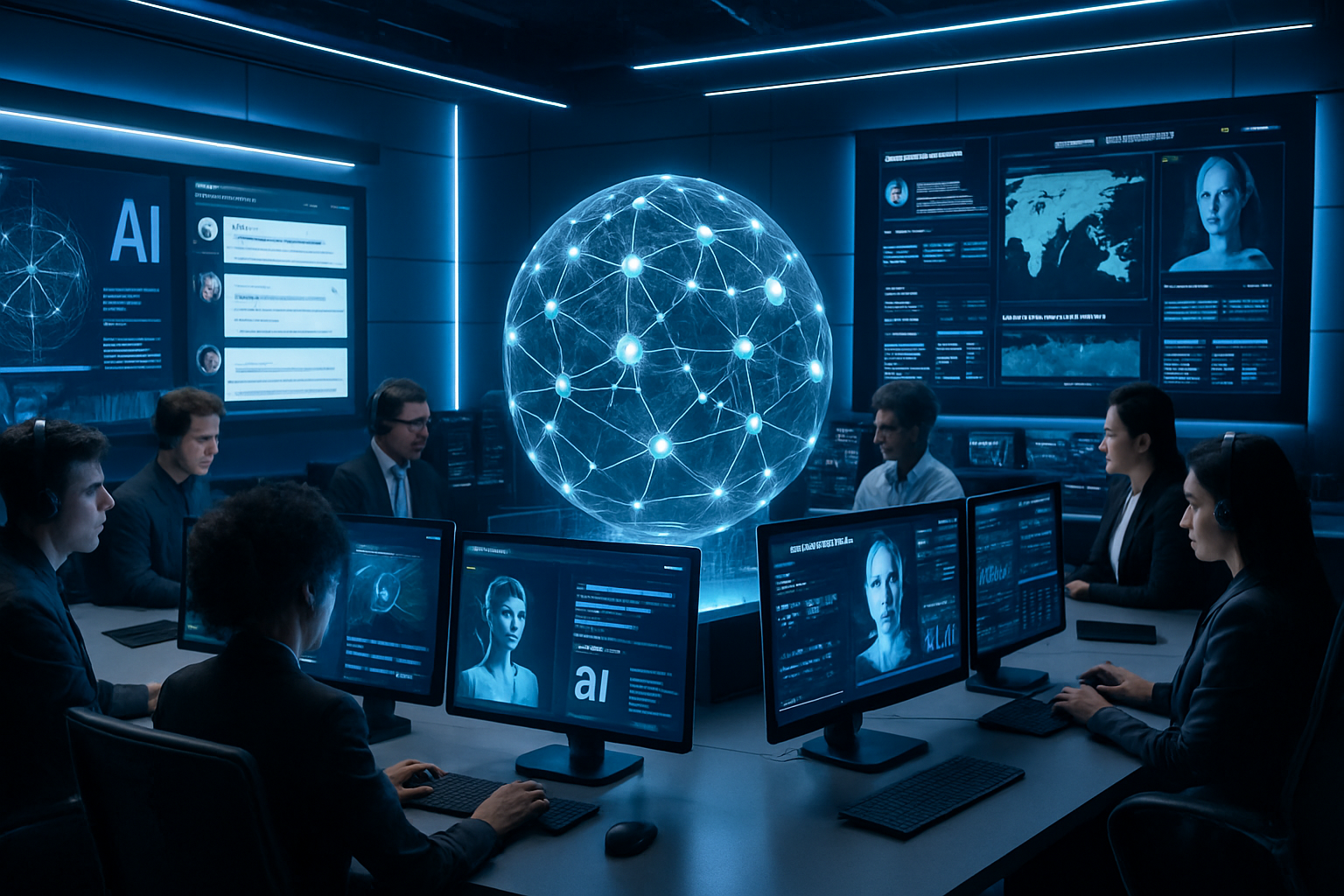
Artificial intelligence is experiencing unprecedented global expansion across sectors ranging from posthumous social media management to advanced military applications, fundamentally reshaping how technology integrates with human society and national security operations.
Recent developments reveal AI's growing sophistication and ubiquity, with major technological breakthroughs occurring simultaneously across multiple continents. From ByteDance's dominance in Chinese markets to OpenAI's military integration and Meta's posthumous profile management, the technology is transitioning from experimental applications to essential infrastructure.
Social Media and Digital Afterlife Management
Meta's neural network technology has enabled a groundbreaking capability: maintaining deceased users' social media accounts posthumously. According to AzerNEWS reports, this development represents a fundamental shift in digital identity management, allowing artificial intelligence systems to continue social media activity after user death.
The technology builds on Meta's patent filed in 2023 and granted in December 2025, which enables AI to mimic human social media behavior patterns. This innovation occurs amid broader concerns about AI's role in social interactions, as evidenced by the emergence of AI-only platforms like Moltbook, where artificial intelligence systems interact without human oversight.
"The implications of AI managing digital legacies extend far beyond social media, touching on fundamental questions of identity, memory, and human agency in the digital age."
— Technology Ethics Researcher, Stanford Digital Observatory
Military AI Integration Reaches New Heights
OpenAI has been contracted to develop voice control technology for U.S. military drone swarm operations, marking a significant escalation in AI military applications. The technology specifically translates battlefield commanders' voice commands into digital instructions for drone coordination, according to sources familiar with the project.
This development coincides with broader Pentagon initiatives to integrate ChatGPT and other AI systems into classified military networks. The Department of Defense's approach represents a strategic recognition that advanced AI capabilities are becoming essential for maintaining military advantage rather than optional enhancements.
The military integration occurs amid increasing global competition, with Chinese AI advances through companies like ByteDance challenging U.S. technological dominance. ByteDance's Doubao chatbot has accumulated over 100 million daily users since 2023, demonstrating the scale of AI adoption in major markets.
Workforce Transformation and Educational Implications
Caribbean leaders are urging fundamental changes to traditional employment models in response to AI advancement. Jamaica's Minister of State Delano Seiveright warned university students that "9-to-5 alone is not cutting it," emphasizing the need for AI skills development and network expansion to compete internationally.
Educational institutions globally are implementing AI integration strategies while maintaining human-centered learning approaches. Canadian universities have successfully deployed AI teaching assistants while preserving critical thinking standards, and Malaysia has opened the world's first AI-integrated Islamic school, combining technology with traditional religious education.
However, the transformation presents significant challenges. Slovak researchers have warned of a generational critical thinking crisis, noting that while students demonstrate confidence in AI capabilities, fundamental analytical skills may be deteriorating. The balance between technological enhancement and human cognitive development remains a critical concern.
Global Technology Competition and Sovereignty
The Pentagon's reported use of Anthropic's Claude AI tool raises questions about AI governance and international cooperation. Portuguese media reports suggest the technology was utilized in operations to capture Venezuelan leader Nicolás Maduro, though Anthropic's terms explicitly prohibit use for "facilitating violence, developing weapons, or surveillance."
European nations are responding with technological sovereignty initiatives. Germany's Deutsche Telekom has launched a massive AI data center in Munich through NVIDIA partnership, creating an "Industrial AI Cloud" as part of billion-euro European AI independence efforts.
The global memory crisis, with semiconductor prices increasing sixfold and affecting major manufacturers Samsung, SK Hynix, and Micron, is constraining AI development worldwide. Supply shortages are expected to persist until 2027, forcing innovations in memory-efficient algorithms and alternative computing architectures.
Regulatory Responses and Governance Challenges
Governments worldwide are implementing increasingly sophisticated regulatory frameworks. Spain has introduced criminal executive liability for social media platform violations, creating personal legal risks for technology leaders. France has conducted cybercrime raids on AI platforms, while the UN has established an Independent International Scientific Panel with 40 experts for AI impact assessment.
The regulatory intensification reflects growing concerns about AI's societal impact. Research indicates that 96% of children aged 10-15 use social media, with 70% experiencing harmful content exposure and over 50% encountering cyberbullying. These statistics drive policy discussions about protection versus innovation.
Economic Transformation and Market Disruption
The AI revolution is creating massive market disruptions, with the "SaaSpocalypse" eliminating hundreds of billions in market capitalization as AI systems directly replace traditional software functions. Indian IT giants have experienced significant declines as AI threatens core business services.
Simultaneously, major technology companies are making unprecedented investments. Alphabet has committed potentially $185 billion for AI infrastructure in 2026, while Amazon plans over $1 trillion in development. These investments occur despite ongoing infrastructure constraints and monetization uncertainties.
Infrastructure and Environmental Challenges
AI development faces critical infrastructure limitations. The World Bank projects AI water demand could reach 4.2-6.6 billion cubic meters by 2027—equivalent to four to six times Denmark's annual water withdrawal—primarily for data center cooling requirements.
Environmental concerns are prompting innovative solutions. Elon Musk has proposed space-based data centers powered by solar energy, though technical feasibility remains under expert scrutiny. The approach reflects industry recognition that traditional infrastructure may be insufficient for AI's growing demands.
Success Models and Responsible Integration
Despite challenges, successful AI integration models are emerging. Singapore's WonderBot 2.0 demonstrates effective conversational AI for heritage education, while Brazil's Carnival 2026 utilized AI-enhanced services generating R$14.48 billion in revenue through QR codes and inventory management.
These success stories share common elements: clear pedagogical or business objectives, cultural sensitivity integration, comprehensive stakeholder engagement, and technology serving specific needs rather than generic implementation.
Looking Forward: Critical Decisions Ahead
February 2026 represents a critical inflection point in AI development. The technology is transitioning from experimental applications to essential infrastructure across healthcare, education, entertainment, and governance sectors. Success depends on resolving infrastructure constraints, developing international cooperation frameworks, and creating sustainable business models that prioritize human welfare alongside technological advancement.
The multipolar AI landscape emerging challenges Silicon Valley concentration, with Chinese breakthroughs, European sovereignty initiatives, and developing nation innovations creating diverse development pathways. The decisions made in 2026 will determine whether AI enhances global prosperity or creates systemic inequality and social disruption.
"We stand at a crossroads where artificial intelligence can either amplify human capabilities or replace them entirely. The choices we make today about regulation, integration, and governance will echo through generations."
— UN Secretary-General António Guterres, AI Scientific Panel Announcement
As AI systems demonstrate increasing autonomy and sophistication, the balance between innovation acceleration and responsible development becomes ever more critical. The technology's integration across sectors—from managing digital legacies to commanding military operations—reflects both its transformative potential and the urgent need for comprehensive governance frameworks that protect human agency while harnessing AI's capabilities for societal benefit.