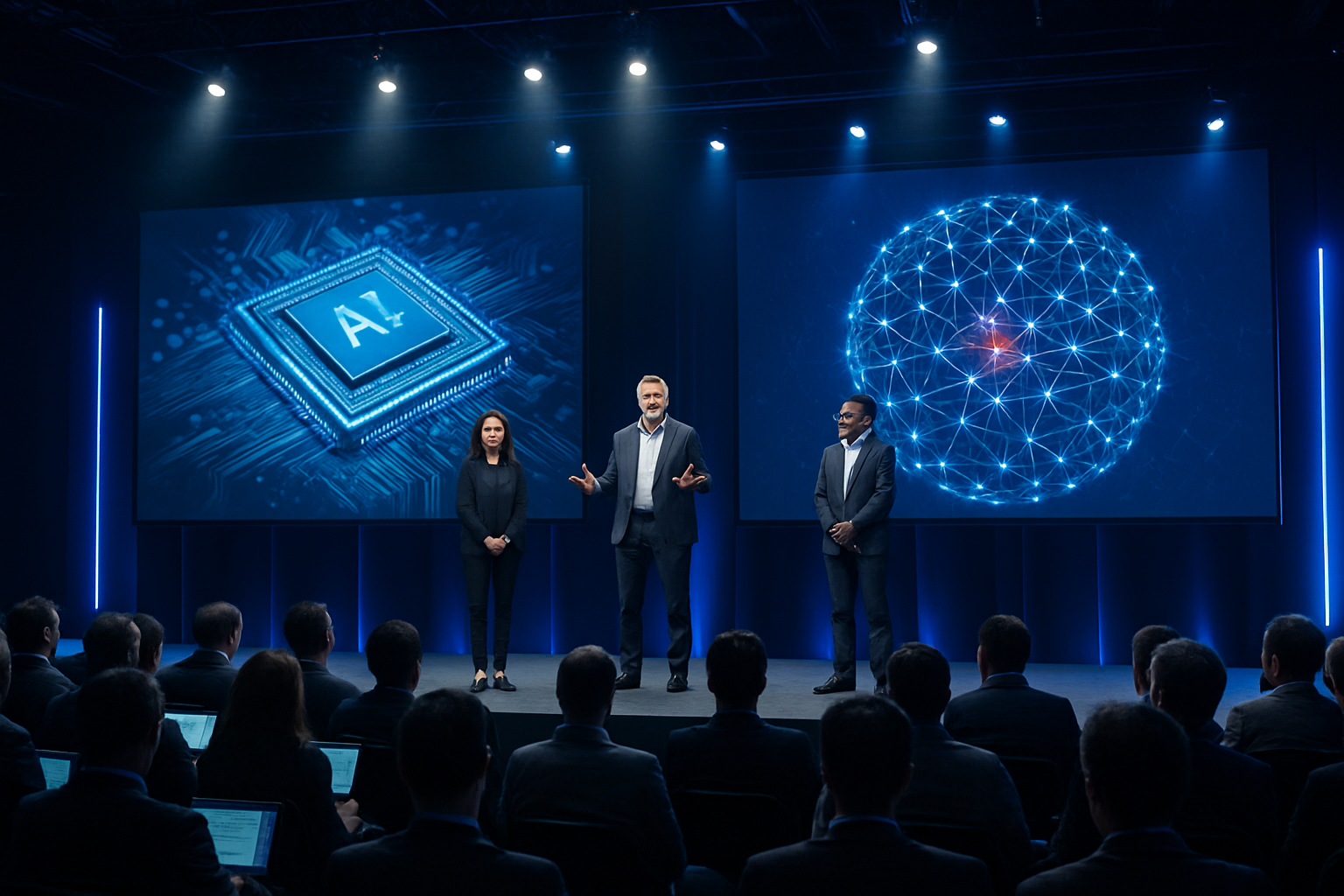
Major technology companies unveiled significant artificial intelligence advances this week, with Nvidia's Jensen Huang making controversial claims about achieving Artificial General Intelligence while ARM announced breakthrough chip architecture expected to generate billions in new revenue.
The developments come as March 2026 emerges as what industry experts are calling a "critical inflection point" in AI's transition from experimental technology to essential business infrastructure across multiple sectors.
Nvidia CEO Makes Bold AGI Declaration
Jensen Huang, CEO of the world's most valuable company, sparked intense debate in the AI community with his assertion that Artificial General Intelligence (AGI) has already been achieved. Speaking at a technology conference, Huang's claim directly contradicts the scientific consensus that AGI—defined as AI systems matching human cognitive abilities across all domains—remains years away.
Austrian technology publication Der Standard characterized Huang's statement as factually unsupportable, noting the lack of evidence supporting such a dramatic claim. The declaration comes as Nvidia continues to dominate the AI chip market, with the company reporting record quarterly revenues of $68.1 billion in February 2026.
"The assertion that AGI has been achieved appears to be more marketing hyperbole than scientific reality. Current AI systems, while impressive, still lack the general reasoning and adaptability that define human intelligence."
— Dr. Frank Bäumer, German AI Research Institute
ARM Unveils Revolutionary AI Chip Architecture
British semiconductor design company ARM announced its new AI-optimized chip architecture, with executives projecting the technology could add billions in annual revenue. The chip design specifically targets the growing demand for edge AI computing and mobile artificial intelligence applications.
The announcement comes amid a global semiconductor crisis that has driven memory chip prices up sixfold, affecting major manufacturers Samsung, SK Hynix, and Micron. Despite supply constraints expected to persist until 2027, massive corporate investments in AI infrastructure continue, with Alphabet committing $185 billion and Amazon pledging over $1 trillion to AI development.
Healthcare AI Applications Expand Globally
Artificial intelligence applications in healthcare reached new milestones this week, with New Zealand announcing plans to deploy AI systems for breast cancer screening. Medical experts emphasized that AI would serve as a "second set of eyes" for radiologists, potentially improving diagnostic accuracy while making better use of limited specialist resources.
The healthcare applications represent part of what researchers term the "Therapeutic Revolution of 2026," characterized by prevention-first strategies and AI integration with human-centered medical care. Estonian hospitals have already demonstrated AI's effectiveness in stroke and radiation therapy treatments, saving doctors significant time while improving patient outcomes.
However, concerns persist about AI's limitations in medical applications. A comprehensive Oxford University study published in Nature Medicine found that AI chatbots performed no better than traditional internet searches across various medical scenarios, highlighting the continued importance of professional medical judgment.
Global Competition Intensifies
The AI developments occur within an increasingly multipolar technological landscape. China continues advancing its AI capabilities through strategic investments and flexible brain-computer interfaces, while European nations implement comprehensive regulatory frameworks including Spain's world-first criminal executive liability for tech platforms.
The United Nations established an Independent Scientific Panel with 40 global experts to provide the first fully independent international AI assessment, recognizing that AI governance requires unprecedented coordination between governments, technology companies, and civil society organizations.
Infrastructure Challenges Drive Innovation
The ongoing global semiconductor shortage, described as the most severe memory crisis since the early 2000s, has paradoxically accelerated innovation in AI development. Companies are developing memory-efficient algorithms and hybrid processing approaches that could democratize access to advanced AI capabilities.
The World Bank projects that AI systems will require 4.2-6.6 billion cubic meters of water annually by 2027 for data center cooling—equivalent to four to six times Denmark's entire annual water consumption. This environmental challenge is driving investments in renewable energy and more efficient computing architectures.
Employment Impact Remains Uncertain
The rapid AI advancement continues generating debate about employment implications. Microsoft's Mustafa Suleyman recently predicted that AI could replace the majority of office workers within two years, with lawyers and auditors particularly vulnerable within 18 months.
However, successful human-AI collaboration models are emerging globally. Malaysia operates the world's first AI-integrated Islamic school, combining artificial intelligence with traditional religious and academic learning. Canadian universities have implemented AI teaching assistants while maintaining critical thinking standards, and Singapore's WonderBot 2.0 has achieved success in heritage education.
These success stories suggest that AI's future lies in sophisticated collaboration that amplifies human capabilities while preserving creativity, cultural understanding, and ethical reasoning that define human potential.
Critical Decisions Ahead
Industry observers characterize March 2026 as a "civilizational choice point" that will determine whether AI serves human flourishing or becomes a tool for exploitation and control. The decisions made during this period are expected to establish decades-long patterns for human-AI relationships across all sectors of society.
Success in navigating this transformation requires resolving infrastructure constraints while maintaining innovation momentum, developing sustainable business models that prioritize human welfare, and establishing international cooperation frameworks that balance national competitiveness with global stability.
As AI transitions from experimental applications to essential infrastructure, the window for coordinated action continues narrowing. The developments this week underscore both the transformative promise and potential risks of artificial intelligence, making March 2026 a defining moment in the technology's evolution and its relationship with humanity.