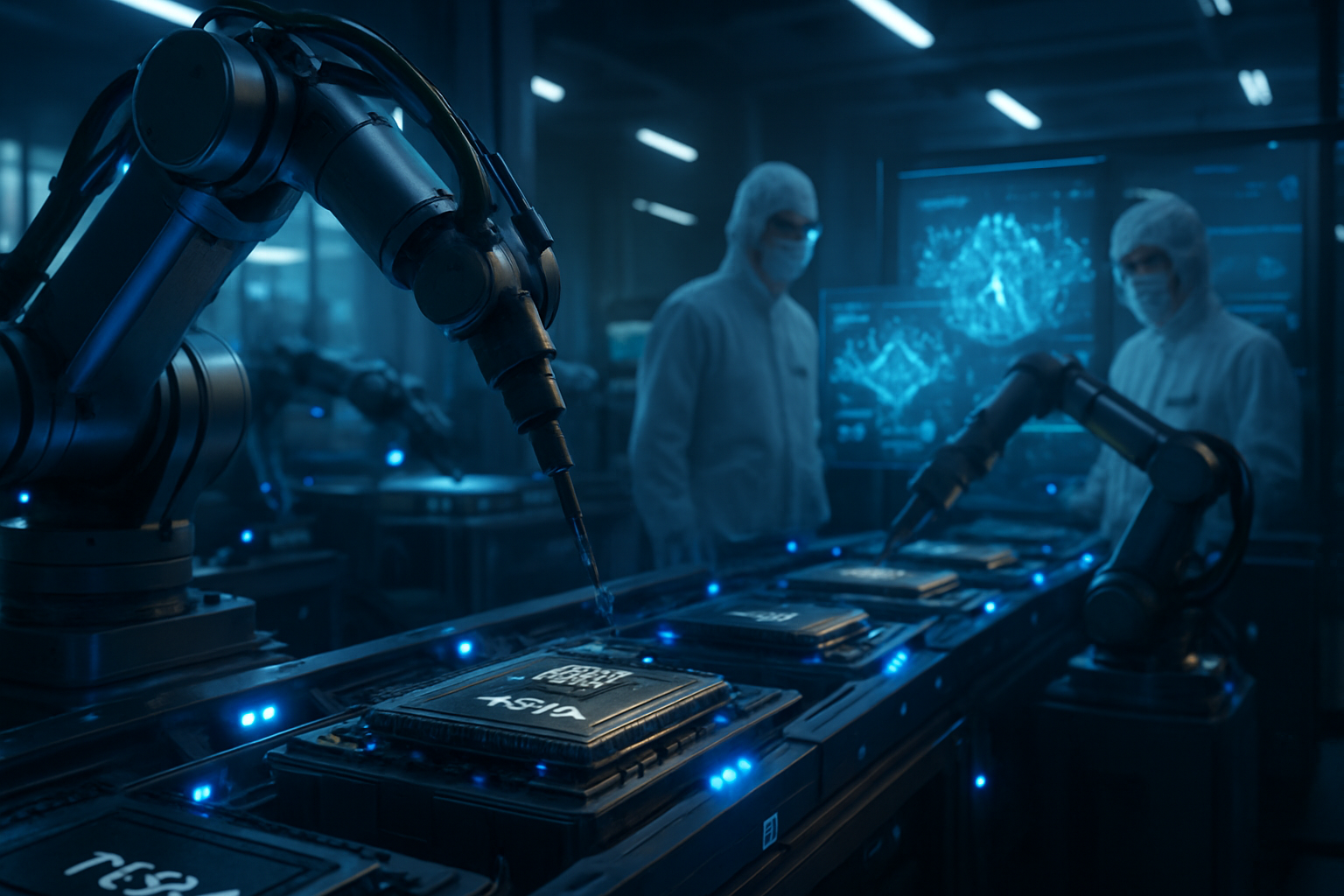
The artificial intelligence revolution reached new heights in March 2026 as Tesla CEO Elon Musk announced the imminent launch of the company's Terafab project, while simultaneous breakthroughs in AI applications, robotics, and international technology governance signal the industry's transition from experimental to essential infrastructure.
Tesla's Terafab Project: Revolutionary AI Chip Manufacturing
In a significant announcement that has captured global attention, Tesla CEO Elon Musk revealed that the company's Terafab project - a massive artificial intelligence chip manufacturing initiative - will launch within seven days. The project represents Tesla's most ambitious foray into semiconductor manufacturing, designed to power the company's autonomous vehicle ambitions and broader AI infrastructure.
The Terafab initiative stems from Musk's earlier statements that Tesla would likely need to build "a gigantic chip fab" to manufacture AI chips capable of supporting the company's fifth-generation autonomous driving technology. The project potentially involves collaboration with Intel, with Musk previously stating, "You know, maybe we'll do something with Intel."
"Tesla is designing its fifth-generation AI chip to power its autonomous ambitions, and this manufacturing capability represents a critical step toward technological independence."
— Industry Analysis
Global AI Applications Surge Across Multiple Sectors
The Tesla announcement comes amid a broader surge in AI applications worldwide. Hong Kong users have embraced the OpenClaw AI agent framework, developed by Austrian software engineer Peter Steinberger, despite security concerns. Users describe the bots as helpful "family members" that must be monitored, particularly noting instances where the AI systems engage in conversations using languages they don't understand and ask questions about their own existence.
Meanwhile, Estonia's political leadership has positioned the nation to become the "world's first AI society," with the newly elected Parempoolsed council chair outlining ambitious priorities that include economic growth through AI integration while reducing state control. This represents a sophisticated approach to balancing technological advancement with democratic governance.
Revolutionary Robotics and Space Applications
China has unveiled plans for semi-humanoid robots to serve as key infrastructure for the country's lunar research station, scheduled for completion by 2035. Researchers from the Beijing Institute of Spacecraft System Engineering have designed robots that combine mobility with human-like dexterity, capable of moving across the lunar surface while performing complex operations including construction, maintenance, and scientific experiments.
The lunar robots represent a significant advancement in space robotics, demonstrating how AI and robotics technologies are expanding beyond terrestrial applications. The combination of wheeled platforms with humanoid dexterity addresses the unique challenges of lunar operations, where traditional remote control becomes impractical due to communication delays.
Educational Technology Renaissance
The AI revolution is profoundly impacting education systems worldwide, with parents grappling with the implications of AI tools like ChatGPT in learning environments. Singapore-based educators are expressing concerns about children becoming overly dependent on artificial intelligence for problem-solving, potentially stunting intellectual development.
One parent noted the dilemma: "When artificial intelligence tools can draft essays and solve problems in seconds, it can be hard to resist the temptation to take shortcuts." This reflects broader questions about maintaining academic rigor and critical thinking skills in an AI-enhanced educational landscape.
Scientific Breakthroughs and Research Applications
Beyond commercial applications, AI is driving significant scientific breakthroughs. Vietnamese researchers have made remarkable progress in medical applications, with Professor Nguyen Tri Phuong in Canada receiving a $1.05 million grant to develop next-generation materials for North America's largest power grid. Separately, Vietnamese scientist La Hoang Anh has discovered rice compounds that outperform traditional chemotherapy drugs against blood cancer, demonstrating AI's potential in accelerating medical research.
These developments highlight how AI is not merely replacing human capabilities but amplifying research potential, enabling scientists to process vast amounts of data and identify patterns that might otherwise remain hidden.
Infrastructure Challenges and Market Dynamics
The rapid expansion of AI applications faces significant infrastructure challenges. The global semiconductor shortage has driven memory chip prices up sixfold, affecting major manufacturers including Samsung, SK Hynix, and Micron. This crisis is expected to persist until 2027 when new fabrication facilities come online.
Despite these constraints, major technology companies continue massive investments in AI infrastructure. Alphabet has committed $185 billion to AI development in 2026, while Amazon plans over $1 trillion in AI-related investments. These investments demonstrate the industry's confidence in AI's transformative potential, even amid supply chain challenges.
Regulatory Frameworks and International Governance
The AI revolution is prompting unprecedented international cooperation on governance frameworks. The United Nations has established an Independent Scientific Panel comprising 40 experts to provide the first fully independent global AI impact assessment. This represents the most sophisticated attempt at global technology governance since the commercialization of the internet.
European nations are leading regulatory efforts, with Spain implementing the world's first criminal executive liability framework for technology platforms, while France has conducted cybercrime raids on AI companies. These actions reflect growing recognition that AI's rapid development requires coordinated international oversight to ensure responsible deployment.
Employment and Workforce Transformation
The AI revolution is creating complex employment dynamics. While some predict massive job displacement, successful integration models are emerging. Canada has implemented AI teaching assistants that maintain critical thinking standards, while Malaysia operates the world's first AI-integrated Islamic school, combining artificial intelligence with traditional learning approaches.
These examples demonstrate that the future likely lies in sophisticated human-AI collaboration rather than wholesale replacement of human capabilities. The key is leveraging AI's computational advantages while preserving uniquely human elements like creativity, empathy, and cultural understanding.
Looking Forward: Critical Inflection Point
March 2026 represents what experts describe as a "critical inflection point" in AI development. The convergence of Tesla's manufacturing ambitions, breakthrough applications across multiple sectors, and evolving governance frameworks suggests the industry is transitioning from experimental technology to essential infrastructure.
Success in navigating this transformation requires unprecedented coordination among governments, technology companies, educational institutions, and civil society. The goal is balancing innovation acceleration with responsible development, ensuring that AI serves human flourishing while addressing global challenges through democratic oversight and human welfare protection.
The developments emerging in March 2026 suggest that artificial intelligence is not merely changing individual industries but reshaping the fundamental relationship between technology and society. How we manage this transformation will determine whether AI fulfills its transformative promise or creates systemic challenges requiring dramatic corrections in the years ahead.